Work on legislation governing the emissions trading market is becoming increasingly opaque. The relevant draft bill, which had been drawn up by the Ministry of Economy and Environment, has vanished without trace from the ministry’s website. Currently, only three versions are available on the Verkhovna Rada’s website, having been posted in circumvention of the public consultation procedure.
EcoPolitic noticed the removal of the draft bill on Friday, 31 July. The link where the document used to be is now broken. There are no specific announcements regarding the document on the Ministry of Economy’s website.
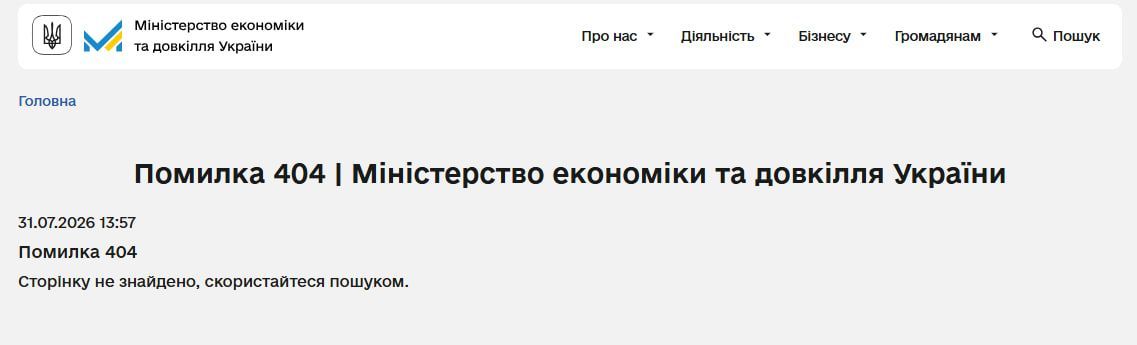
Screenshot from the website of the Ministry of Economy and Environment
This draft law “On the Principles of Operation of the National Greenhouse Gas Emissions Trading System” (NGGETS) was published on 15 May. For a month, the Ministry of Economy collected proposals and comments, which it promised to consider for the final version. It now appears we may never learn which specific comments the authorities actually decided to take into account.
Unforeseen alternatives
In July, three other versions of draft laws concerning the Ukrainian NGGETS were registered on the website of the Verkhovna Rada. All of them came as a surprise to experts and businesses because lawmakers chose not to present the documents to stakeholders nor discuss them publicly. This means that those who will be directly affected by the new law have no influence on it.
Draft Law No. 15386 “On the National Greenhouse Gas Emissions Trading System” was registered on 7 July. The initiators are a group of nine Members of Parliament. The first is Andrii Motovylets, followed by Oleh Bondarenko, who heads the Verkhovna Rada Committee on Environmental Policy and Nature Management. Information on the expert community’s reaction and key provisions can be found at this link.
Draft Law No. 15386-1 “On the Principles of Operation of the National Greenhouse Gas Emissions Trading System” was registered on 21 July. It was initiated by four parliamentarians led by Olena Kryvoruchkina, Deputy Head of the Verkhovna Rada's Environmental Committee. EcoPolityka has written in more detail about its provisions, as well as the experts’ and authors’ views in a separate article.
Draft Law No. 15386-2 “On the National Greenhouse Gas Emissions Trading System” was registered on 23 July. It has a sole initiator: Oleh Bondarenko, head of the Verkhovna Rada Committee on Environmental Policy and Nature Management.
All documents are currently at the “Submitted for review” stage.
Advancement without coordination
Еcocommittee has not officially reviewed any of the documents; however, the provisions of one version have already been presented to parliamentarians from other committees. For example, at the meeting of the Committee on State Authority Organization on July 29, the State Agency on Energy Efficiency and Energy Saving presented the draft national emissions trading system.
The option being promoted provides for all proceeds from the sale of quotas and the purchase of permits to be transferred to the already existing Decarbonization Fund, which is overseen by the State Agency on Energy Efficiency. As we can see, regarding the principle of using ETS revenues and the tightening of cancellation obligations, this aligns with the version of Law No. 15386-2 authored by Oleh Bondarenko. Although the presentation does not specify which draft law was used as the basis, this information can be found in the relevant provisions of that very document.
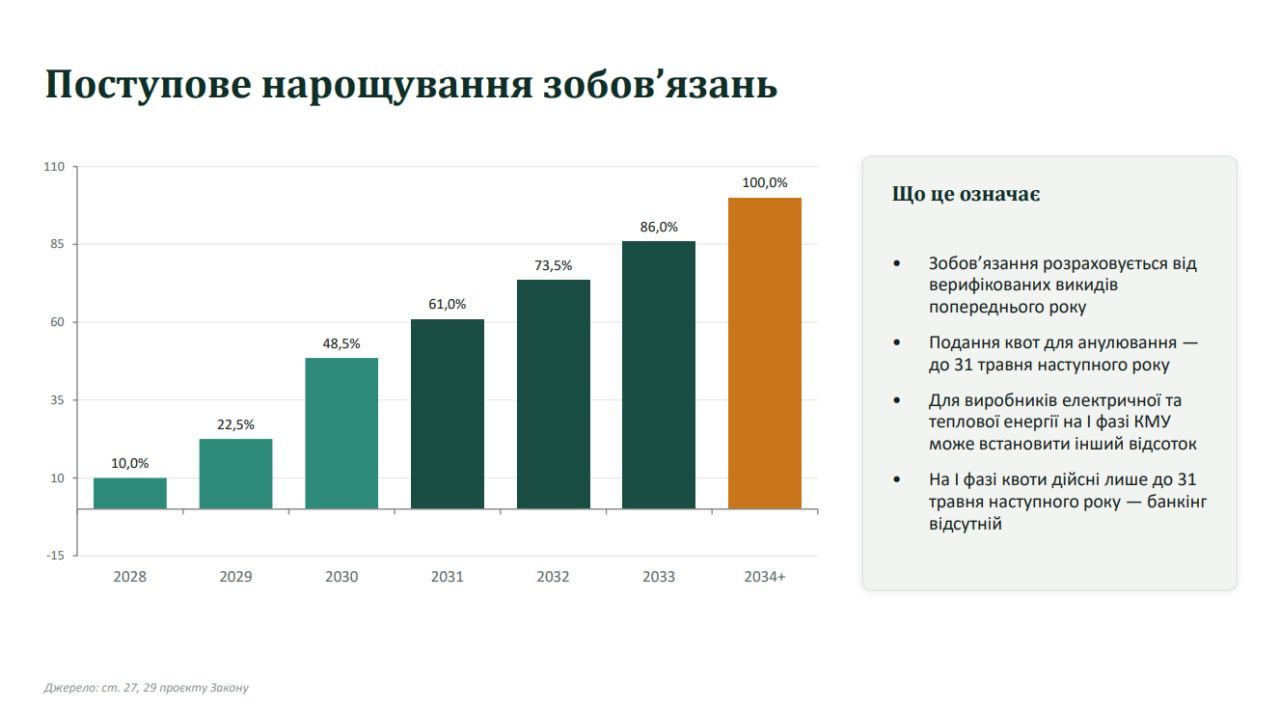
Screenshot from the State Agency on Energy Efficiency presentation
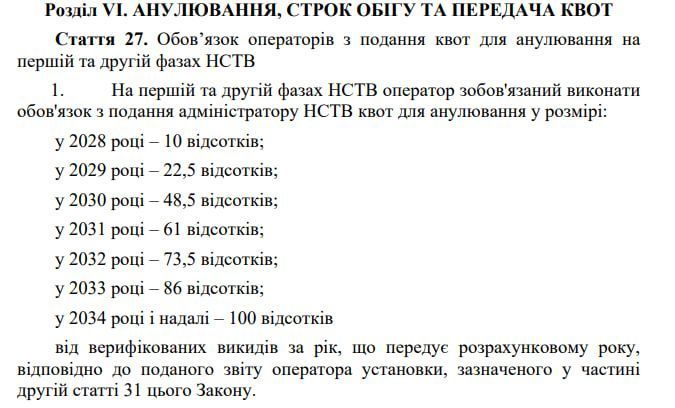
Excerpt from draft law No. 15386-2
The national emissions trading system is a mechanism under which polluters will pay for greenhouse gas emission permits. Some allowances will be allocated for free, while any excess will have to be traded on the quota market. This is an important decarbonization tool, but without a balanced approach it could become a significant financial blow to Ukrainian industry. For a detailed analysis of the ETS, see this article.