Three days after the draft bill No. 15386 “On the National Greenhouse Gas Emissions Trading Scheme” was listed on the website of the Verkhovna Rada of Ukraine, its text and accompanying documents were finally published. On the same day, 10 July, the draft law was referred for consideration to the relevant committee, which has been designated as the Verkhovna Rada Committee on Environmental Policy and Nature Management.
This was reported by EcoPolitic, citing an update on the Verkhovna Rada’s website.
The creation of a national emissions trading system is one of Ukraine’s fundamental commitments in the process of European integration. This market-based mechanism will effectively establish a new principle of carbon taxation, involving the sale of permits, free allowances and the use of carbon revenues. All these principles are to be regulated by the new draft law.
However, the problem is that draft law No. 15386 was introduced in circumvention of the procedure — without prior publication or consultation with stakeholders.
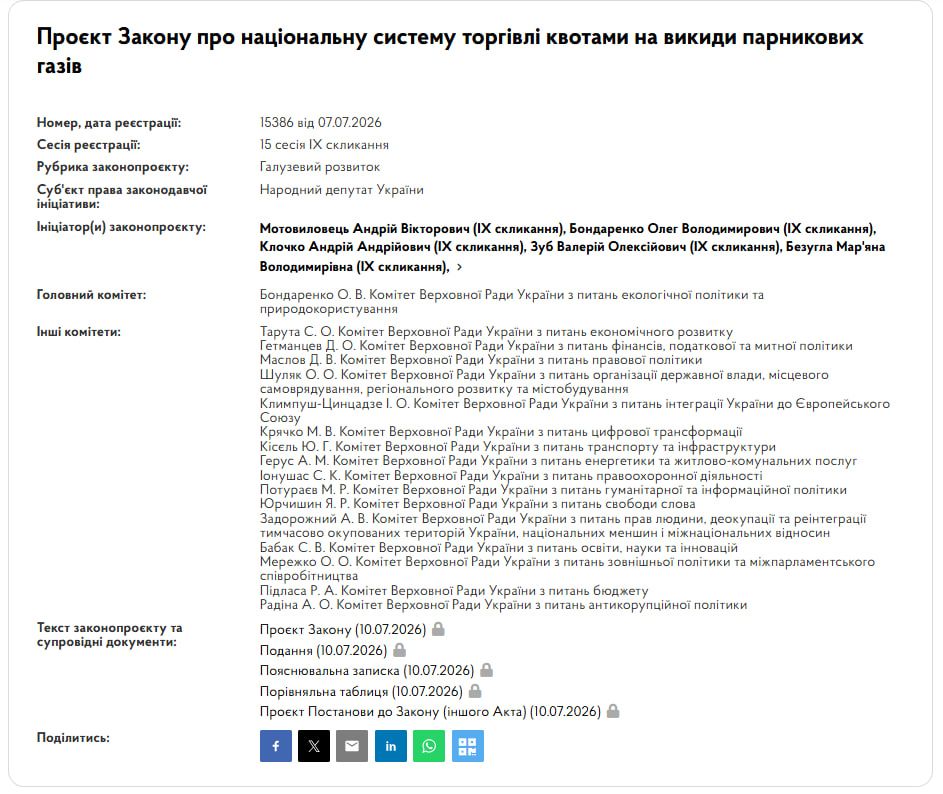
The explanatory note to the draft law, along with justifying the introduction of the NGGETS and referring to both European and current Ukrainian legislative frameworks, states that the document defines:
- two phases for the gradual implementation of the NGGETS;
- the types of activities that will fall under the system’s scope;
- the participants in the ETS-installation operators, aircraft operators, and shipping companies;
- the procedure for the issuance, circulation, and cancellation of allowances, setting price caps, and other operations necessary for the functioning of the market;
- the creation of the NGGETS registry;
- the procedure for providing support to carbon-intensive enterprises through the existing Decarbonization and Energy Efficiency Transformation Fund;
- liability for violations of NGGETS legislation.
Soon, EcoPolitica will present a thorough analysis of the text of draft law No. 15386, engaging experts and representatives of the business community.
Unfortunate secrecy
Recently, we reported that the news about this draft law came as an unpleasant surprise for the expert community and industry representatives. EcoPolitica received its text and briefly analyzed the provisions in this article.
For a long period, the Ministry of Economy worked on its own version of the document, which became the subject of professional discussions. It was published on May 15. During the following month, the ministry received a number of proposals and comments, including from the European Commission and the European Business Association (EBA).
However, the new document essentially became a “pig in a poke”, which experts were unaware of.