Whilst the Ministry of Economy, Environment and Agriculture and stakeholders have been actively working for several months on the final version of the draft bill on the operation of the National Greenhouse Gas Emissions Trading Scheme (NGGETS), an alternative draft bill No. 15386 has unexpectedly appeared, practically out of nowhere, tabled by an initiative group of nine MPs led by Andriy Motovilovets.
But the most interesting thing is that sectoral experts, who were supposed to have been involved in its discussion, are simultaneously being told that this draft bill has allegedly already been agreed upon by all parties. However, as the experts themselves claim, no one has yet seen the text of this document or the accompanying materials. As of the morning of 8 July, none of this is available on the parliament’s website in the entry for Bill No. 15386.
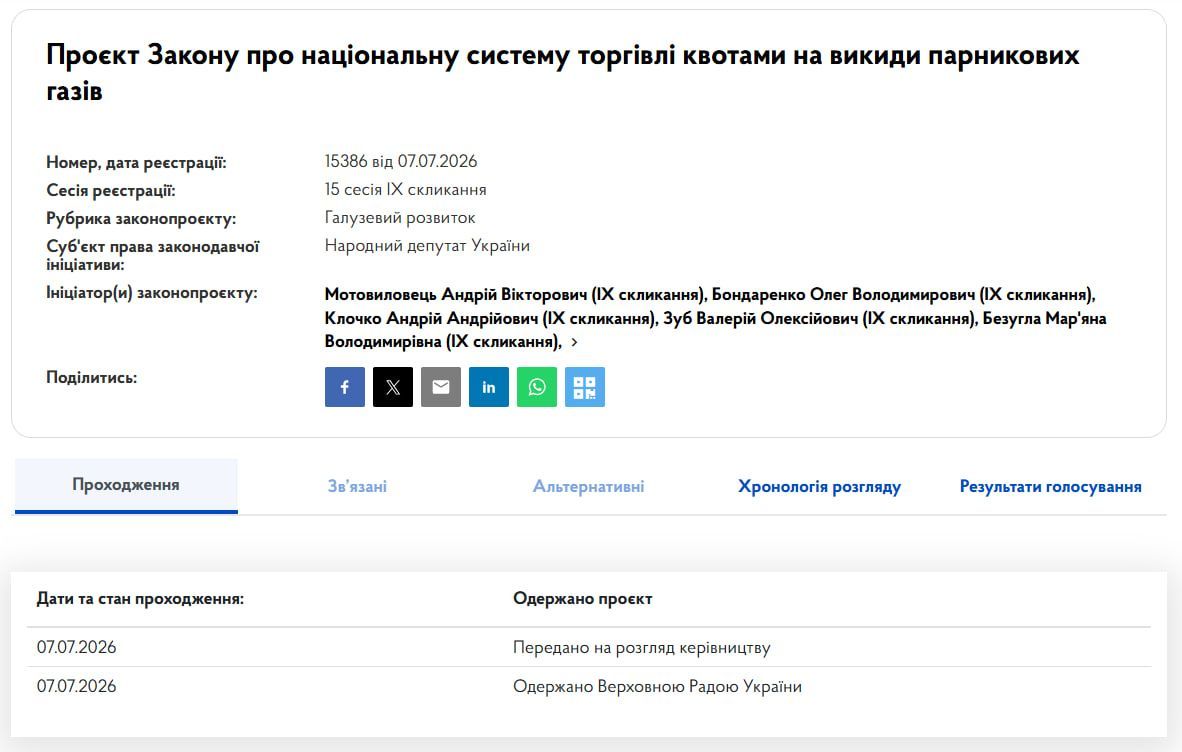
Screenshot from the website of the Verkhovna Rada of Ukraine as of 16:00 on July 8, 2026.
This level of secrecy seems at least strange, especially considering that the draft law prepared by the Ministry of Economy, both before and after its publication, became the subject of widespread discussion among professionals. Businesses, industry associations, and experts submitted their proposals to it. Later, the document was analyzed by the European Commission, which sent its comments and recommendations to the Ministry of Economy.
EcoPolitic tried to find those lucky ones from the business and expert community who had an opportunity to review the new draft law on the Ukrainian ETS.
However, the specialists declined to comment. Why? Here is what we found out.
Experts not aware
The first to respond to EcoPolitica’s inquiry was the president of the Association of Environmental Professionals (PAEW), Lyudmyla Tsyhanok.
“None of our colleagues has seen the new draft law. I can only comment on the previous document,” she said.
A similar response was voiced by the European Business Association (EBA).
“Unfortunately, we are unable to comment on Bill No. 15386 at this stage, as the text of the bill and the accompanying documents have not yet been published. Experts from the European Business Association took part only in the public consultation on the draft bill published by the Ministry of Economy on 15 May. As the text of the registered bill is not publicly available, we are unable to assess its content or compare it with the Ministry of Economy’s version,” said Victoria Karpets, manager of the Committee on Industrial Ecology and Sustainable Development of EBA.
EcoPolitic also sought comment from one of the bill’s initiators, Oleg Bondarenko, Chair of the Verkhovna Rada Committee on Environmental Policy and Natural Resource Management.
He explained that the text of the document has not yet been published, as the bill is still undergoing the registration process in the Verkhovna Rada. According to the MP, the text and accompanying documents are due to appear on the parliament’s website “in the next few days”.
Funds to the Decarbonisation Fund
The text of this mysterious Bill No. 15386 has reached our editorial office. Our journalists have already had a brief look at it. Let us emphasise straight away: as the text of the document has not yet been officially published, it is too early to draw any firm conclusions. At the same time, even an initial comparison with the Ministry of Economy’s draft suggests that this is not a matter of cosmetic amendments, but rather a different concept for structuring Ukraine’s emissions trading system.
One of the most fundamental differences in the MPs’ bill is the proposed model for using the proceeds from the sale of greenhouse gas emission allowances.
Whilst the Ministry of Economy’s draft provided for the creation of a separate Fund for the Modernisation of Ukraine, with a dedicated management system and project selection procedures, the MPs are proposing a different approach. They wish to channel the funds into the existing Fund for the Decarbonisation of Ukraine (FDU), which operates under the management of the State Agency for Energy Efficiency and Energy Saving.
Furthermore, the drafters of the bill propose that the State Agency for Energy Efficiency and Energy Saving be designated as the competent authority responsible for the operation of the National Emissions Trading Scheme (NETS). In effect, this means concentrating within a single state body both the powers to administer the emissions trading scheme and the oversight of the use of the funds it will generate.
At the same time, the activities of the Decarbonization Fund have repeatedly become a subject of discussion. In particular, EcoPolitica has previously pointed out that the Fund finances a wide range of projects – from equipping government institutions with solar power plants to programs for homeowners’ associations and the utilities sector. According to a number of experts, this approach dilutes its original goal – supporting decarbonization specifically in industry, which is the main payor of the tax that is allocated to the Decarbonization Fund.
Additional questions about the Fund’s operations also arose this spring, when it selected a supplier of equipment for UAH 192 million without any competition, simply using a negotiated procedure.
Major enterprises may never receive funding
Article 25 of draft law No.15386 limits the maximum share of financial support for decarbonization projects from non-repayable receipts of the National Greenhouse Gas Emission Trading System (NGGETS) to no more than 10% of the project cost.
It should be understood that capital-intensive decarbonization technologies (for example, hydrogen metallurgy, carbon capture and storage (CCS), and deep modernization of cement kilns) require substantial grant injections. For instance, in the EU, the Innovation Fund finances up to 60-100% of additional costs. The 10% restriction risks making state support unattractive to businesses, which will significantly slow the modernization of industries crucial to Ukraine’s exports, while the funds will accumulate in the Fund or be used inefficiently.
Institutional conflict
The role of technical administrator of the Unified State Greenhouse Gas Emissions Management System (USGGEMS) is being transferred to the Decarbonization Fund of Ukraine, which is at the same time a state joint stock company. Moreover, the State Agency on Energy Efficiency and Energy Saving (SAEE) is the holder of the system, while the National Securities and Stock Market Commission (NSSMC) oversees the auctions.
This creates a significant risk: assigning the functions of administering a sensitive state registry and databases to a commercial joint stock company (even if 100% state-owned) generates corruption risks, conflicts of interest, and contradicts European practices, where the registry administrator is an independent state body or specialized non-profit institution.
What about future integration into the EU ETS?
The NGGETS is not being created in isolation. Its main strategic objective is the gradual integration of Ukraine into the European Union Emissions Trading System (EU ETS), which is a key element of European integration. That is why experts from the European Commission reviewed the Ministry of Economy’s draft law. After this, they provided their recommendations to Ukrainian officials. Whether the parliamentary draft law underwent this type of analysis is currently unknown; however, in our view, the likelihood is quite low.
While comparing the parliamentary bill No. 15386 with the Ministry of Economy's version, EcoPolitica noted that the document provides a significantly less detailed description of the actual mechanisms for such integration. Whereas the government version included specific provisions regarding the third phase of the ETS, the functioning of the system after integration into the EU ETS, and other harmonization mechanisms with the European model, these norms are substantially reduced in the parliamentary draft. The draft devotes noticeably less attention to describing these mechanisms than the project developed by the Ministry of Economy.
The law is written. But who will implement it and how?
Unlike the ministerial bill, the MPs’ version offers virtually no insight into the elected representatives’ vision for ensuring the smooth operation of this complex system. After all, simply passing a law is not enough to launch the National Emissions Trading Scheme. It is necessary to establish a complex state infrastructure, which includes an emissions allowance registry, a system for monitoring, reporting and verifying emissions, the conduct of auctions, market administration, enforcement of compliance, as well as dozens of new procedures and the training of a large number of specialists.
This is precisely why the Ministry of Economy’s government bill contained a whole section of provisions devoted to the institutional framework of the system. In particular, it provided for the creation of a separate ETS administrator — a legal entity under public law — which was to ensure the operation of the registry, the administration of the system and the performance of other specialised functions.
This concept was abandoned in the parliamentary version of the bill. A separate administrator is no longer envisaged, and it is proposed that its functions be transferred to the competent authority — the State Agency for Energy Efficiency and Energy Saving of Ukraine.
Moreover, the draft law itself devotes considerably less attention to how exactly this institutional model will work in practice, what resources will be required for this, and how it will ensure the future integration of the Ukrainian ETS into the European ETS system.
By way of comparison, in most European Union countries, the operation of emissions trading schemes is managed by specialised institutions or separate organisational units that are solely responsible for administering the ETS, maintaining registries, conducting auctions and liaising with market participants. The Ukrainian government’s draft bill was also geared specifically towards this approach.
When the aim is to outpace the ministry and gain political leadership
EcoPolitc’s overall initial subjective impression at this stage is as follows: MPs drafted their bill in a hurry in order to seize political leadership on the issue of the ‘green transition’ and secure their status as the architects of the reform. It is not sufficiently developed or well thought out to serve as an effective tool for promoting European integration. The document also fails to take into account many of the points raised by industry representatives during meetings with officials from the Ministry of Economy.
However, is it appropriate to rush through such a large-scale reform, one which will have a very significant impact on Ukraine’s economy and is one of the key conditions for integration into the EU’s internal market?
In the Verkhovna Rada, the tabling of an alternative or separate MP-sponsored bill is often a tactical move designed to force the ministry to the negotiating table. With their own bill in hand, backed by part of the relevant committee, MPs will be able to gain leverage. Whilst the two documents are being reconciled into a compromise version (or during committee consideration), they will demand that mitigating amendments be made to the text prepared by the ministry in exchange for withdrawing their own bill.
Once Bill No. 15386 appears on the Verkhovna Rada’s website, EcoPolitika will certainly analyse it together with representatives of the business community and the expert community. Look out for our analysis shortly after the document is published.