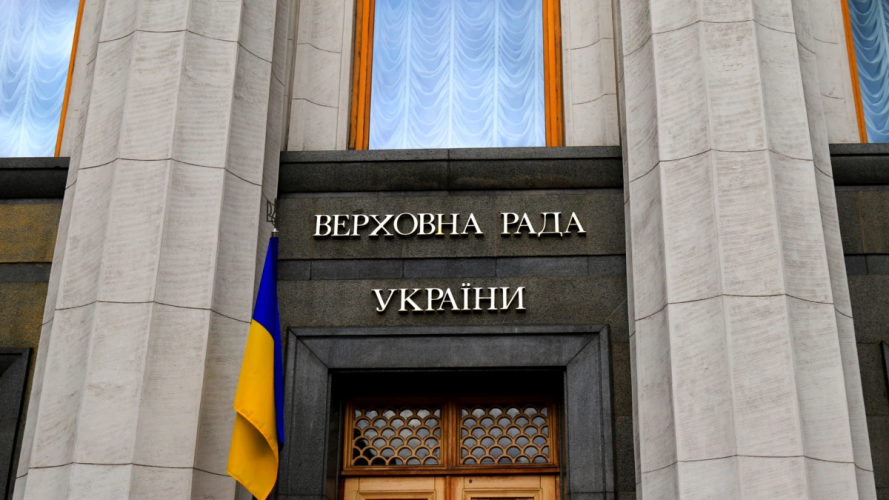
The MPs’ behind-the-scenes legislative work was not limited to the two draft laws on the establishment of the National Emissions Trading System (NETS). On Thursday, 23 July, another document appeared on the Verkhovna Rada’s website — registered under number 15386-2. Nothing is known about this ‘surprise’ from the MPs — neither the text nor any accompanying documents have been made available as yet. And, in keeping with the tradition of Ukrainian law-making, stakeholders have heard nothing about it.
EcoPolitic reports that the document is currently being forwarded to the leadership for consideration.
Bill No. 15386-2, entitled “On the National Greenhouse Gas Emissions Trading System”, was initiated solely by Oleg Bondarenko — Chair of the Committee on Environmental Policy and Nature Management.
It is this committee that has been designated as the lead committee for the two previous bills, which were also initiated by MPs. It is noteworthy that Oleg Bondarenko is a co-author of the first of the three ‘shadow’ documents concerning the NETS — No. 15386.
We have absolutely no idea how this bill differs from the previous ones, as, as of 11:30, no documents have yet been attached to the bill’s file.
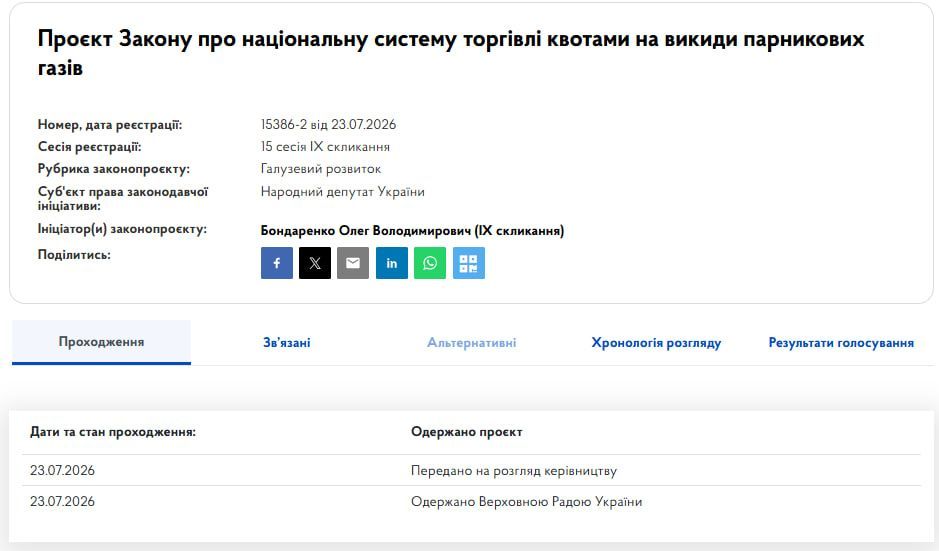
Screenshot from the website of the Verkhovna Rada of Ukraine as of 11:30
It appears that all those who are to be directly affected by NETS have simply been put “before the fact.” According to EcoPolitics’ sources, there was no prior presentation or discussion on this draft law either. Therefore, the provisions it proposes will become yet another surprise for everyone – business, experts, and civil society.
We are witnessing a tug-of-war
In less than two weeks, the Verkhovna Rada has stunned stakeholders three times by registering alternative documents regarding the quota market.
The first was document No. 15386 “On the National Greenhouse Gas Emissions Trading System” from an initiative group led by MP Andrii Motovilovets. Like Bondarenko’s proposal, it was initially published without the text of the draft law or any supporting documents. These were released only three days later. At that time, EcoPolitics analyzed the proposed provisions in this material.
Two weeks later, on July 21, another document appeared on the Verkhovna Rada website, No. 15386-1 “On the Principles of Functioning of the National Greenhouse Gas Emissions Trading System.” Here, the group of initiators is led by Olena Kryvoruchkina – Deputy Chairperson of the Committee on Environmental Policy and Nature Management under Oleh Bondarenko. At least in this case, all documents were immediately available. Therefore, EcoPolitics prepared an analysis of the document, at the same time interviewing its initiator. In brief, the fundamental difference lies in supporting business eco-modernization through funds from the ETR (emissions trading regime).
Іn just two days, on July 23, we will see yet another alternative – No. 15386-2. It is not possible to compare it with the previous versions until the texts are published, but as soon as it appears, we will prepare a separate material.
Before this parliamentary “game of hide and seek” began, the authorities were still trying to develop a fundamental draft transparently, albeit not without remarks. This concerns the version from the Ministry of Economy and Environment, which was published on May 15.
The National Emissions Trading System is an important climate policy instrument that Ukraine must implement under the terms of European integration. Simply put, this is another fiscal mechanism according to which businesses will pay for excess CO2 emissions. It will contribute to the reduction of greenhouse gas emissions, and, if properly organized, should support the decarbonization of industry. However, the devil is in the details, and these very details have become the subject of heated debate. As we can see, the parliament has chosen to avoid it.