The new global energy crisis has forced the European Union to intensify its search for alternative energy sources-clean, safe, and independent of the political landscape. Projects for the production of green hydrogen, which were previously suspended due to economic factors, have once again appeared on the agenda.
Ukraine’s resources and infrastructure make it possible for the country to secure a leading position in the EU’s hydrogen economy. However, there is often a significant gap between potential and reality. Today, EcoPolitic will analyze how far Ukraine has advanced in developing its own hydrogen energy cluster and what short-term prospects our country has in this area.
Europe has already bet on hydrogen
Back in 2020, in its “Hydrogen Strategy for a Climate-Neutral Europe,” the EU identified hydrogen as one of the foundations of a climate-neutral economy. The Green Hydrogen for a European Green Deal: A 2x40 GW Initiative, introduced in the same year, envisages the installation of 80 GW of electrolyzers for the production of green hydrogen: 40 GW in the EU and 40 GW in neighboring countries (including a focus on Ukraine and North Africa) by 2030.
In 2022, this environmentally friendly gas accounted for less than 2% of Europe's energy consumption. It was used mainly in the production of chemical products, particularly plastics and fertilizers.
After the start of russia’s full-scale invasion of Ukraine, in response to global upheaval in the energy market, the European Commission adopted the REPowerEU strategic plan. It set a target to produce 10 million t and import an equal amount of renewable hydrogen by 2030. European officials plan to meet about 10% of the bloc's energy needs with this gas by 2050.
The driver of green hydrogen in Europe has become Germany, which, after shutting down its nuclear power plants and ending its reliance on russian gas, is looking for other sources of “clean” energy, including hydrogen.
Here’s what has been accomplished in the EU over the last 4 years:
-
In autumn 2023, the Hydrogen Bank was created with initial funding of €800 million to partially subsidize green hydrogen production.
-
Four Projects of Common Interest were gradually launched to finance innovative developments: “IPCEI Hy2Tech”, “IPCEI Hy2Use”, “IPCEI Hy2Infra”, and “IPCEI Hy2Move”. The total amount of public funding allocated for these projects is approximately €19 billion.
-
A joint public–private Clean Hydrogen Partnership was initiated, scheduled for 2021–2027 and supported by the European Commission under the Horizon Europe program.
The EU has concluded that its own resources are insufficient to produce enough green hydrogen in Europe. Therefore, the bloc needs suppliers, and Ukraine is seen as one of its key partners.
Ukraine is at the center of the EU’s hydrogen plans
Within the framework of the Green Hydrogen Initiative 2×40 GW, the European Commission identified our country as a strategic partner in scaling up renewable hydrogen production and planned the construction of up to 10 GW of electrolyser capacity in Ukraine by 2030 for its generation. There are solid grounds for this, as our country has:
-
significant potential in solar, wind, and biomass energy, the capacities of which are essential for producing truly “green” hydrogen;
-
a developed gas transmission system for the supply of this fuel;
-
an advantageous geographical location – proximity to the EU – resulting in lower transportation costs.
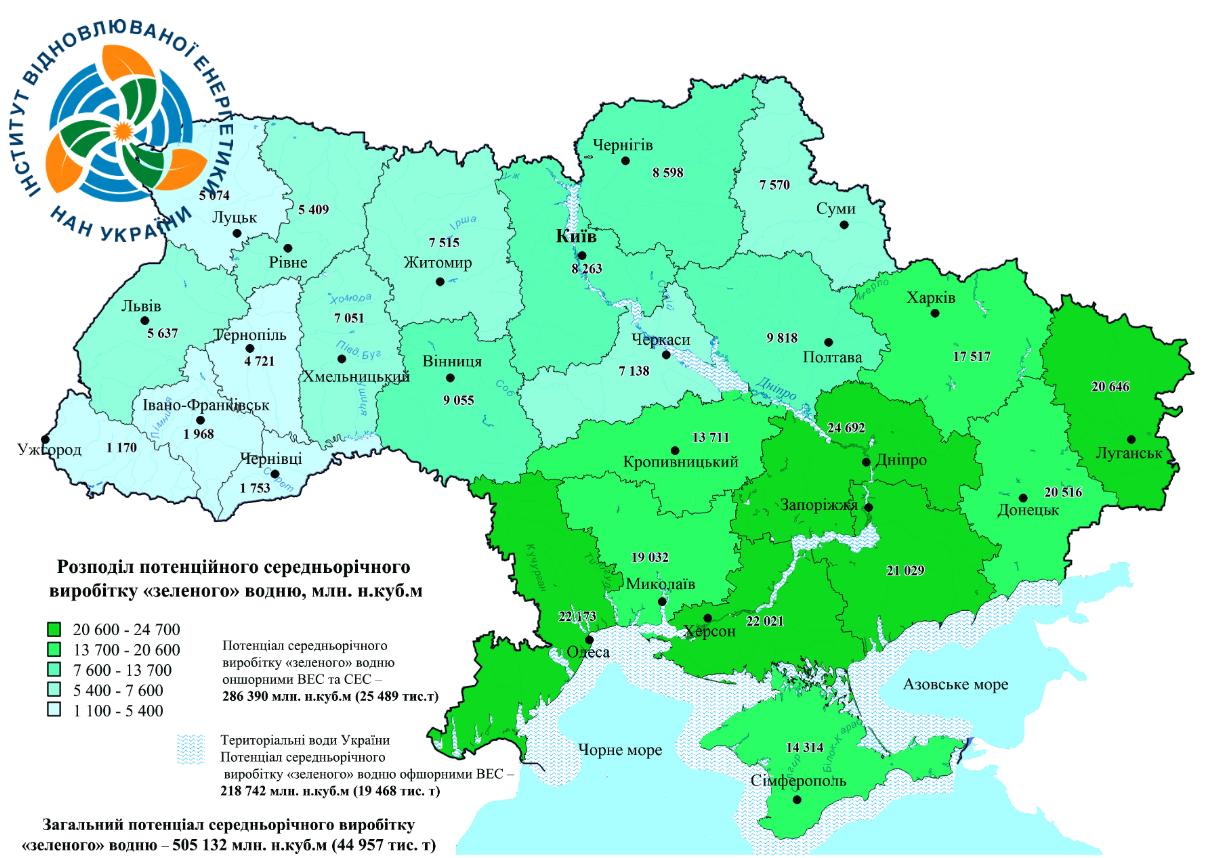
Source: Institute for Renewable Energy, National Academy of Sciences of Ukraine
Ukraine and the EU have signed the following documents regarding cooperation in the field of hydrogen energy:
-
February 2023 – Memorandum on strategic partnership in the areas of biomethane, hydrogen, and other synthetic gases;
-
January 2025 – Memorandum of Understanding on the creation and support of the full cross-border hydrogen value chain “Ukraine-EU Hydrogen Corridor.” According to this, hydrogen will be transported via the existing, but repurposed, pipeline network to Slovakia, the Czech Republic, Austria, and Germany after 2030.
According to European plans, by 2030 Ukraine could provide up to 9.8 GW of electrolyser capacity, producing more than 730,000 t for export and covering over 4% of the total hydrogen market in the EU. The estimated required investments are between €6–7.5 billion.
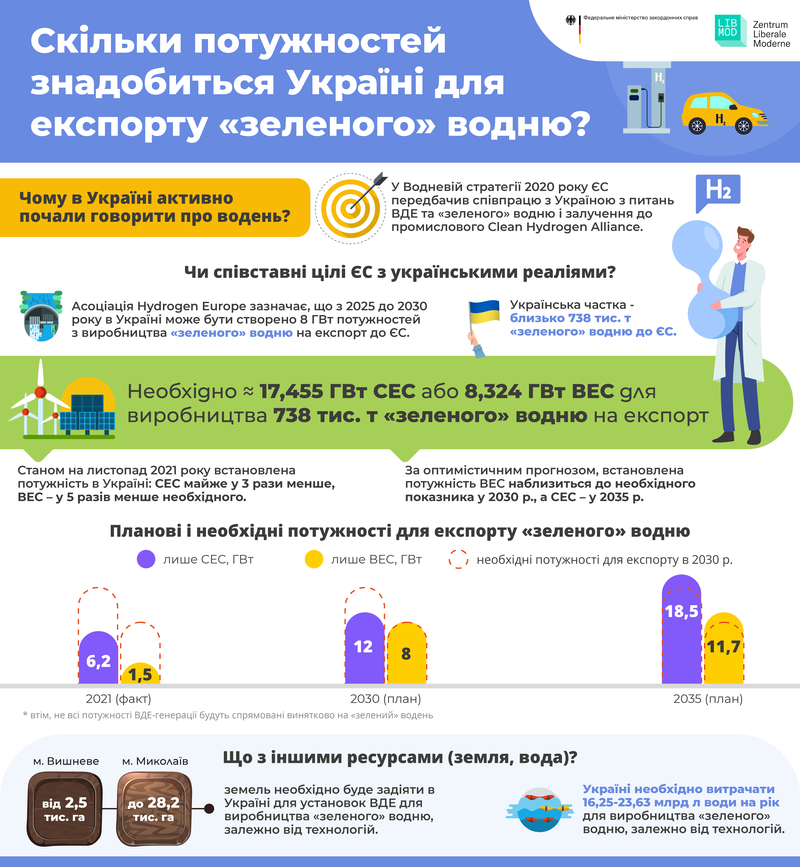
Infographic: Dixi Group.
According to the Green Hydrogen Investment and Support Report by the European association Hydrogen Europe, in order to secure the operation of 10 GW of electrolyser capacity, Ukraine will require €20.1 billion in investments:
-
€3.5 billion – for the construction of electrolysers;
-
€13.3 billion – for the construction of wind power plants;
-
€3.3 billion – for the construction of solar power plants.
Ukrainian legislative framework
When it comes to regulatory documents on the development of hydrogen energy in Ukraine, the situation is rather bleak:
-
Draft resolution “On the development of hydrogen energy with the aim of ensuring Ukraine’s economic and energy security” has been under review by the relevant parliamentary committee for more than three years;
-
The draft Hydrogen Strategy of Ukraine for the period up to 2050, published two years (!!!) ago-in May 2024-still has not been approved. It envisaged that by 2025 Ukraine would have already launched an export market for “green” hydrogen. Do you see it? Neither do we.
In the list of draft laws that the government planned to work on during this year, there are also no documents regarding the development of hydrogen energy.
From memorandums to real projects
Currently, the pace of development of the domestic hydrogen sector does not appear very promising: the hydrogen projects that were announced in 2021–2023 are either progressing slowly, or there is no public information available about their progress at all. The full-scale war has also significantly adjusted plans for the development of hydrogen energy.
-
DTEK was the first to announce its intention to launch pilot “green” hydrogen production projects by the end of 2021. In March of that year, this Ukrainian energy holding and the German company Siemens Energy agreed upon a similar project: a water electrolysis plant was to be constructed at the Metinvest steelworks in Mariupol. Currently, the facility is heavily damaged and located in occupied territory.
-
In May 2023, representatives of Japan signed a letter of intent on cooperation under the "Green Hydrogen" project with the Bucha City Council in Kyiv region. This is Ukraine’s first pilot project for a "green" community. As of early 2025, it was still at the planning and financing search stage. We found no new updates on the progress of this case.
-
At the end of 2023, PJSC Ukrhydroenergo signed a memorandum with the German company Andritz Hydro GmbH for a "green" hydrogen production project in Ukraine with a capacity of 5–10 MW. In August of the following year, this project was registered on the state DREAM platform. Its current status is listed as “In Progress,” but there have been no updates on the implementation status available online.
-
In May 2024, the company “Voden Ukrainy” and AB5 Consulting received a grant from the United Kingdom for the implementation of the H2U project for renewable hydrogen production in the city of Reni, Odesa region. In addition to building a 100 MW electrolysis unit for hydrogen generation, the project also includes the construction of a solar power plant with a capacity of 120 MW and a wind power plant of 80 MW, respectively, to ensure reliable power supply to the enterprise. In November 2025, it became known about the completion of the feasibility study (FS) for the future main hydrogen pipeline between Ukrainian Reni and Romanian Galați.
-
The project “Hydrogen Valley H2U – Zakarpattia” has become controversial. According to experts from the Institute of Renewable Energy of the National Academy of Sciences of Ukraine (NASU), this western region has the lowest potential in Ukraine for producing this type of ecological fuel as well as for wind power capacities. The environmental community has been fighting for years against the construction of a wind farm on the Zakarpattia mountain meadows, which is accompanied by numerous violations and the destruction of valuable Carpathian ecosystems. Environmentalists insist that the region’s proximity to the EU was the decisive factor for the project to be implemented here, since all hydrogen produced will be exported.
-
Among the national program projects in Ukraine's Recovery Plan (2022), the construction of approximately 15 GW of electrolyzer capacity is planned by 2032, along with the testing and development of hydrogen transport infrastructure and the construction of over 30 GW of renewable energy facilities for the production of “green” hydrogen. The document’s authors propose not only exporting hydrogen, but also developing "green" metallurgy based on this fuel and using it to produce ammonia and fertilizers. They assume that a “hydrogen cluster” can potentially be established in Zaporizhzhia and Dnipropetrovsk regions.
-
In Volyn region, the Ukrainian company UDP Renewables plans to implement a large-scale “green” hydrogen production project worth €2 billion. According to business owner Serhiy Yevtushenko, the parties are close to signing an agreement. The enterprise will produce about 50,000 t of hydrogen per year. The potential investor is likely to also be the buyer of the products, exporting the produced gas to Europe for its own needs.
What is preventing Ukraine from becoming a hydrogen hub
-
The absence of even a framework law that would establish general principles for industry development. Ukraine’s Hydrogen Strategy for the period up to 2050 has yet to be approved, and other legislative initiatives have also stalled for years.
-
The critical situation in Ukraine’s energy system caused by massive Russian attacks and significant damage to power generation facilities. The priority for energy produced by new wind and solar power plants is to meet the needs of existing industrial facilities. To supply new enterprises, new renewable energy capacities must be built.
-
Investors do not have clear conditions for operation – Ukraine is becoming a risk zone for them, not only due to the full-scale war, but also due to lack of transparency and predictability. Regulatory uncertainty slows down private investment and makes long-term planning more difficult.
-
There is a need for significant investment. According to various estimates, the required amount ranges from €6.5 billion to over €20 billion.
-
Our country should be prepared to compete with African nations for the opportunity to supply “green” hydrogen to the EU. According to experts, Ukraine’s direct competitor in the European market is Morocco, where the utilization rate of both solar and wind power plants is significantly higher. Therefore, this country, as well as others with more favorable natural conditions, has an advantage in production. However, they lose out in logistics, as transporting over long distances becomes economically unfeasible. Thus, Ukraine should focus on the central part of Europe.
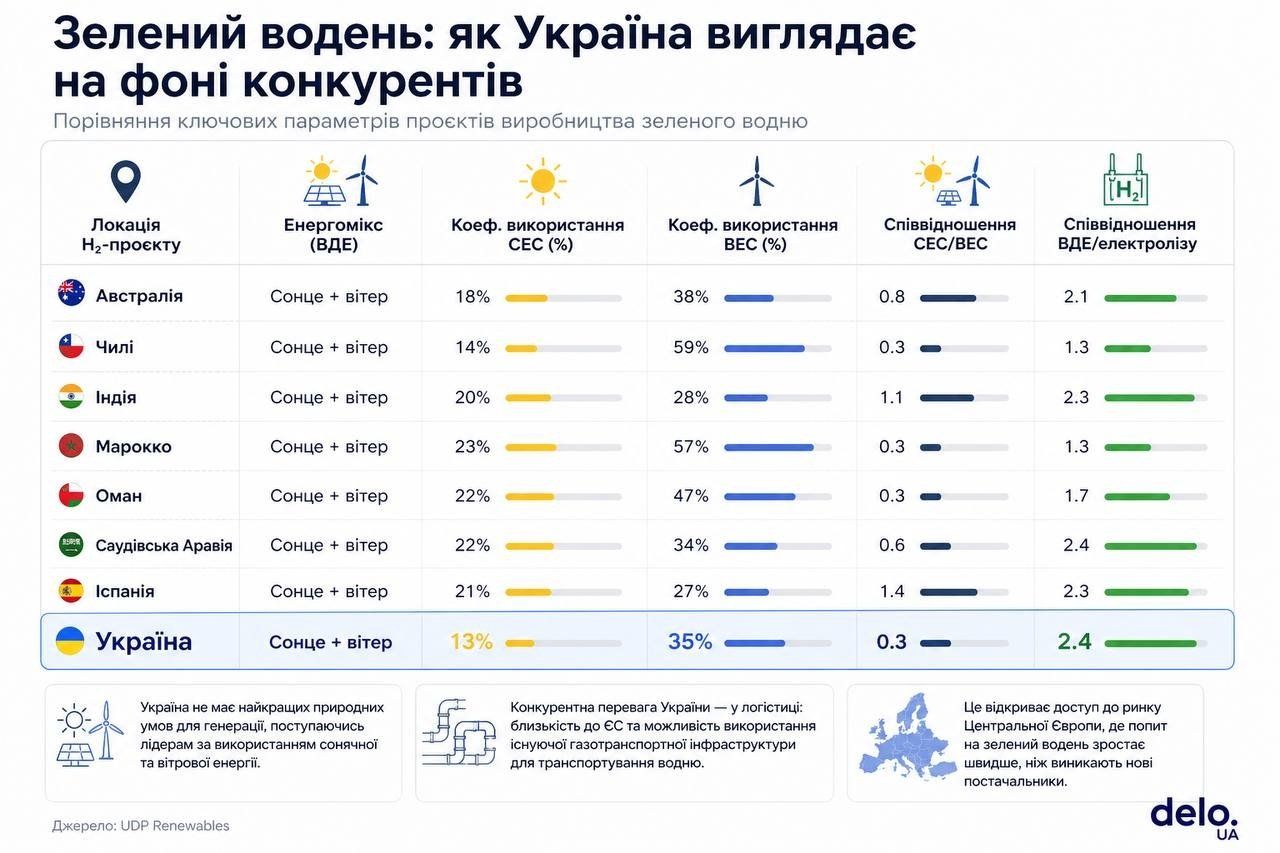
Source: delo.ua
-
In recent years, Ukraine has faced a certain water deficit, without which hydrogen production is impossible. Experts note that there are even difficulties in filling the reservoirs of the Dnipro Cascade to their design capacity.
There is potential, but it is still a long way from being realized
So, is Ukraine ready? The short answer is-not yet. We lack a comprehensive strategy, there is no market, and no large-scale projects have been launched.
To become a hydrogen hub, it is necessary to have:
-
the adoption of a national strategy;
-
attraction of financing;
-
clear rules for investors;
-
integration with the EU market;
-
experience in launching successful pilot projects.
With a sound approach, Ukraine can turn “green” hydrogen into a new driver for the economy.
“Hydrogen could become the driving force that raises the country to a new level of energy security, but only if the state, business, and civil society work in unison,” believes Oleksiy Hnatenko, member of the Supervisory Board of the Eastern European Association for the Development of the Hydrogen Economy.
Are all parties ready for such cooperation? Will it be possible to turn environmentally clean fuel into a significant item in Ukraine’s export revenue structure without harming our own environment? Will renewable hydrogen become an effective tool for decarbonizing the national chemical and metallurgical industries? I would very much like all these questions to be answered in the affirmative in the near future.