Hiking in Ukraine’s picturesque forests is a popular domestic tourism attraction. With the arrival of warmer weather, more and more Ukrainians are planning hikes or walks. However, martial law has changed the situation, so only in a handful of regions can people enjoy the forest without security restrictions.
This was reported by the NGO "Forest Initiatives and Society" (FI&S).
Accessible forests
Forests are open to visitors in only a few regions of western Ukraine, but even there, certain restrictions apply in some areas. This applies to the Chernivtsi, Ternopil, Zakarpattia, and, partially, Ivano-Frankivsk regions. Activists report that they have not yet received updated information from the Lviv Regional State Administration, so they are sharing information as of 2025.
However, two restrictions should be noted here as well: during periods of high fire danger and on certain border routes.
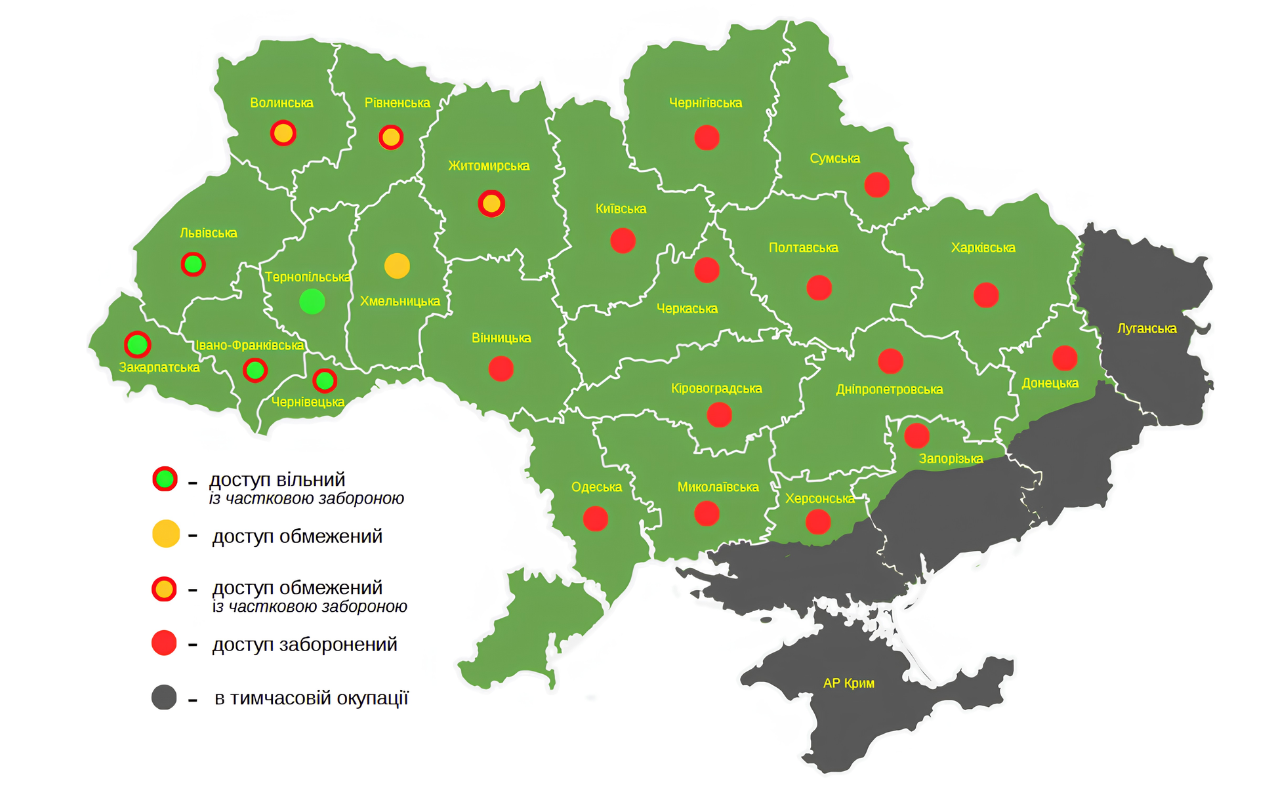
Source: forestcom.org.ua
Restricted visits
Partial access to forests is allowed in four regions. However, it is important to consider some territorial and functional restrictions here.
Zhytomyr region. Visiting forests is prohibited within 30 km of the border with Belarus, as well as around settlements that were under occupation. These include Radcha, Nova Radcha, Stara Radcha, Davydky, Hrezlya, Tychkiv, Vilkhova, Rovba, and Rubezhivka of the Narodychi settlement council. Accessing the border zone or entering for subsoil use is only permitted with the approval of military command.
Khmelnytskyi region. In this region, driving vehicles into the forest and making campfires is prohibited.
Volyn region. In the forests of the region, it is strictly forbidden to leave forest roads and drive onto the roadside, as well as to cross artificially created timber barriers. Restrictions on collecting mushrooms and forest berries apply to the following areas:
- a 5 km strip along the border with Belarus;
- Zabolottivska and Samarivska territorial communities of Kovel district, Kamin-Kashyrsky and Kovel districts.
Partial prohibition applies to the territories of Shatska, Dubechenska, Ratnivska, and Zabrodivska territorial communities of Kovel district.
Rivne region. Here, visiting forests is forbidden, but 125 recreational sites in nature have been established. Key restrictions apply to the following areas:
- lands of Loknytska, Zarichnenska, Vysotska, Myliatska, Starosilska, and Berezivska communities, where some forests are mined;
- border forests and other border zones controlled by the "Volyn" Operational Territorial Unit (OTU), as well as the Varash and Sarny district military administrations.
Completely prohibited
For civilian citizens, a total ban on visiting forests is in effect in the following regions:
- Vinnytsia;
- Dnipropetrovsk;
- Donetsk;
- Zaporizhzhia;
- Kyiv;
- Kirovohrad;
- Luhansk;
- Mykolaiv;
- Odesa;
- Poltava;
- Sumy;
- Kharkiv;
- Kherson;
- Chernihiv;
- Cherkasy.
It is prohibited to walk or drive in the forests. Exceptions are made, of course, for military personnel, as well as law enforcement officers, foresters, and other authorized services.
"De-occupied and border areas remain particularly dangerous—even after liberation, mines and unexploded ordnance may remain in the forests," the LIIs emphasizes.
Dangerous fire
Fire hazard is a factor that can lead to a ban on walks even in accessible forests.
If a Class IV-V fire danger is reported, regions may restrict not only the lighting of fires but also simply visiting forests.
EcoPolitic reminds us that it is precisely people’s irresponsible actions that are the most common cause of fires in ecosystems. Setting dry vegetation on fire can result in a fine of over 6,000 UAH. However, in the event of a large-scale fire with significant consequences, criminal liability may also apply.