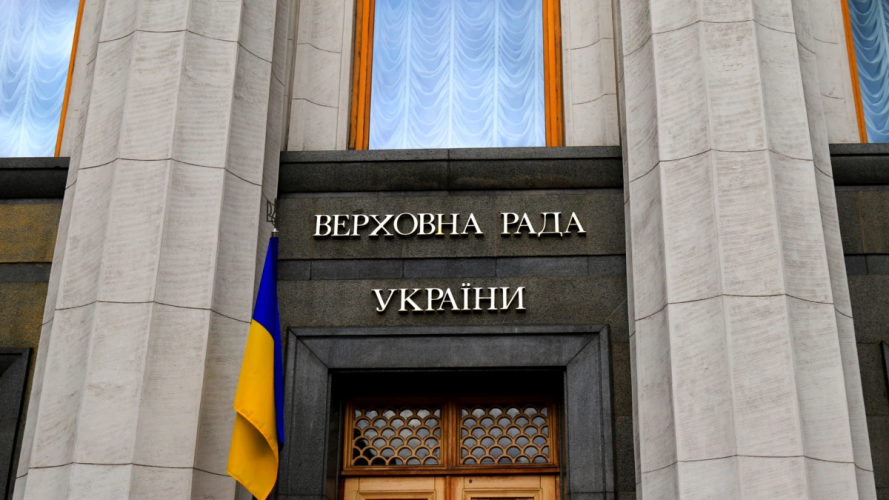
Parliament has sprung yet another unpleasant surprise on industrialists and experts – an alternative draft bill on the National Emissions Trading System (NETS) has appeared on the Verkhovna Rada’s website. Like its predecessor, Bill No. 15386, the document numbered 15386-1, ‘On the Principles of Operation of the National Greenhouse Gas Emissions Trading System’, was registered without any prior discussion or public presentation.
EcoPolitic has discovered that on Tuesday, 21 July, the bill was received by the Rada and forwarded to the leadership for consideration. On Wednesday, 22 July, the document had already been referred to the relevant committee for consideration.
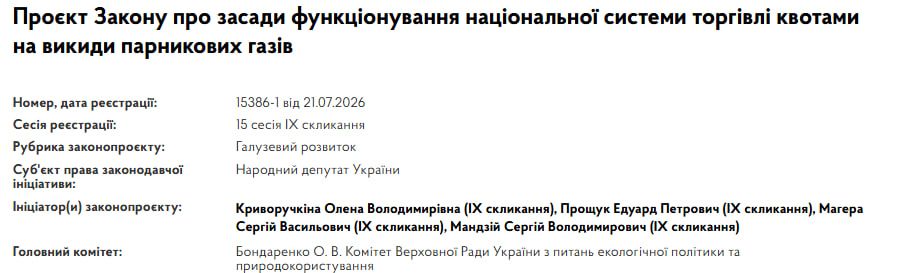
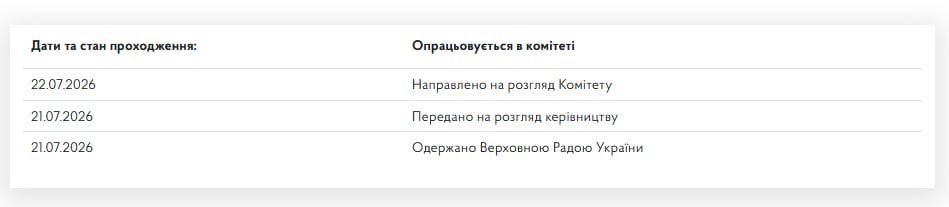
Screenshot from the website of the Verkhovna Rada of Ukraine
Another “pig in a poke”
According to EcoPolitics’ own sources, the expert community, representatives of industry, and the public were not informed about the development of this version of the draft law.
It seems that the parliament is isolating stakeholders from the drafting of a critically important legislative act that could fundamentally change the rules of the game for Ukrainian industry.
The situation was similar with draft law No. 15386 "On the National Greenhouse Gas Emissions Trading System," which was registered on July 7. Moreover, after registration, the actual text of the document remained unavailable for three days.
Alternative version of the NETS
In contrast to its shadowy predecessor, the project card for draft law No. 15386-1 included the texts of the draft and supporting documents almost right away. The drafting was initiated by a group of Members of Parliament headed by Olena Kryvoruchkina, who serves as Deputy Chairperson of the Parliamentary Committee on Environmental Policy and Nature Management.
According to a preliminary review of the explanatory note, the new draft law nevertheless features some differences. For example, it envisions the introduction of three NETS phases instead of two.
The fundamental difference is that this version proposes establishing a special dedicated fund, formed from the revenues of the quota trading system. These resources are intended to finance investment and innovation projects in the field of decarbonization. For comparison, draft law No. 15386 proposed assigning these responsibilities to the already existing Decarbonization Fund. EcoPolitics provided an overview analysis of its text in this article.
For reference, prior to the publication of these legislative initiatives, the Ministry of Economy had developed its own draft law “On the Principles of Operation of the National Greenhouse Gas Emissions Trading System” (NETS).
This process was still relatively transparent compared to the complete lack of communication regarding documents No. 15386 and No. 15386-1. During the month following the publication on May 15, the ministry received a number of proposals and comments, including from the European Commission and the European Business Association (EBA).
The national emissions trading system is an important part of European integration. Essentially, it represents a virtually new fiscal instrument for Ukraine, which will collect fees from polluters for emissions via the quota market. A certain CO2 emission limit will be free of charge; any excess will require payment.
After joining the European Union, the Ukrainian national emissions trading system will be fully replaced by the European alternative – EU ETS.
You can read more about the Ukrainian system in the article by EcoPolitics.