Work continues in Ukraine on the creation of its own emissions trading system. The relevant draft law was published for public discussion by the Ministry of Economy on May 15, giving 30 days for suggestions and comments. Experts from the European Business Association (EBA) voiced their proposals – from setting a clear goal for the ETS to a more flexible response to fluctuations in greenhouse gas quota prices.
EcoPolitiс has prepared for its readers a review of the analytical study by the EBA, “The Quota Trading System in Ukraine: EU Experience and Opportunities for Ukraine.”
“The key is to find a balance between ambition and real capabilities. The biggest problem for the Ukrainian economy over the past 20 years has been access to financing, while decarbonisation projects require investments amounting to billions. The draft ETS law proposed by the Ministry of Economy is a good starting point. It defines the architecture of the future system, takes into account the EU experience, as well as the specific features of the Ukrainian economy,” noted Stanislav Zinchenko, Head of the Industrial Ecology and Sustainable Development Committee of the European Business Association.
Forecast for сarbon prices and impact on business
The EBA has presented calculations within its own model for the development of the carbon market in Ukraine.
By 2034, the marginal quota price may reach €10/t, and in 2035 – €12/t. The quota surrender obligations in 2035 will amount to €27/t for a ton of steel, €9/t for a ton of cement, and €15/MWh for coal generation.
The carbon payment burden on GDP will be higher than during phase four of the European ETS (EU ETS): 0.35% versus 0.22%.
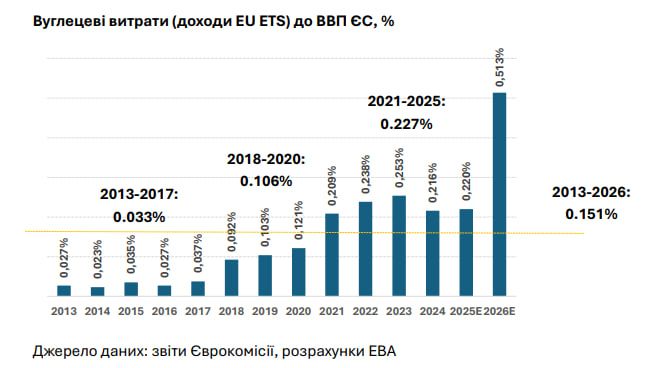
The Ukrainian ETS could traverse in eight years the path that took the EU 15 years.
If carbon emissions remain at the 2028 level, by 2035 the carbon payment burden on GDP will reach 6.5% with ETS quota prices at €227/t.
“Such a burden on the economy would halt all business activity. Therefore, by the beginning of Phase 3 of the ETS, decarbonisation processes in Ukraine should be largely completed. The start of Phase 3 should not be considered before 2040,” the business association emphasises.
1. The Goal and Performance Markers are Defined
In its current version, the draft does not formulate a clear objective for the ETS in Ukraine. Meanwhile, the European ETS provides for “the stimulation of greenhouse gas emission reductions in a cost-effective and economically efficient manner.”
According to industry analysts, this focus on economic impact is vitally important, as even the EU is now shifting its approach to its ETS, placing greater emphasis on balancing decarbonisation with preserving competitiveness.
Similarly, the Ukrainian ETS should incentivise decarbonisation without threatening deindustrialisation.
KPIs could include reducing total emissions relative to the 1990 level, lowering carbon intensity, and the amount of investment in low-carbon projects.
2. The Minimum for the Second Phase is Eight Years
The reference is to the period during which the prices of Ukrainian allowances under the ETS will approach those within the EU ETS. The draft law stipulates a rather abstract end date for the second phase. If its start date is January 1, 2028, its completion is expected no earlier than three years after the end of martial law.
The European Business Association (EBA) proposes to legally establish a minimum duration for this phase of eight years. This could help ensure a smoother transition to European prices and reduce stress on industry.
The EBA’s analytical model indicates that if Ukrainian and European allowance prices reach parity as early as 2035, the carbon cost burden on GDP will reach 6.5%, based on the consensus forecast quota price of €227/t. If carbon intensity is not reduced by then, companies simply will not be able to continue operating.
3. Predictable Linear Reduction Factor
The Ukrainian ETS draft law provides for an annual review of the linear reduction factor. In contrast, in the EU, LRFs are set in advance.
The EBA believes that Ukraine should also plan this factor several years ahead. This would give businesses clarity about the rate at which the number of greenhouse allowances will be reduced and allow them to factor this into their operations.
4. Clear Term of Decarbonization Credit Certificate Validity
The draft law does not specify how long decarbonization credit certificates will be valid. At the same time, the document allows the carryover of unused credits to subsequent years, so the experts suggest that such certificates should automatically remain valid until the completion of the second phase of the ETS. If an enterprise invests additional funds in emission reductions, it is proposed that the old certificate should be canceled and a new one issued-taking into account the new expenditures.
5. Calculation According to a Non-Existent Methodology
The draft law states that the maximum prices for greenhouse allowances will be determined by a methodology to be approved by the Cabinet of Ministers. However, this methodology has not yet been created, posing certain risks for industry.
The draft also states that prices will be influenced by the country’s actual economic situation. To determine this, the share of economic burden from ETS auctions in GDP will be considered. However, the period for determining this share is too broad-15 years.
The business association believes that the rules for setting prices should be more precise. In particular, it is necessary to clarify how the “military load coefficient” will work, and different reference indicator values should be set for different ETS phases.
6. Response to Sharp Market Fluctuations
In Ukraine, as in the EU, it is planned to “release” allowances from the stability reserve to the market in case of market surges-specifically, if prices exceed 2.4 times the average over six months. The comparison will use the average over the previous two years.
However, the Ukrainian draft law allows this to be done only once a year, and it does not specify the exact number of allowances from the reserve that will be released to the market. At the same time, this process still does not guarantee a return of prices to a set price corridor.
Других мер воздействия на цены проект не предусматривает. Именно поэтому эксперты из ЕВА подчеркивают важность планирования и других гибких мер реагирования на скачки цен.
7. Do not leave the reserve empty
The draft law should consider a likely situation when the market needs quotas from the stability reserve, but the reserve ends up empty. To address this, the business association recommends one of two options:
- establish a procedure for additional quota issuance for reserve needs;
- ensure a certain level of reserve filling at the very start of its operation. For example, deviations between actual CO2 emissions and those provided for in the Nationally Determined Contribution under the Paris Agreement could be transferred into quotas.
8. Free quotas
The procedure for distributing free quotas in the draft law generally aligns with the European approach, but lacks specificity. The European Business Association (EBA) highlights that it should be clearly stated that the distribution of free quotas is, on the one hand, based on benchmarks, and on the other, takes into account the established share of quotas to be sold through auctions.
9. Fair support for decarbonisation investment projects
Following the EU example, Ukraine plans to provide financial support to sectors most exposed to the risk of carbon leakage. The Decarbonisation Fund will carry out this function. However, the legislative framework governing its activities is somewhat imperfect and contains a number of contradictions.
For example, Article 38 specifies that the support share must not exceed 30%, while Article 40 refers to 60% of relevant costs. There is also no explanation of what these “relevant costs” are.
Further inconsistencies exist with regard to the sectors eligible for support. The Ukrainian draft law, in certain articles, lists road transport and building thermal modernisation among them. In Europe, these activities are covered by ETS 2, which operates separately from the ETS.
Therefore, experts recommend the following:
- set the same financing limits for investment and innovation projects or combine them into a single concept (decarbonisation project);
- provide for interest rate compensation on loans as a support mechanism via the Modernisation Fund. This is due to the low revenues of the National GHG Trading System (NGHTS), which will not allow support via grants as is done in the EU;
- eliminate inconsistencies, particularly in the list of eligible activities.
10. The quota submission deadline should be set uniformly for all phases of the NGHTS – by 30 September of the year following the reporting year. Currently, the draft applies this period only to phase three, while for the others, it provides just 30 days (until 31 January of the following year). This is insufficient time for emissions verification.
11. Aviation and maritime transport should be included in the NGHTS in the second phase, not the first. Such a deferred inclusion is consistent with European practice.
In general, the development of an effective and fair National Carbon Trading System (NCTS) is a fundamental issue for Ukraine, as what is at stake is not only the reduction of emissions but also the sustainability of the economy and the competitiveness of enterprises in the European market. EcoPolitic has compiled expert opinions in a separate article.