The Ministry of Economy, Environment, and Agriculture of Ukraine has published a draft law titled “On the Principles of Operation of the National Greenhouse Gas Emission Allowance Trading System” (NGGA) for public comment.
Its 107-page text, explanatory note, comparative table, and financial and economic calculations have been posted on the ministry’s official website.
The ministry noted that the draft law and accompanying documents have been sent to the European Commission for review. Feedback on the results of the review is expected around May 20.
Structure of the draft law
The legislative act contains 13 sections, 72 articles, and two annexes:
- Section I. General provisions.
- Section II. State policy and regulation in the field of NGGA.
- Section III. Greenhouse gas emission permits.
- Section IV. General provisions on the quota market.
- Section V. Use of NGGA revenues.
- Section VI. Circulation, transfer, and cancellation of quotas.
- Section VII. Monitoring, reporting, and verification.
- Section VIII. Market manipulation and insider trading. Quota market monitoring.
- Section IX. Review of the scope of NGGA and scientific-expert support for NGGA development.
- Section X. Disclosure of information and ensuring proper functioning of the quota market.
- Section XI. Relations with other greenhouse gas emissions trading systems.
- Section XII. Responsibilities of quota market participants.
- Section XIII. Final and transitional provisions.
- Appendix 1. List of activities included in the scope of NGGA.
- Appendix 2. List of greenhouse gases.
Phases of the NGGA rollout: when they will begin and what they entail
The launch of the National Greenhouse Gas Emissions Trading System envisions three stages of its operation:
- initial – first phase;
- “mature” – second phase;
- full operation – third phase.
The beginning of the first stage is planned for 2028. At the same time, the Ministry of Economy did not specify whether this will be at the beginning, middle, or end of the year. During this period, the NGGETS registry and auction platform will be introduced. There will be no free quotas.
In the second phase, which will begin no earlier than three years after the end of martial law, secondary trading of quotas and the carryover of accumulated quotas from year to year will be permitted. There will also be no free quotas.
The third stage foresees full operation within the EU ETS framework. Ukrainian companies will be able to participate in EU auctions and receive free quotas in accordance with European Union allocation rules. Proceeds from the auction will be distributed between Ukraine and EU funds.
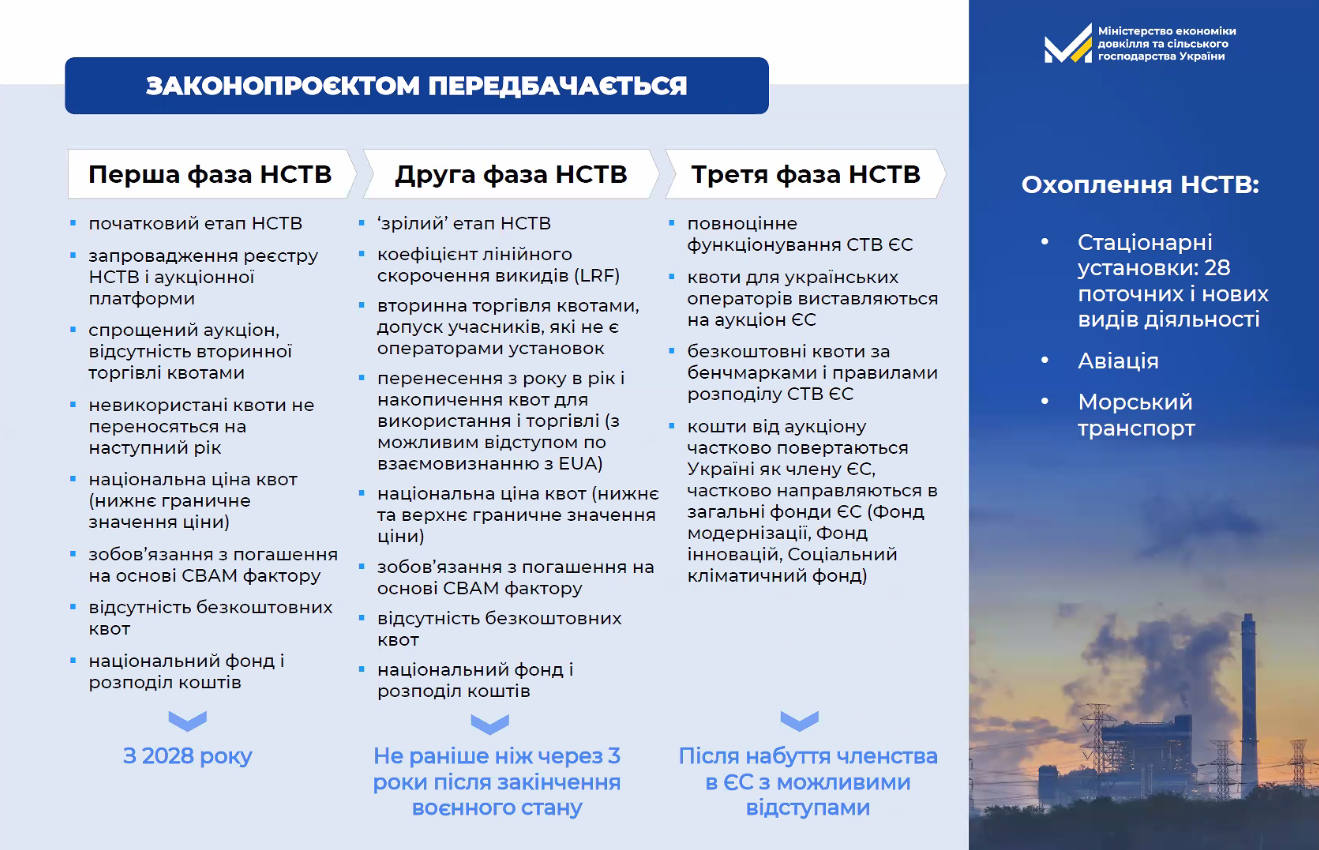
Source: screenshot from the Ministry of Economy presentation slide
Key elements of NGGA
-
The national quota price will be set as a percentage of GDP. According to the preliminary forecast, it will be up to €10 per ton of CO2 in 2034.
-
Proceeds from the sale of allowances will be accumulated in a special state budget fund – the “Ukraine Modernisation Fund.” This will be a new fund created in accordance with Directive 2003/87/EC “Establishing a scheme for greenhouse gas emission allowance trading within the Union and amending Council Directive 96/61/EC.”
-
Revenues from the National GHG Trading System (NGHTS) will be used to finance decarbonisation projects. Enterprises will be able to cover up to 30% of the cost of their investment projects.
-
If businesses invest their own funds in projects with a proven decarbonisation effect, they will be able to reduce their contributions for allowances to 10% of the accrued amount.
-
A national CBAM mechanism and voluntary carbon adjustment are being introduced, and manufacturers will also be able to use the proceeds for eco-modernisation of production processes.
-
Operators of NGHTS installations will not pay a CO2 tax.
-
The state will provide support in sectors with high risk of carbon leakage.
More details are available in the slide below.
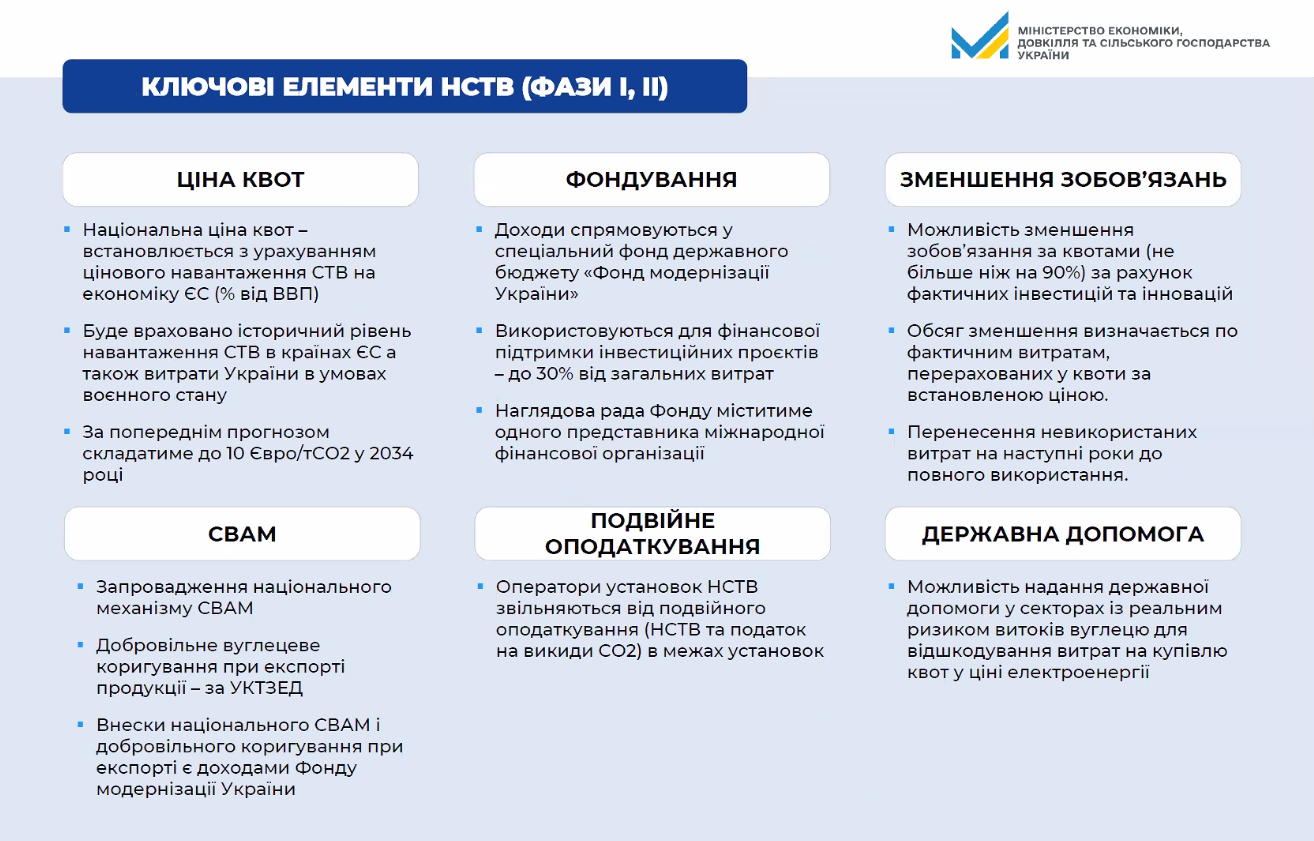
Source: screenshot of a presentation slide by the Ministry of Economy
Distribution of powers
Several government agencies and regulators will be involved in the launch and operation of the NGHTS:
-
Cabinet of Ministers of Ukraine;
-
Ministry of Economy;
-
NGHTS administrator;
-
National Securities and Stock Market Commission;
-
State Environmental Inspection;
-
allowance market operator.

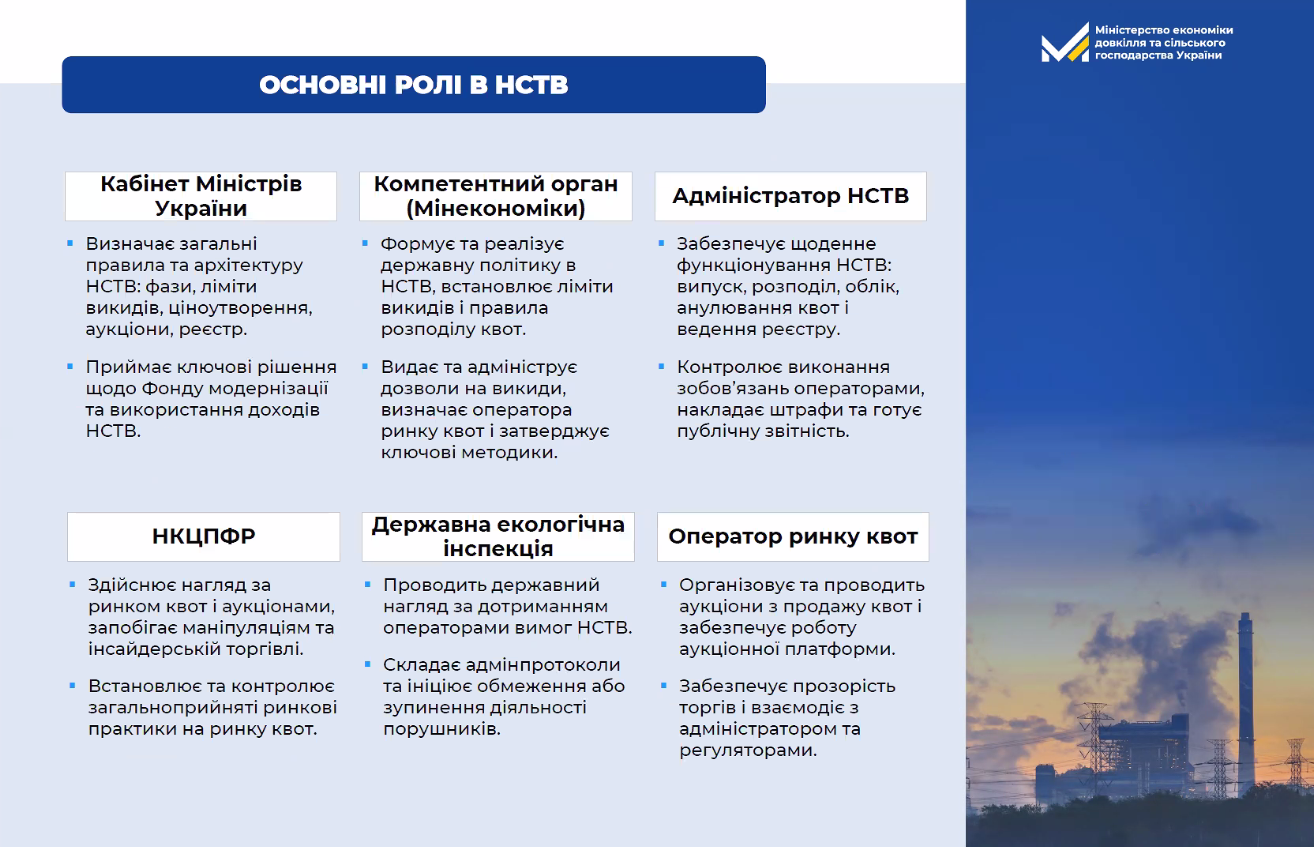
Source: screenshot of a presentation slide by the Ministry of Economy
Earlier, EcoPolitic reported on the preliminary discussion of the draft law on the Ukrainian ETS, which took place on April 16. At that time, officials from the Ministry of Economy promised to publish the document “today or tomorrow”, but in reality they needed another month for revision. We also gathered participants' impressions of the event and the main positions presented to stakeholders.