The Ministry of Economy, Environment, and Agriculture has drafted a bill titled "On the Principles of Operation of the National Greenhouse Gas Emission Allowance Trading System" and has already submitted it to the ministry's legal department for review.
This was announced during the discussion of the draft law by Bohdan Semenko, Head of the Department of Environmental Protection and Industrial Pollution Prevention at the Ministry of Economy.
The main provisions of the draft law on the national greenhouse gas emissions trading system (NGETS), as outlined by officials during the event, are as follows:
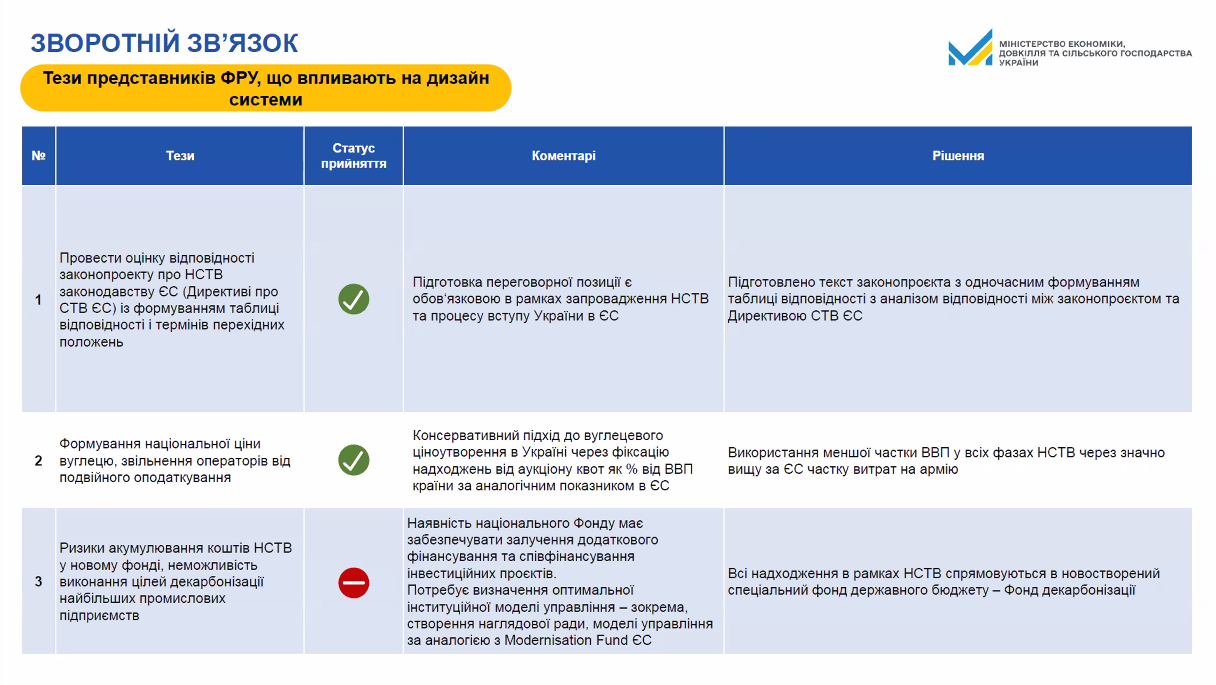
- The text of the Ukrainian draft law has been made as consistent as possible with Directive 2003/87/EC on the EU ETS. The significant pause between the previous discussion and today’s session at the Ministry of Economy was explained by the attempts to fully implement European standards so that, after Ukraine joins the European Union, it will not be necessary to radically overhaul the domestic carbon market law.
- When calculating the base quota price, a lower percentage of GDP will be used compared to EU countries, as Ukraine’s defense spending is significantly higher than in Europe.

Source: Ministry of Economy, Environment and Agriculture of Ukraine
- All revenues within the NGGETS framework will be directed to a newly established special state budget fund-the Decarbonization Fund. Both event participants and we ourselves raised the question of whether it is appropriate to create another fund, since a budget program and a joint stock company with similar names and receipts from the eco-tax already exist. Deputy Minister Oleksandr Krasnolutskyi responded that this is a matter for debate, but, for certain reasons, the decision was made to proceed with a new fund.
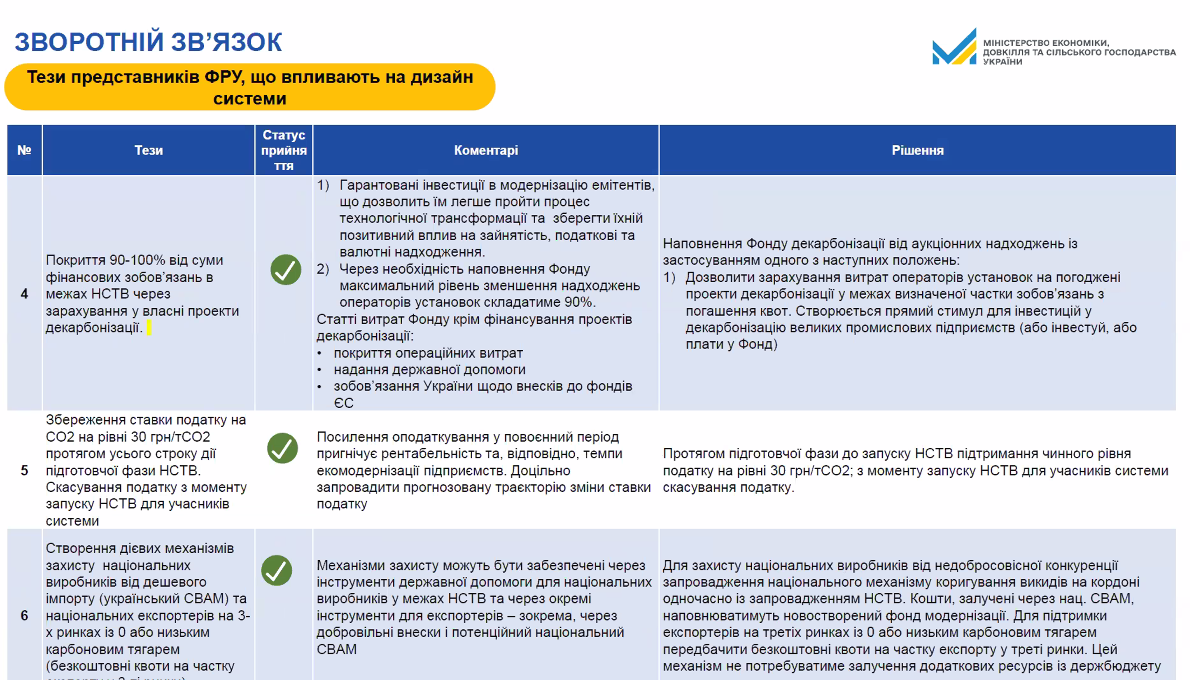
- A mechanism will be introduced by which companies will be able to use 90% of the payments made under the NGGETS to implement their own decarbonization projects. Mandatory requirements for such projects are that the costs must be market-based without overpricing, and a proven decarbonization effect is required.
- Greenhouse gas emission permits will be issued on a paid basis. Proceeds from their sale will be credited to the state budget. The price of such a permit will be five times the subsistence minimum.
- Simultaneously with the introduction of the NGGETS, officials plan to launch a national carbon border adjustment mechanism based on the CBAM principle. For this, a separate law on carbon duty will be developed. Its main goal is to protect domestic producers from unfair competition by foreign manufacturers. To support exporters on third markets with a zero or low carbon burden, free quotas are planned to be granted for that share of exports.

Source: Ministry of Economy, Environment and Agriculture of Ukraine
- Ukraine does not yet plan to allocate 25% of revenue from the ETS, as required by Directive 2003/87/EC, to EU funds. There is a risk that funds will leave the country, while domestic businesses might not receive financing from these European institutions. However, the Ministry of Economy will negotiate after the ETS is launched in 2028 regarding possible financing from EU funds for the modernization of Ukrainian enterprises.
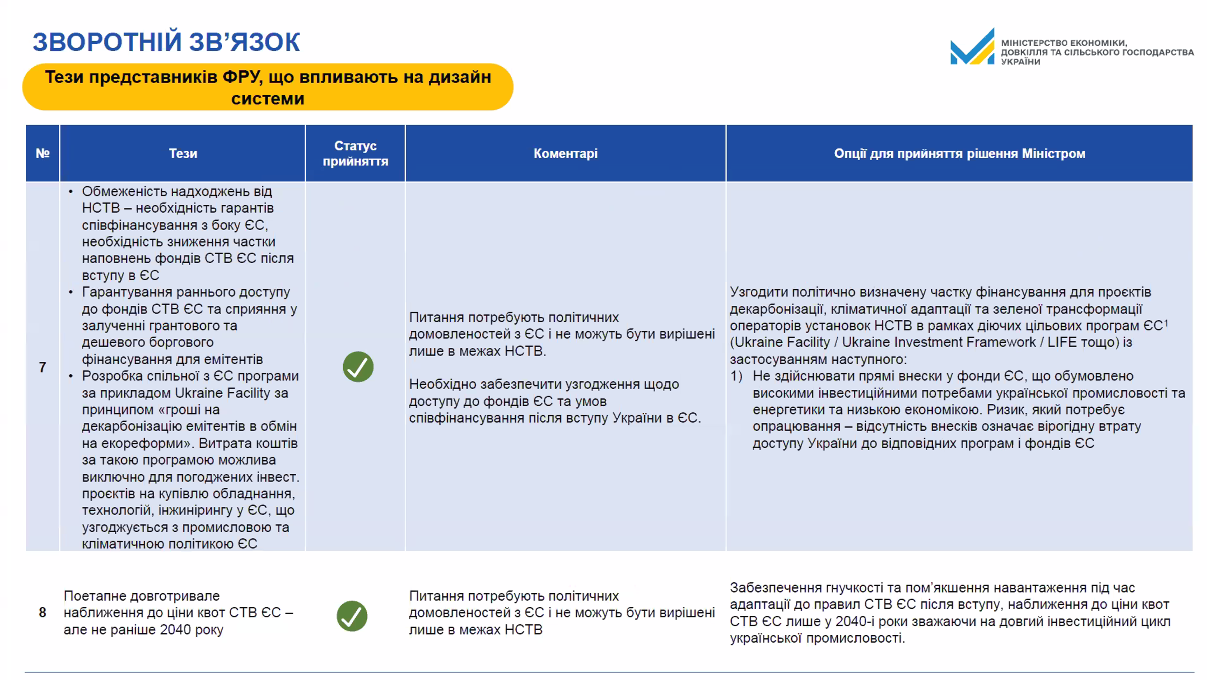
Source: Ministry of Economy, Environment and Agriculture of Ukraine
Within a month, the Ministry of Economy expects to receive comments and suggestions on the draft law from both businesses and the public, as well as from the EU. At the end of May or early June, officials plan to prepare the final version of the ETS bill, which will be submitted to the Verkhovna Rada.
The Ministry of Economy has also identified the number of necessary subordinate regulatory acts required for the implementation of the ETS law and has begun drafting them.
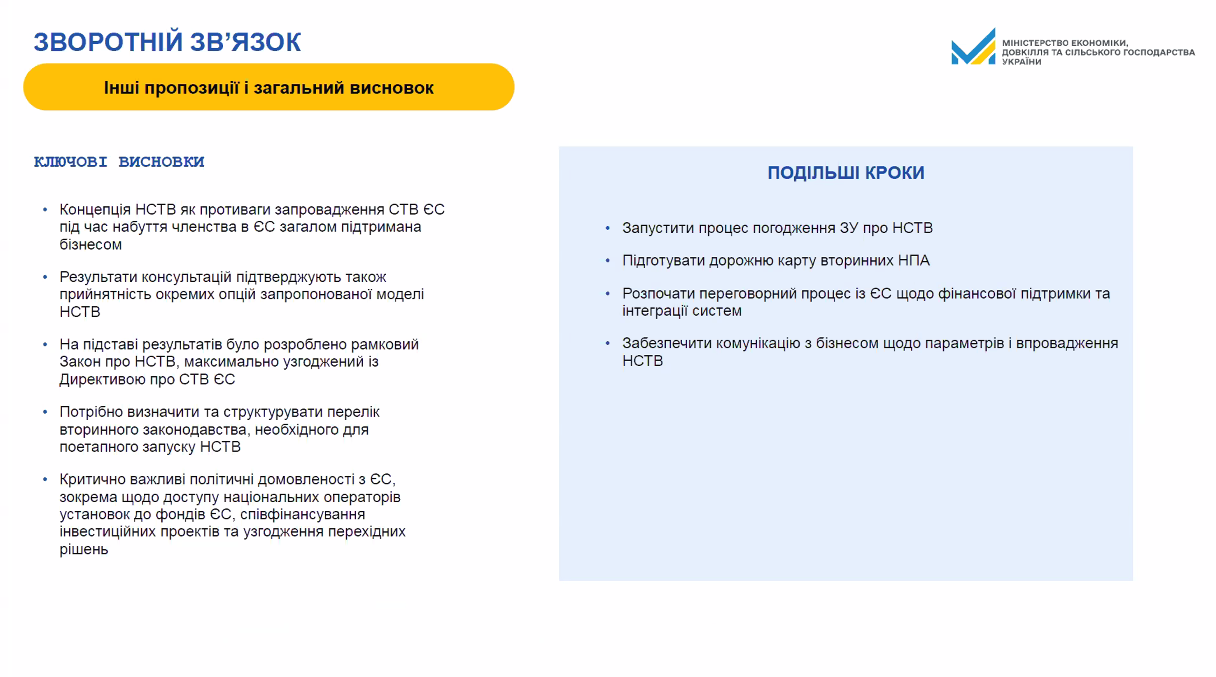
Source: Ministry of Economy, Environment and Agriculture of Ukraine
Earlier, EcoPolitic prepared an in-depth article on how Ukraine is preparing to launch its own ETS.