Green energy technologies are gradually becoming more cost-effective than their fossil fuel counterparts. Solar and wind power, electric vehicles, and biofuels already have this financial advantage—four out of the 15 technologies needed to limit global warming.
This is evidenced by an analysis by the EU Joint Research Centre (JRC) based on data for 2025.
The report’s main focus is on the prospects for green technologies and the necessary policy support. This includes regulatory frameworks and investments in sectors that are currently lagging behind.
Competitiveness of clean technologies
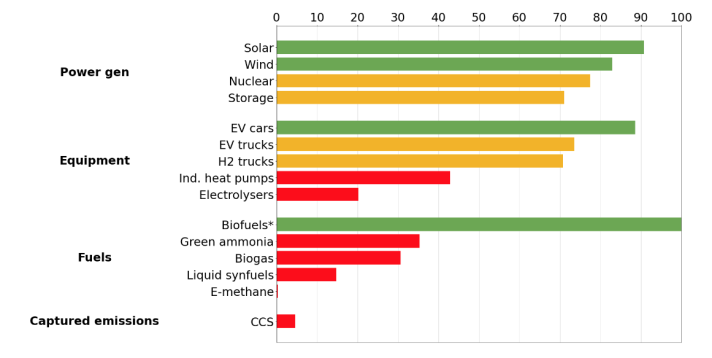
The JRC has divided the 15 key technologies into groups based on how well their development aligns with 2050 scenarios.
- Competitive – over 80% of the plan. Presently, this group includes solar energy, wind energy, biofuels, and electric vehicles. Overall, they are already competitive compared to fossil fuels. They have sufficient market support for broad deployment.
- Advancing – 50–80% of the plan. This group includes nuclear energy, the energy storage sector, and low-emission technologies for freight transport. They have fairly positive prospects but require additional political support to bridge the gap and reach levels corresponding to climate goals.
- Developing Technologies – less than 50%. Low-carbon fuels, technologies for electric industrial heating, innovations for CO₂ capture – these and other solutions require continuous investment and early political support.
Source: Joint Research Centre
Trade fragmentation as a threat to progress
The study separately examined the impact of international trade fragmentation in contrast to globalization. The JRC's findings are mixed.
Overall, the interaction between trade and climate policy at the global GDP level is rather insignificant.
Key findings regarding trade fragmentation:
- it can reduce emissions, but this reduction will be smaller than the resulting GDP losses;
- it is an obstacle to full deep decarbonization.
Currently, the energy trade sector is increasingly driven by national climate policies. However, the exchange of manufactured goods continues to be shaped by trade policy.
EcoPolitic previously reported that, according to International Energy Agency forecasts, by 2050 half of the world's energy will be generated by renewable sources and nuclear energy.