The global energy storage market could reach 500 GW by 2031, and 75% of global demand in the highly consolidated market will come from the US and China.
Demand in Europe lags behind, with only 159 GWh projected by 2031, reports Stockhead.
"Growth in Europe has stalled as regulatory barriers fail to improve the economics of the storage project, – said Dan Shreve, WoodMac's head of global energy storage. – Limited access to electricity markets and the lack of revenue accumulation opportunities, combined with the absence of auctions in the capacity market, have reduced investment in grid storage in Europe."
The article noted that despite this, the market for energy storage in Germany continues to grow and by 2030 will become the third largest market for energy storage after the USA and China - 32 GWh is forecast for the country, 61% from the residential segment.
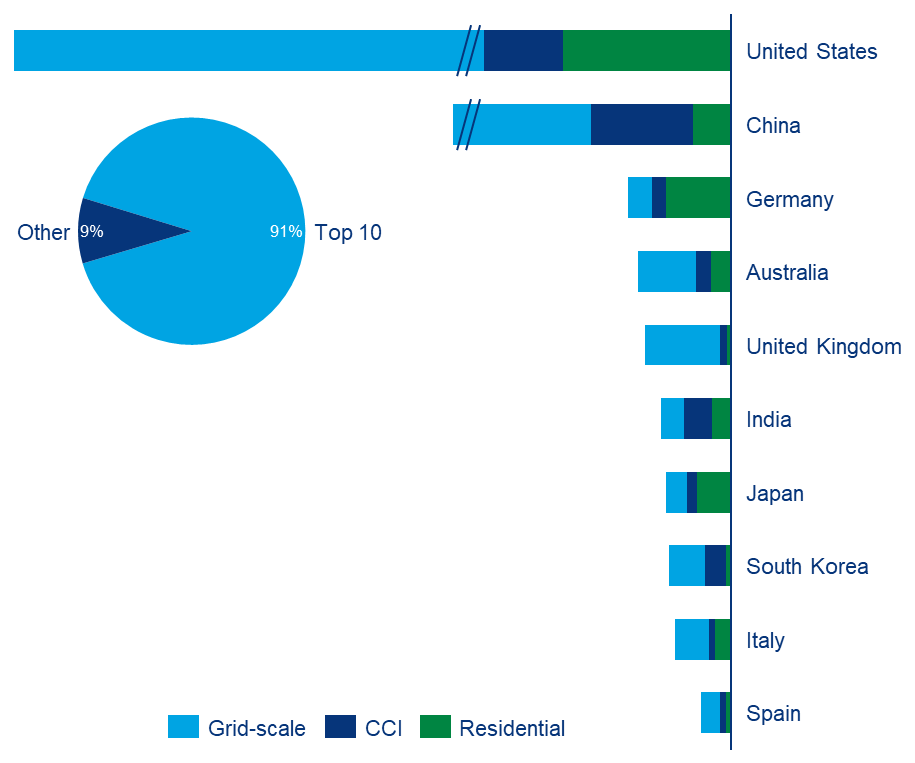
Graph: Capacity forecast of the ten largest energy storage markets: 2021-2031 (GWh). Source: Wood Mackenzie.
However, the European Commission's REPowerEU plan will further boost the EU energy storage market as it insists on a greater share of renewable energy supply in EU member states.
Europe has already seen an increase of 12 GWh since the launch of the plan in May 2022, which set a target of 600 GW for the solar PV market and pledged to simplify permitting procedures for both storage and PV systems.
"While REPowerEU does not set a specific target for energy storage, higher targets for the supply of renewables will stimulate demand for flexible energy solutions, including energy storage," Shreve added.
In the United States, a decrease in demand for 2022 and 2023 is predicted by 34% and 27%, respectively, due to anti-dumping disputes and a decrease in the dynamics of the introduction of solar energy.
The demand for storage systems in Europe lags behind China and the USA, but the sharp growth of renewable energy sources, gas shortages and congested interconnection networks may give impetus to the development of the region's network market in the coming decades.
As EcoPolitic reported before, in the last 4 years, it has become one of the main directions of development of rechargeable batteries joint construction of RES facilities with 25% of new capacities of energy storage systems (ESS).