Since 2014, the number of Europeans employed in the green economy has been growing by 6% annually. As of 2023, this figure had already reached 5.8 million full-time equivalents. The largest increase in jobs occurred in "green" construction, particularly in the renewable energy sector.
This is evidenced by Eurostat data.
Top in employment
Between 2014 and 2023, employment in construction rose from 0.7 million to 1.6 million full-time equivalents. On average, the sector added 11% of jobs annually, making it the most dynamic employer in the "green" economy. Statistics include in this segment work in the construction of renewable energy facilities, energy-efficient buildings, and energy modernization.
Sustainable agriculture ranks second in terms of growth. Here, the number of jobs increased by 5% annually. As of 2023, the sector accounted for 0.7 million full-time equivalents.
Employment in "green" manufacturing also increased by 5% annually—from 0.7 to 1 million full-time equivalents.
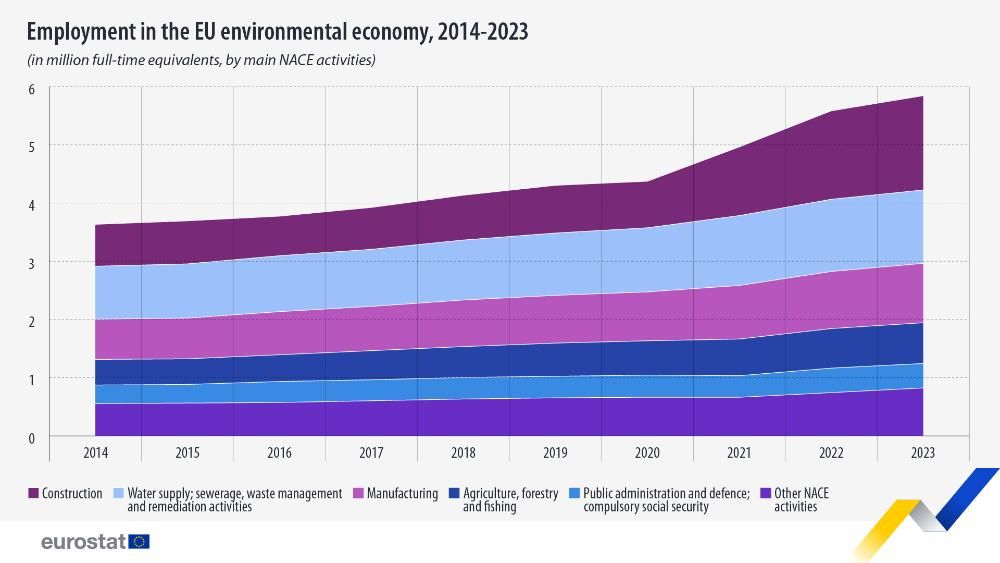
Source: Eurostat
Employment structure by environmental direction
Analysts also propose another approach to classifying "green" employment – by environmental objective. The growth in the number of jobs from 2014 to 2023 by sector was as follows:
- renewable energy – from 0.4 million to 0.8 million (+79%);
- soil, surface and groundwater protection – from 0.4 million to 0.7 million (+60%);
- air and climate – +48%;
- materials recovery and savings – +47%;
- wastewater management – +38%;
- waste management – +30%.
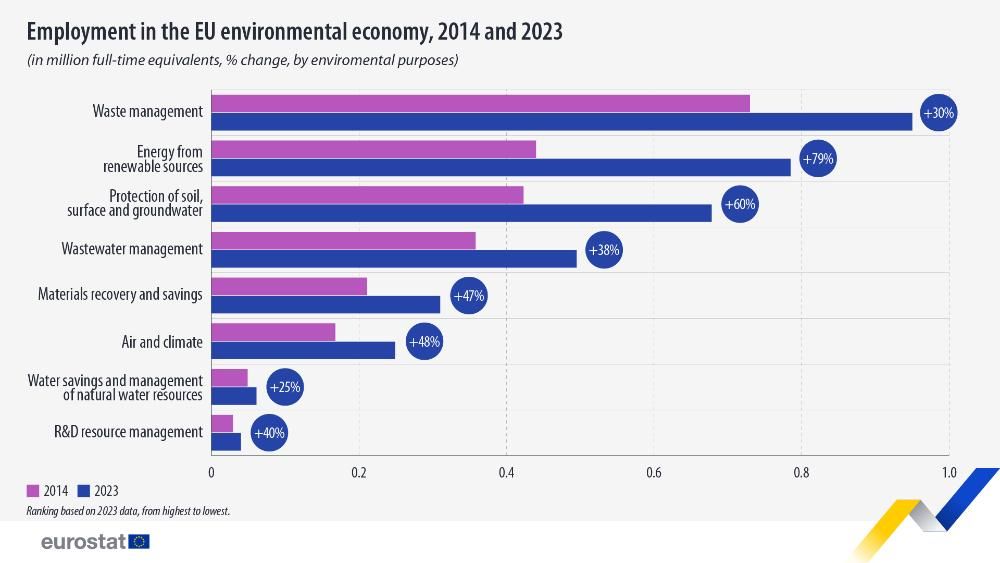
Source: Eurostat
EcoPolitic previously reported that despite the general decline in consumption, European industry continues to increase its use of energy from renewables and biofuels.