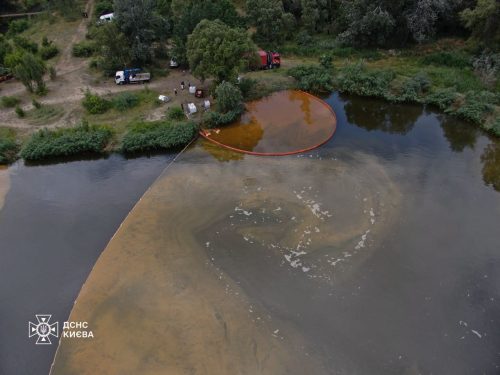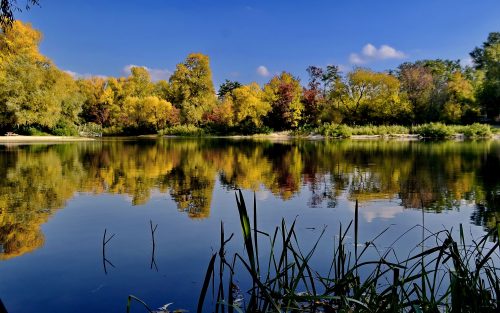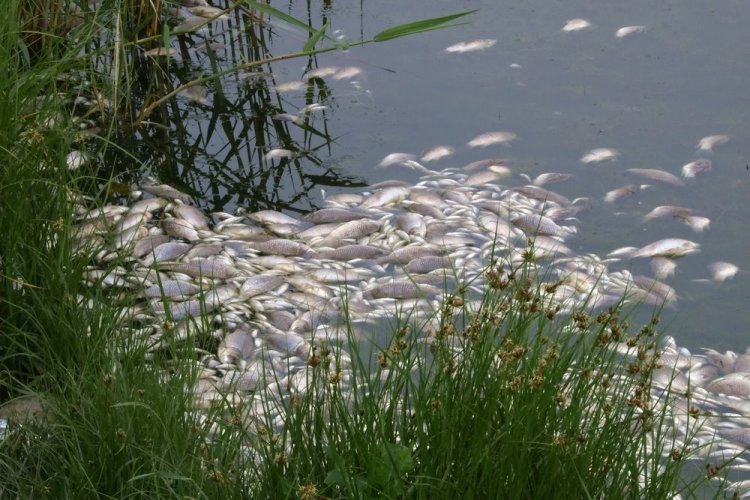
In the city of Rivne, eco-inspectors took samples from Lake Basiv Kut to find out the causes of the plague of fish.
In one of the samples, an excess of the maximum permissible concentration (MPC) of ammonium was found by more than 2 times, reports the State Inspectorate of Polissky District on Facebook.
The resident reported the incident through the hotline.
Two samples were taken at the Basiv Kut lake near the boat rental station and rescue station (from the pier), and the third one was taken on the Ustya River near the "Venetsia" cafe.
According to preliminary results, the maximum limit for ammonium was exceeded by 2.1 times for the reservoirs of economic and domestic water use near "Venice"
Eco-inspectors also recorded at the selection point on the Ustya River low content of dissolved oxygen – 1.7 mg/dm3, with a norm of 4.0 mg/dm3.
Also, at the sampling point on Lake Basiv Kut near the boat rental station, the content of dissolved oxygen reached 6.9 mg/dm3, at the sampling point on Lake Basiv Kut near the rescue station, the content of dissolved oxygen was 7.7 mg/dm3.
"At other observation points and other indicators (nitrates, phosphates, chlorides) no excesses were recorded," the material says.
The surface water temperature at the sampling points was 26.5 degrees.
In the "Sfera-TV" story, it was noted that fish plague has been a common phenomenon in Basovo Kuta for the past 10 years.
"Environmentalists even conducted research and found unauthorized discharges in Ustyu. However, the city authorities made no attempt to find the culprits and bring them to justice," the story says.
The material also noted that specialists of the Rivne regional center determined that the water in Basovo Kuta does not meet the standards for sanitary and chemical indicators, in particular for smell, color, and the presence of Escherichia coli.
Mayor Oleksandr Tretyak explained that after the recent rains, the situation with the reservoir has worsened. However, the plague of fish in such reservoirs in the summer is not a unique phenomenon, especially in reservoirs that are polluted by runoff from buildings.
"Since the spring of this year, we had plans to do the first stage of work on clearing our water pond, but, unfortunately, the war stopped these plans," said Tretyak.
He also added that, in fact, the state budget "took away" all the funds for the army from the city, and currently Rivne has no opportunity to carry out such works.
As EcoPolitic reported before, in the Rivne region near the town of Berezne there was a plague of fish in the Sluch River, during which 43,670 fish died.