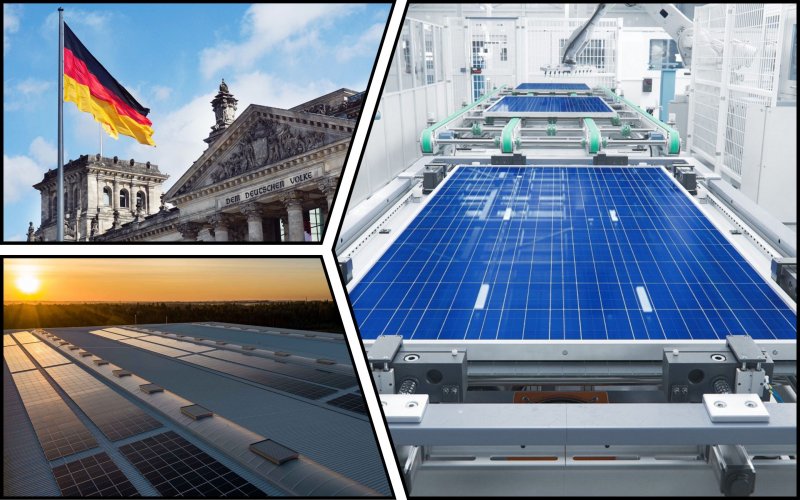
In Germany, in March, the Swiss company Meyer Burger, the country's largest solar panel manufacturer, will close its plant in Freiberg and move its production sites to the United States.
This will reduce the total solar panel production capacity in the EU by about 10%, Euractiv reports.
It is noted that the company has been reporting unprofitable production for several years, and its shares have fallen by 90%. In order to avoid closing the plant in January, Meyer Burger asked the government to provide subsidies, but received no response. Due to the lack of agreement within the three-party government, the aid package for solar energy producers in Germany is unlikely to be agreed upon by the end of March.
"The lack of European protection against unfair competition from China is jeopardizing almost four years of hard work by outstanding employees in Europe," the board of Sentis, the company's largest shareholder, said in a statement.
The material said that the factory in Freiberg was part of the large cluster "Silicon Saxony", which became a long-awaited impetus for the development of the economically lagging region. In 2023, the plant produced 650 MW of modules, which was about 5% of the installed capacity in Germany. However, the company was unable to sell all of its products.
It is noted that the total European production capacity of solar panels reaches 6 GW. However, in 2023, 56 GW of solar power plants were installed in the EU.
The material said that Meyer Burger plans to raise €262 million in the US to finance new plants in Colorado and Arizona. And it also expects to receive €1.4 billion in tax credits as part of a large-scale program to support green technologies in the US, which is provided by the Anti-Inflation Act (IRA).
Euractiv added that in February, the EU agreed on the law "On industry with zero emissions" (NZIA) to support local companies producing green technologies. However, it will enter into force no earlier than 2025, and it will take years to implement it.
Earlier, EcoPolitic wrote, that in 2022 in Germany, the energy company RWE dismantled one of the 8 wind turbines of the Keienberg park in the western state of North Rhine-Westphalia, to expand the Garzweiler coal mine (open pit).
As EcoPolitic previously reported, the Rystad Energy report showed that in 2023 there were solar panels with a total capacity of 40 GW, which is equivalent to the installed capacity in the block in 2022.