The share of European companies that follow strategies aimed at achieving climate goals has increased from 3% in 2019 to 23% in 2025.
These results were published by the British analytical non-governmental organization InfluenceMap after analyzing 200 of the largest European companies.
At the same time, from 2019 to 2025, the share of companies that are considered “inconsistent” with the direction of achieving global climate goals fell from 34% to 13%.
Support for science-based climate policy from European companies
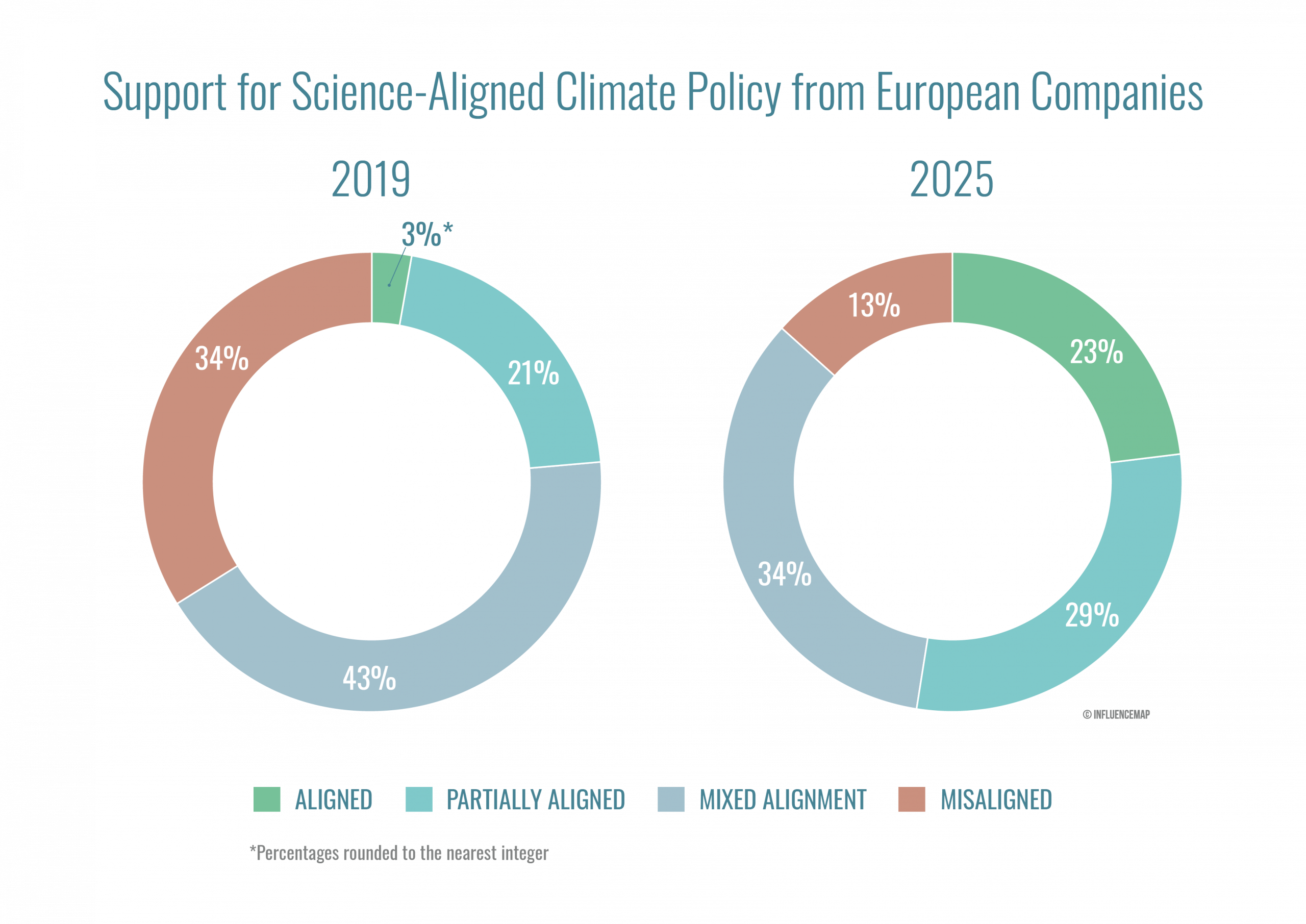
Green color – “support”, blue – “partially support”, gray – “mixed support”, brown – “do not support”. Source: influencemap.org.
The report notes that more than half of companies are at least “partially committed” to ways to help prevent global temperatures from rising by 1.5°C above pre-industrial levels by the end of the century.
“Those who actively oppose the energy transition achieve enormous weight in the public debate. However, this study demonstrates that there is a large silent majority that supports decarbonization and advancing progress through climate policy,” said Venetia Roxburgh, an analyst at the nonprofit organization InfluenceMap.
The researchers tracked business engagement in climate policy through various channels, from corporate reporting to EU consultation documents and social media posts. They found that “an increasingly large part of the corporate sector” is engaged in positive climate advocacy.
The analysts recalled that in 2019, when the European Commission announced its Green Deal, only one in four companies partially lobbied for the Paris Agreement's goal of keeping the planet from warming by 1.5°C. Now this share has doubled.
The worst performers in the ranking, weighted by the level of their political participation, are Polish utility company PGE, Austrian oil and gas company OMV, Spanish oil and gas company Repsol, Spanish gas transmission system operator Enagás, and German airline Lufthansa.
As EcoPolitic recently reported, the new Austrian government does not support the European Commission's recommendation to reduce emissions by 90% by 2040.