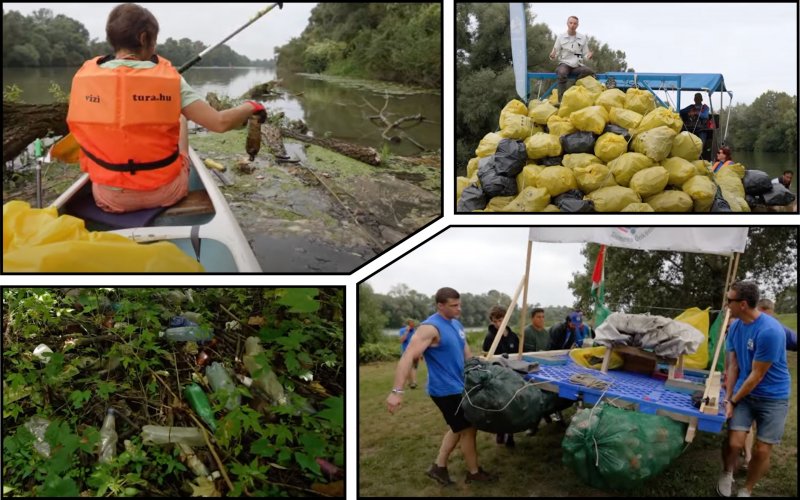
Transcarpathian rivers brought about 90 tons to Hungary plastic garbage, mostly bottles, which covered the river and the banks of Bodrog.
To overcome the accumulation of garbage, European activists organized the Plastic Cup action, during which they collected 11 tons of plastic, reports Euronews.
It is noted that in Transcarpathia the waste disposal system is not established. In addition, as a result of Russian aggression, thousands of residents of the occupied regions evacuated to the west of the country, which made it difficult for communal services to work.
"In Transcarpathia, waste disposal is not established, they are simply dumped in the river floodplain, and when a flood occurs, the water picks up the garbage and brings it to Hungary," explained the head of the Plastic Cup project Miklós Dzhalaj-Korpos.
He added that the campaign is held every year. About 1,500 volunteers on home-made rafts and boats go down the river and collect garbage for several days. After that, the waste is sorted and sent for processing.
"It's really just the tip of the iceberg. We know we can't remove all the trash from the floodplain. I think the real solution is to use less plastic so that this kind of waste doesn't appear at all. But if you do buy it, throw away the packaging in the correct bin for separate waste collection!", he said Jalai-Korposh.
The article emphasized that plastic from Transcarpathia enters the Black Sea through Hungary. However, this problem is not unique to Ukraine. After all, about 80% of plastic enters the world ocean through rivers and canals.
It is noted that The European Union is taking measures to reduce plastic pollution of the ocean and residual household waste by half by 2030. However, the process is currently being delayed and the volume of packaging in household waste has increased by 19% in 10 years.
"Plastic waste is spreading across the world across borders, and it can only be stopped by joint efforts. The Hungarian organizers of the Plastic Cup are working with partners from Western Ukraine to prevent further pollution of the river," the article says.
Earlier, EcoPolitic wrote, that the eco-community called on the Minister of Environmental Protection and Natural Resources, Ruslan Strilets, to help preserve the only garbage sorting station in Berehove in Transcarpathia.
As EcoPolitic previously reported, whole streams of garbage move from Ukraine to Hungary along the Tisza River at a speed of 100 bottles per minute. The reason for such a critical ecological situation is the absence of a waste management system.