Finland has become one of the most ambitious countries in climate policy, as it has set a legislative goal of achieving zero emissions in 2035.
By 2040, it will have a negative net emission, that is, it will absorb more carbon than it emits, reports Climate Home News.
Only South Sudan, a developing country, has a more ambitious goal of zero emissions by 2030. However, such a goal is highly dependent on international funding.
Finland's targets were set based on an analysis by a group of independent economists from the Finnish Commission on Climate Change. They calculated Finland's fair share of 420 Gt of carbon dioxide the world could emit and still have a two-thirds chance of limiting global warming to 1.5C.
The commission justified this fair share based on Finland's share of the world's population, its ability to pay for emissions reductions, and its historical responsibility for causing climate change.
It is believed to be the first target to be set in this way.
Finland's environment minister and the Green Party in a coalition of five centre-left parties, Emma Kari, stressed the importance of working with researchers and the climate community to set a target.
"High income countries have to take a progressive and active role when it comes to tackling climate change," she said.
While most developed countries, including the EU and the US, have set net zero targets by 2050, a Finnish analysis found that Germany and the EU should reach net zero in the early to mid-2030s.
Kari said that climate targets should be based on climate science and the Paris Agreement, and if the targets are not compatible with it, they should be increased and earlier target dates should be set.
The minister called Finland's goal ambitious but achievable and noted that it has broad cross-party support in Finland.
Whether Finland meets its climate goals will largely depend on its forests, which cover three-quarters of its territory. According to Statistics Finland, for the first time in 2021, these forests emitted more greenhouse gases than they absorbed. After all, trees were cut down faster and planted more slowly.
"Emissions from deforestation have increased over the past decade, offsetting reductions in energy emissions as the country moves away from fossil fuels," the report said.
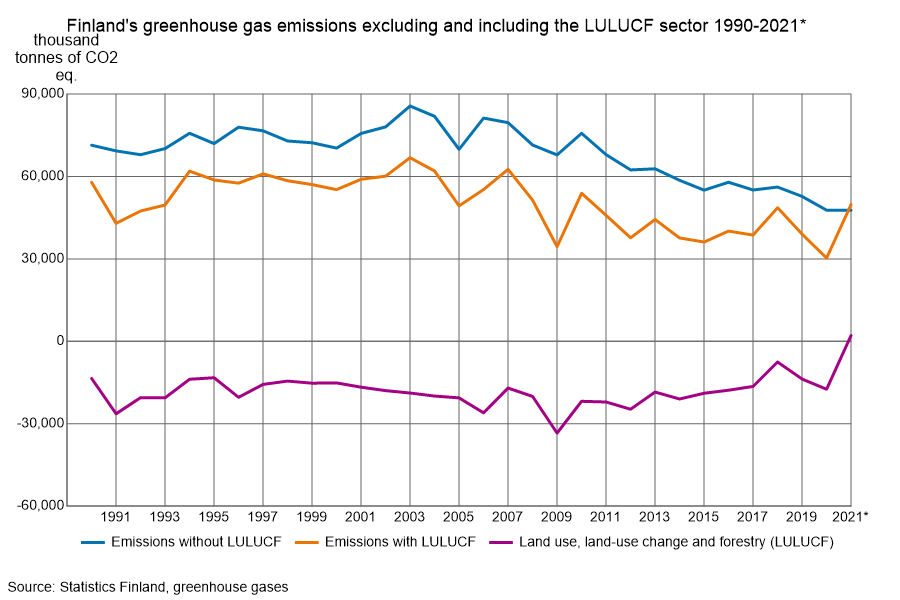
Emissions in Finland excluding land use, land use change and forestry (blue), together with it (orange) and emissions from it alone (purple).
Finnish logging companies convert their trees into pulp and paper and sell them to be burned for energy that is often ambiguously advertised as green and renewable.
The Ministry of Agriculture and Forestry is already working on its first climate plan.
Kari added that Russia's invasion of Ukraine accelerated Finland's energy transition as the government boosted wind power and made buildings more energy efficient and less dependent on fossil fuel heating.
She also noted that the goal would be achieved without relying on international carbon offsets, where one country pays another to reduce emissions on its behalf.
Earlier, EcoPolitic wrote, that Australia passed law that establishes tougher goals regarding the reduction of greenhouse gas emissions.
As EcoPolitic previously reported, in 2022 humanity established a record for the speed of resource depletion planet, because the date when all the renewable resources that the Earth renews in a year are used, fell on July 28.