The amount of CO₂ that humanity can emit without exceeding the 1.5°C global warming limit is only 130 billion tons starting in 2025. At current levels of air pollution, this limit will be reached by 2028.
These data were presented by a team of more than 60 international UN scientists in an annual report published in the journal Earth System Science Data.
They warned that the world is at a “critical time” to avoid warming above the key 1.5°C threshold set out in the Paris Climate Agreement.
In their annual report, the scientists presented a comprehensive picture of the current state of the climate and calculated the anthropogenic factors behind its changes. They presented the main generalized data in an infographic:
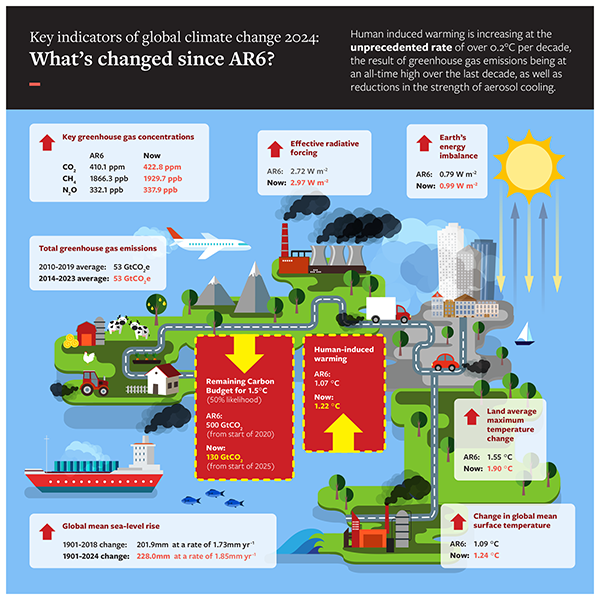
Source: Earth-System-Science-data.net.
The “carbon budget,” i.e. the amount of CO₂ that can be emitted without exceeding 1.5°C, will be used up in just over 3 years at current levels of CO₂ emissions.
This means that without radical emissions reductions, the world will not be able to prevent the dangerous warming threshold from being exceeded, which will lead to an increase in the number of extreme weather events, climate-related disasters and increase the risk of triggering irreversible changes.
The authors of the report warn that the carbon budget of 1.6°C or 1.7°C could also be exceeded within 9 years, which would significantly exacerbate these impacts.
Long-term estimates by scientists show that the current average global temperature is 1.24°C higher than in pre-industrial times.
According to the study, between 2019 and 2024, the average global sea level also rose by about 26 mm, which is more than double the long-term rate of 1.8 mm per year observed since the early twentieth century.
In early June, EcoPolitic wrote that, according to the World Meteorological Organization, our planet will warm up by more than 1.5°C compared to pre-industrial levels in the next 2 years.