The EU carbon market is facing increasing political pressure. Business lobbyists are demanding reforms to the Emissions Trading System (EU ETS), while leaders of some countries, notably Italy, are calling for the system to be suspended altogether.
This was reported by Carbon Credits.
Problems in the world's largest emissions market
The EU ETS covers about 40% of all greenhouse gas emissions in the European Union, regulating pollution from heavy industry, power plants, and aviation. Clear limits have been set for these industries, and businesses are required to purchase permits for each ton of CO2 emitted.
However, carbon prices are unstable, and pollution costs undermine the competitiveness of European industry.
It works for decarbonisation
The European Emissions Trading System was launched in 2005. Each year, limits on greenhouse gas emissions are reduced, forcing businesses to adapt and emissions to fall. At the same time, the pace of limit reductions is also increasing – the annual linear reduction factor has risen to 4.3% for 2024 to 2027 and to 4.4% for 2028 to 2030.
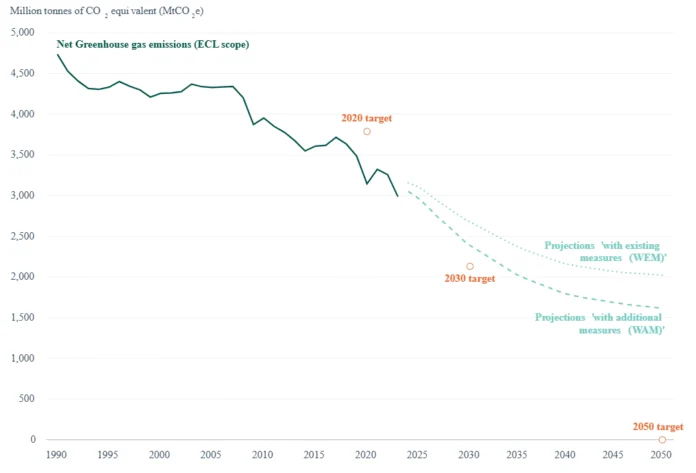
Yet it is effective. Compared to 2022, emissions in 2023 fell by 15.5%, referring to the sectors covered by the European ETS.
Overall, the EU has set a target to reduce emissions by at least 55% by 2030 compared to 1990 levels, with the EU ETS being the main tool to achieve this.
Source: carboncredits.com
Prices fluctuate
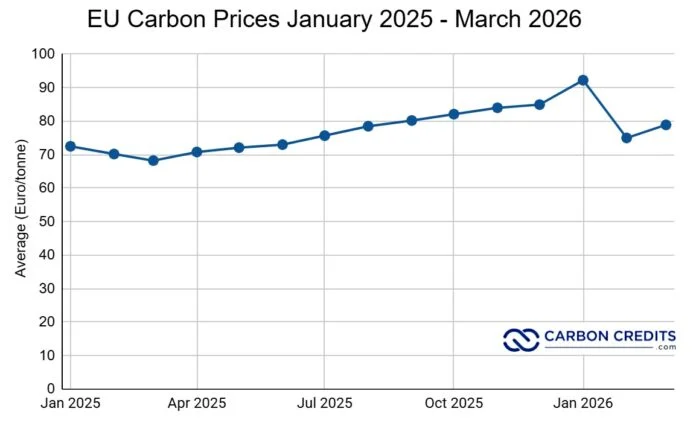
In recent years, carbon prices have increased significantly – from less than €10 per tonne in 2018 to around €100 at the beginning of 2023.
In 2024, prices dropped slightly, and at the beginning of 2025 fluctuated within €60–70 per tonne. At the beginning of March 2026, they rose again to €70–75 per tonne.
Thus, price volatility remains very high, making the emissions market unpredictable and increasing costs in the steel, cement, aluminium, and chemical industries.
Source: carboncredits.com
Business demands reform
The most influential EU business association, BusinessEurope, called for reforms of the EU carbon market in 2026. Their arguments include undermining Europe’s industrial capacity amid high energy and carbon prices.
Industrialists consider deindustrialisation and relocating production abroad to be the main risk for the EU. This will not only weaken the economy but will also transfer the sources of pollution to countries with weaker climate principles.
Therefore, businesses are asking EU authorities to review the Market Stability Reserve (MSR), regulate carbon price fluctuations, and finally align climate policy with industrial competitiveness.
“The EU has not yet introduced effective short-term measures to reduce energy costs and bridge the related competitiveness gap faced by European companies compared to their global competitors. Moreover, EU climate and energy policy still lacks a truly technology-neutral approach,” BusinessEurope emphasised.
At the same time, the Carbon Border Adjustment Mechanism (CBAM) started operating in the EU. It will impose a carbon levy on imports of cement, steel, aluminum, fertilizers, electricity, and hydrogen. This aims to level the playing field between domestic and foreign producers.
Categorical appeals
The position of Italy is stricter – to temporarily suspend the EU ETS. They claim that high carbon prices increase electricity costs and harm households and businesses.
“The system of trading goods and services, in its current form, constitutes an additional tax on European companies, affecting their costs and limiting their competitiveness,” emphasized Italy’s Minister of Industry, Adolfo Urso.
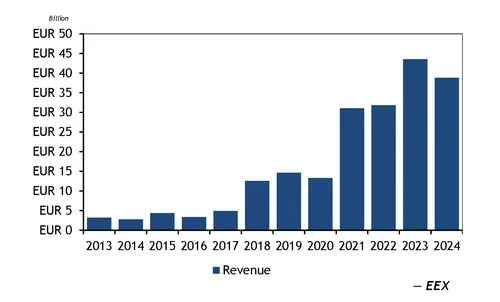
However, the carbon market is regulated by EU law, and an individual country cannot suspend it unilaterally. The European Commission will not take such steps – on the contrary, it defends the EU ETS, calling it economically efficient and important for the revenue generation of EU member states. These funds, in turn, support climate action, the energy transition, and social initiatives. These are significant amounts. According to EU official sources, from 2013 until the end of 2025, total auction revenues exceeded €245 billion.
Source: carboncredits.com
Will There Be Reform?
The European Commission does not rule out a review of the ETS in 2026. It will be carried out as part of the EU’s plan to achieve net zero emissions by 2050.
The reform will likely include:
- changing the pace of allowance reductions;
- adjusting the method for calculating or allocating carbon prices;
- modifying how new sectors, such as transport and construction, are integrated into the system.
There are also calls to change the CBAM, but the European Commission rejects such appeals. Its position is that this mechanism protects EU producers, so it should remain stable.
Recall that as early as April, the first quarterly CBAM certificate price will be announced.
Also, EcoPolitic reported that the Council of the EU officially approved its main climate target – to reduce emissions by 90% compared to 1990 levels by 2040.