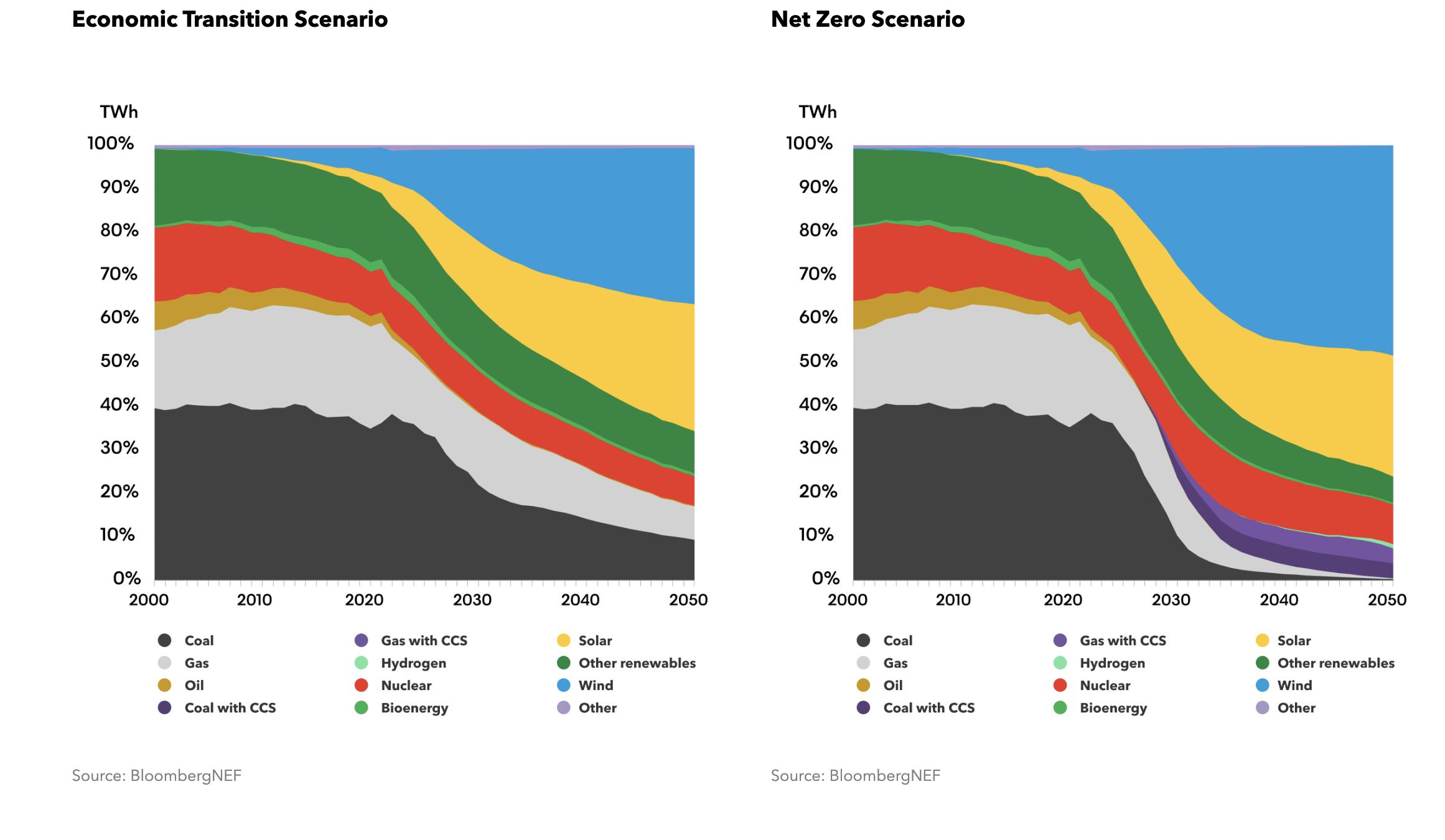
The Energy Transition scenario envisages a doubling of global electricity production to 46,000 TWh by 2050, and the Net Zero strategy – to more than 80,000 TWh, which is three times the current amount.
This was shown by the analysis of long-term scenarios of the New Energy Outlook (NEO) from BloombergNEF, BNEF reports.
Analysts have suggested that hydrogen will become the single largest source of electricity demand worldwide by 2050, equal to total global demand in 2020. The Net Zero scenario assumes that annual hydrogen demand will reach 23,000 TWh and 88% of generation will come from grid-connected electrolyzers. However, the demand for hydrogen electricity in the economic transition scenario is insignificant.
The report emphasized that Net Zero requires significant changes in the structure of the energy mix. After all, this is actually a completely different energy system. In 2050, hydrogen production will increase to 500 million metric tons per year, which is five times more than today.
It is noted that achieving zero emissions will result in almost zero fossil fuel electricity generation without carbon capture and storage. It will also require increased nuclear generation, as well as solar and wind. In the Net Zero scenario, wind and solar power account for more than three-quarters of total electricity generation.
The report added that carbon and hydrogen capture and storage are emerging as key technologies for deep decarbonization applied in industry, energy, construction and transportation.
BloombergNEF estimates that around 7 gigatonnes of carbon dioxide will need to be captured annually in 2050, which is equivalent to the existing combined energy sector emissions of Europe, China and India.
Earlier, EcoPolitic wrote, that in 2022, South Africa became the most coal-dependent country, which accounted for 69% of primary energy consumption, and China and India were the largest consumers of coal in absolute terms.
As EcoPolitic previously reported, according to BloombergNEF data, the US and China are beginning a decade of development of energy storage systems.