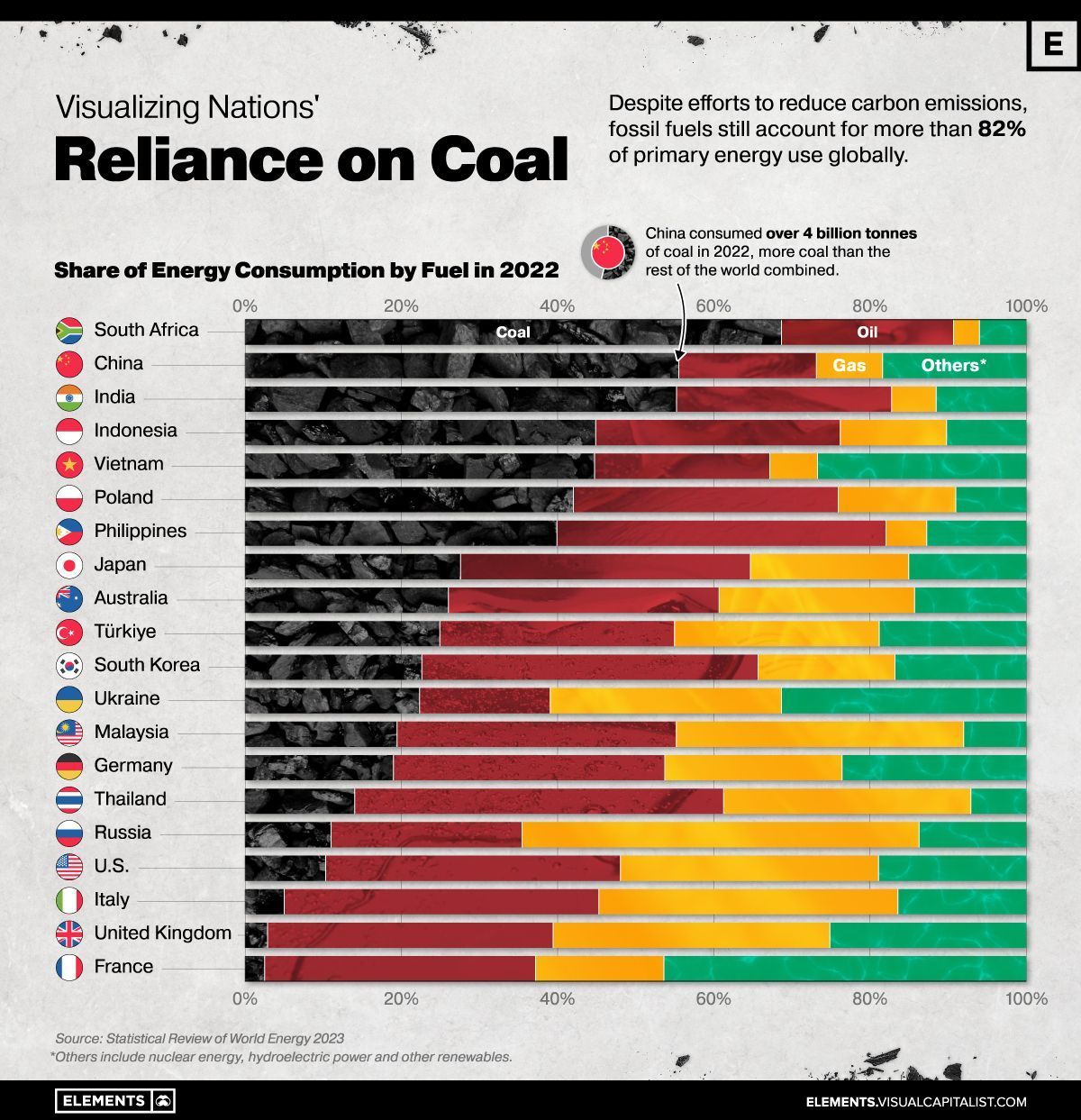
In 2022, South Africa became the most coal-dependent country, accounting for 69% of primary energy consumption, with China and India the largest coal consumers in absolute terms.
China's power sector accounts for a third of global coal consumption, and India is set to become the world leader in coal consumption growth over the coming years, Elements reports.
It is noted that in 2022, global coal consumption exceeded 8 billion tons per year for the first time. Despite the global green transition and reduced emissions, fossil fuels still account for more than 80% of primary energy consumption worldwide. Coal, the world's most affordable energy fuel, is also the largest source of energy-related CO2 emissions.
The material emphasized that, in addition to energy production, coal is used for the production of iron, steel and cement.
However, in developed countries, there is a significant decrease in c coal consumption. In the US, this figure fell by 50% compared to 2010.
A similar trend is observed in the EU. Thus, in Germany, coal generation provided 18.9% of total energy consumption, in particular due to an increase against the background of the energy crisis. In 2012, this indicator reached 24.9%.
"As coal consumption in developed countries declines but remains stable in emerging economies, the International Energy Agency predicts that demand for coal will remain at the level of 2022 until 2025, when it will begin to decline," the material said.
Earlier, EcoPolitic wrote, that a new United Nations report showed that carbon emissions will be reduced by 2% by 2030 from the 2019 level, although according to the Paris Agreement they should be reduced by 43%.
As EcoPolitic reported earlier, a study by American scientists has shown that the world is in the early stages of a climate emergency and will exceed global warming by 1.5°C by 2030 and 2°C by 2050.