Solar and wind energy are now almost always the cheapest and fastest option for producing new energy.
This conclusion was reached by the United Nations based on the results of two reports published on July 22. These reports are the UN inter-agency report Seizing the Moment of Opportunity and the recent report by the International Renewable Energy Agency (IRENA) Renewable Power Generation Costs in 2024.
According to the researchers, the global transition to renewable energy has reached a “positive turning point.” Here are the main findings that support this thesis:
- In 2024, the increase in global renewable energy capacity reached 582 GW, which is almost 20% more than in 2023 and the largest annual increase since observations began.
- Almost all new energy capacity built worldwide last year uses renewable energy sources (RES).
- Almost every continent added more renewable energy capacity than fossil fuels last year.
- About 75% of the increase in electricity generated worldwide was provided by wind, solar, and other green sources.
- More than 90% of new RES worldwide generate electricity at a price lower than the cheapest fossil fuel alternative.
- Wind, solar, and new hydropower were the three cheapest sources of electricity last year.
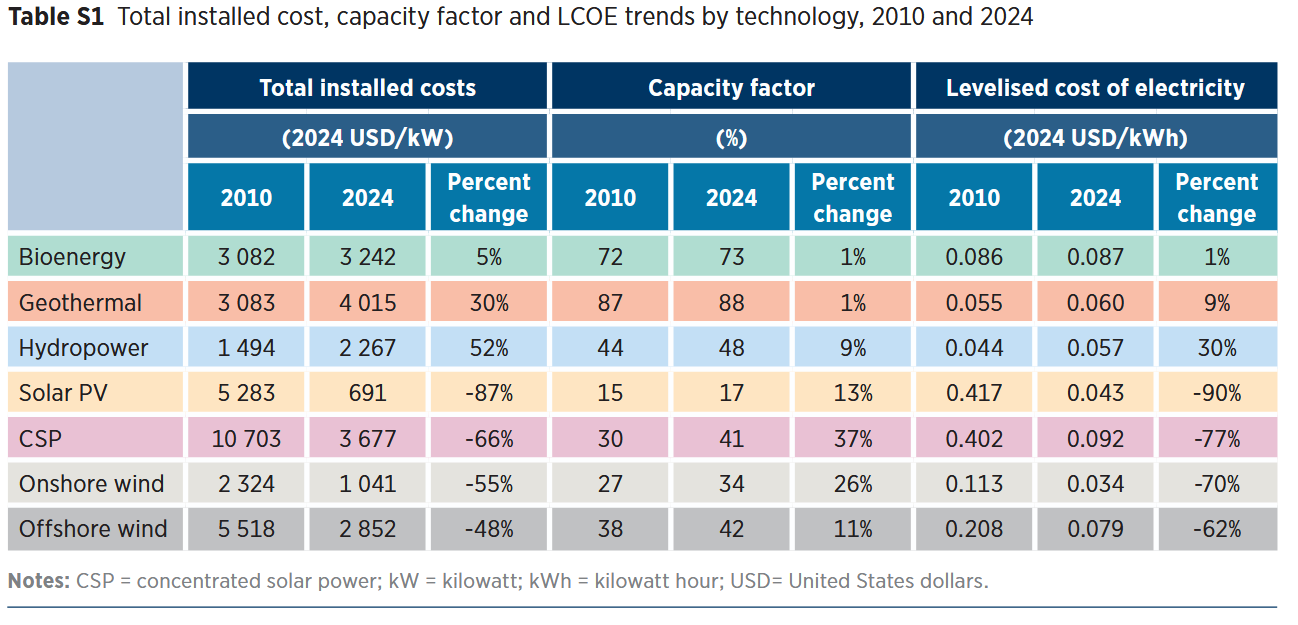
- Solar energy is now 41% cheaper than fossil fuels. Not so long ago, it was four times more expensive.
- Offshore wind is now also 53% cheaper and is the most affordable source of new renewable energy.
- Last year, about $2 trillion was spent on clean energy — that's $800 billion more than on fossil fuels and more than 70% more than in 10 (!!!) years.
A comparison of the total installed cost, capacity factor, and levelized cost of electricity (LCOE) by technology in 2010 and 2024 is shown in the table:
Source: irena.org.
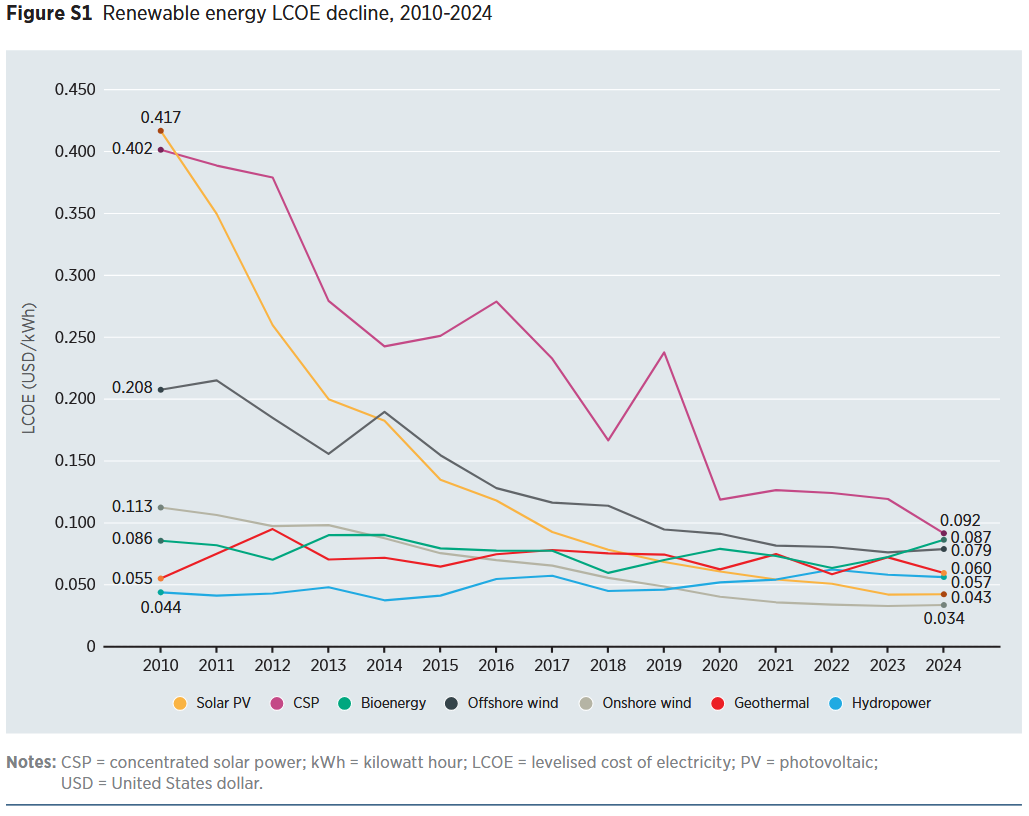
The significant reduction in the average cost of electricity since 2010 is clearly visible in the graph:
Source: irena.org.
“Fossil fuels are taking a back seat, and the sun is rising on the dawn of a clean energy era,” said UN Secretary-General António Guterres.
He added that for decades, emissions and economic growth have risen in parallel. But now, in many developed countries, emissions have peaked, while economic growth continues.
According to research, in 2023 alone, clean energy sectors accounted for 10% of global GDP growth and nearly 33% of growth in Europe.
Potential obstacles
IRENA Director-General Francesco La Camera warns that this progress is not guaranteed.
“Rising geopolitical tensions, trade tariffs, and restrictions on the supply of materials threaten to slow momentum and lead to higher costs,” he said.
These factors create risks that could temporarily increase costs.
The authors of the reports suggest that higher costs will persist in Europe due to structural problems: delays in obtaining permits for new projects and limited power grid capacity.
La Camera believes that in order to preserve the achievements of the transition to renewable energy, the world must strengthen international cooperation, ensure open and sustainable supply chains, and create a stable framework for policy and investment, especially in the Global South.
“The transition to renewable energy sources is irreversible, but its pace and fairness depend on the choices we make today,” he said.
The UN Secretary-General recalled that fossil fuels still receive almost nine times more government subsidies than renewable energy sources.
As EcoPolitic reported earlier, last year, renewable energy sources generated 47% of all electricity in the EU and became its leading source.