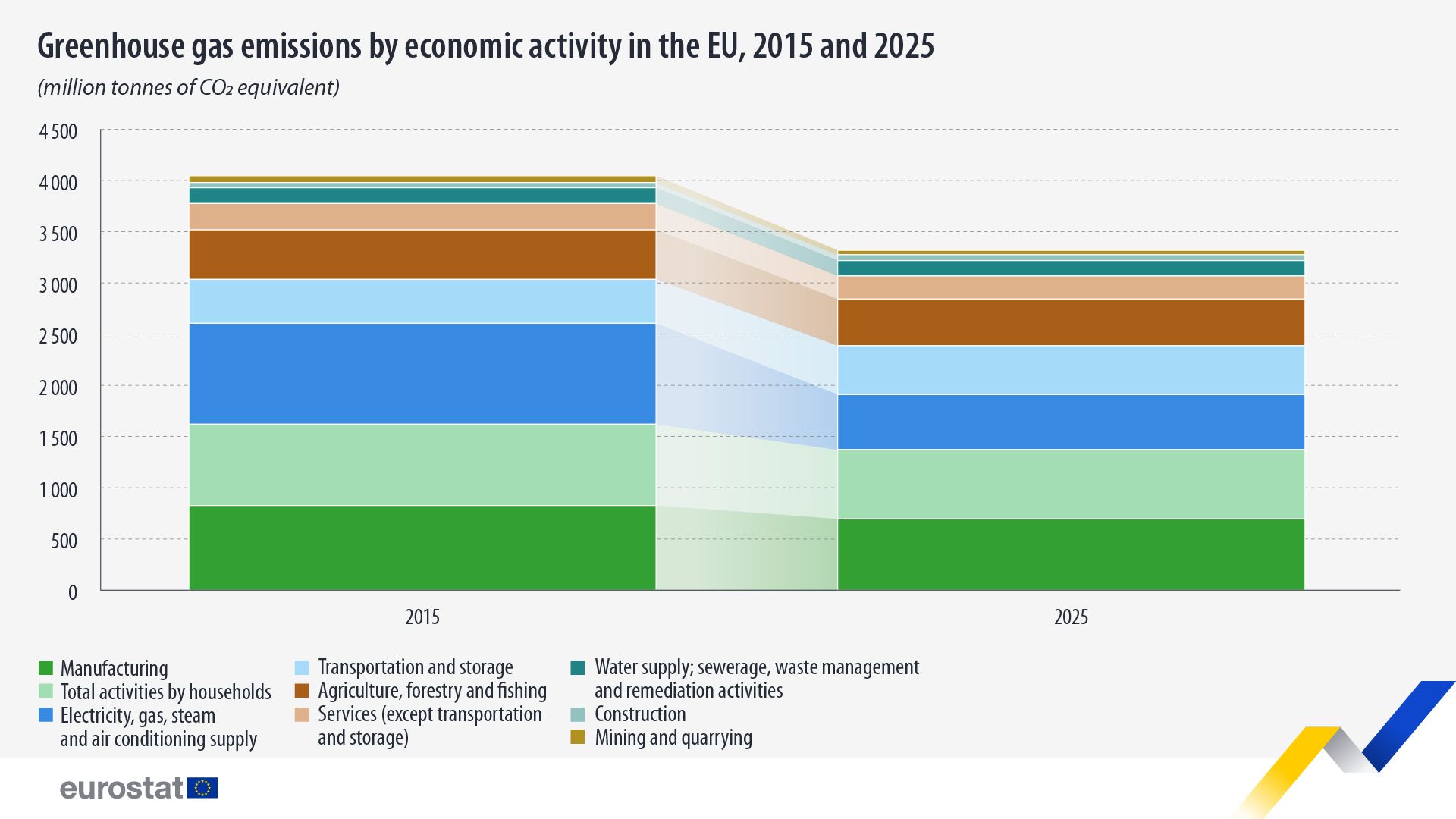
Throughout 2025, businesses and households in the European Union were responsible for emissions of 3.3 billion tonnes of CO₂ equivalent. This figure covers all types of activity and may seem staggering. However, according to the statistics, it is 17.2% lower than it was ten years earlier — in 2015.
This is reported by Eurostat, citing a preliminary report for 2025.
Trends by economic sector
Greenhouse gas emissions have fallen across most sectors. The energy sector led the way in terms of climate improvement, with emissions falling by 45.3 per cent. This refers to total emissions from the supply of electricity, gas and steam, as well as from air conditioning.
Over the same period, emissions from the mining industry fell by 33.3 per cent, from manufacturing by 16 per cent, from households by 14.7 per cent, and from the services sector by 11.9 per cent.
However, in two sectors, pollution levels actually rose. These were the construction sector, which saw an 11.4 per cent increase in emissions, and the transport sector, with a 10.9 per cent rise.
Country leaders
Between 2015 and 2025, emissions decreased in 23 European Union countries. The most positive trend was seen in Estonia, with a 41.7% CO2 reduction. Finland (-30.7%) and Germany (-27.3%) also ranked among the top three.
By contrast, four countries increased their greenhouse gas emissions over the decade: Romania (+5.4%), Lithuania (+9.5%), Cyprus (+10.7%), and Malta, which saw a staggering leap of +169.4%.
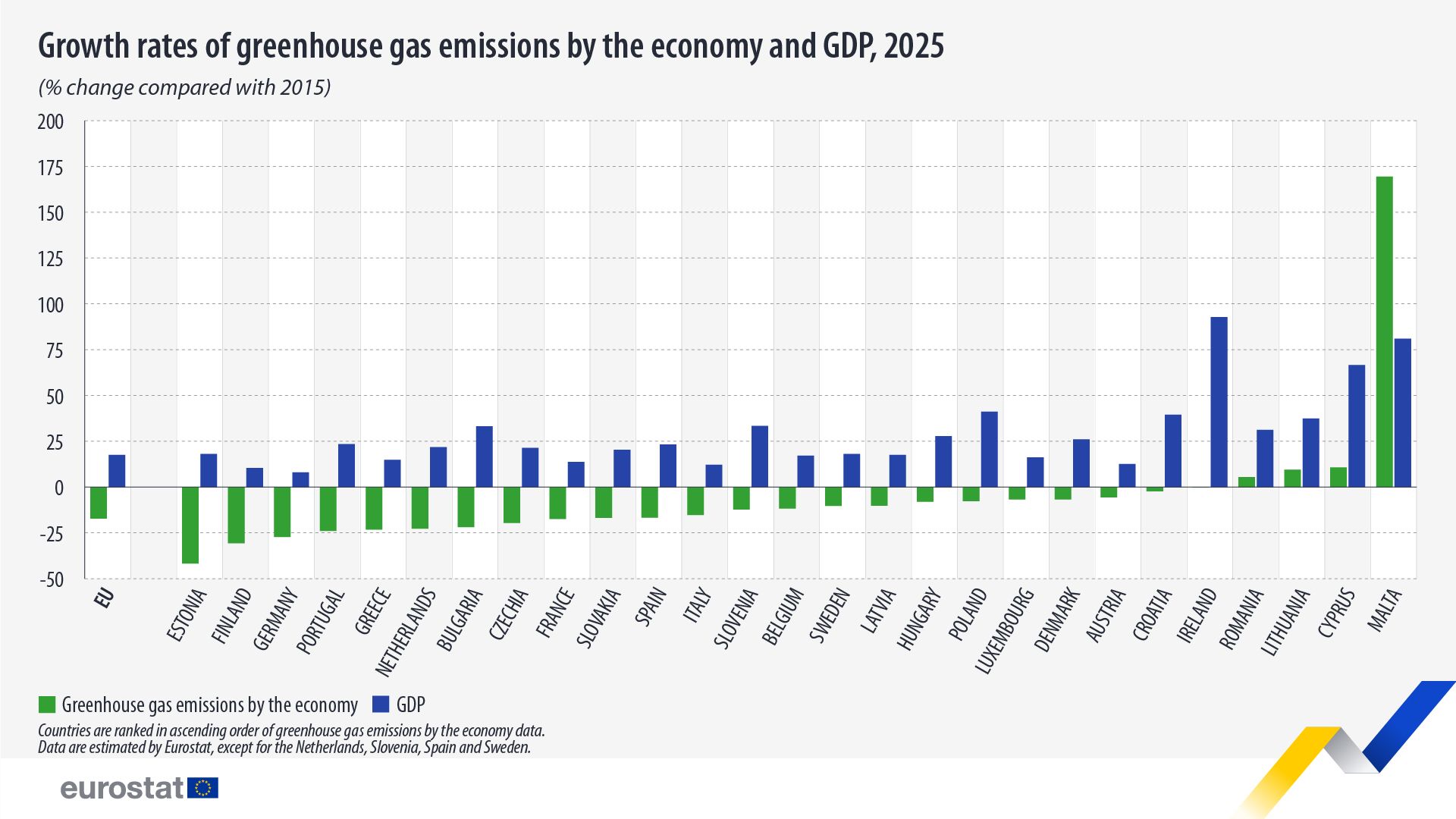
Source: Eurostat
EcoPolitic reported that the EU plans to reduce greenhouse gas emissions by 62% from 1990 levels by 2030. The goal for 2040 is a 90% reduction.
In sectors covered by the European Union Emissions Trading System (EU ETS), greenhouse gas emissions halved over 20 years.
Ukraine, for its part, has pledged to reduce CO2 emissions by more than 65% by 2035.