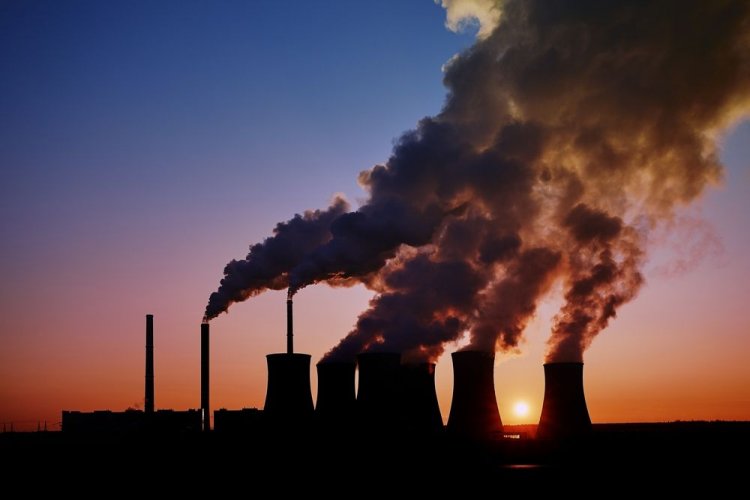
In the European Union, the share of lignite and hard coal in electricity generation is steadily declining. Whilst it stood at 30.4 per cent in 2000, it is projected to be just 9.2 per cent by 2025.
This is according to the latest data from Eurostat.
Last year, hard coal accounted for 3.7 per cent of the EU’s total gross electricity generation — 105.6 TWh. Lignite accounted for 5.5 per cent — almost 154.2 TWh.
Coal’s share fell below 10 per cent for the first time as early as 2024.
A steady decline
As far back as 1990, over a third of the EU’s total electricity was generated from coal. By 2000, this share had fallen slightly to 30.4 per cent.
The downward trend continued for virtually all subsequent years. A slight increase was recorded only in 2011–2012 and 2021–2022. By 2025, the share of coal had reached an all-time low.
By coal type
The EU uses hard coal and lignite for power generation. In 1990, they ranked second and third respectively in terms of energy output — 19.8 per cent and 15.3 per cent.
By 2025, these sources of power generation had slipped to sixth and seventh place. They are now surpassed by nuclear power, renewable sources and natural gas.
Both types of coal were overtaken by nuclear power in 1994, by natural gas in 2019, by hydropower and wind power in 2023, and by solar power in 2024.
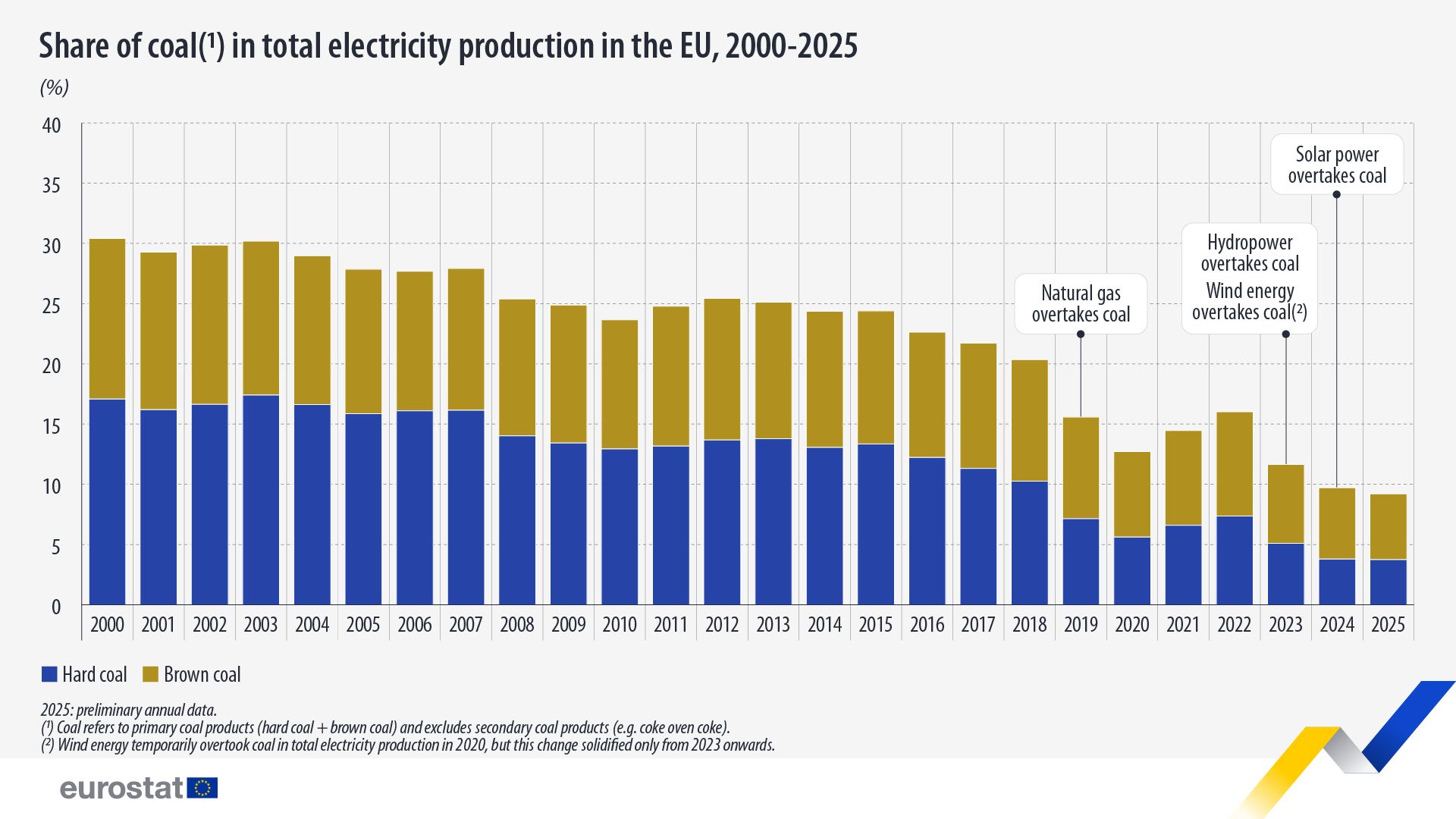
Джерело: Євростат
The path to complete withdrawal
Whilst the share of coal-fired power generation is falling, coal production and consumption are also declining. According to statistics, last year the European Union consumed just 107 million tonnes of hard coal and 180 million tonnes of lignite.
Some EU Member States are gradually phasing out the use of coal entirely. For example, in 2021, Portugal stopped using hard coal to generate electricity. In 2024, Slovakia ceased lignite mining.
EcoPolitic previously reported that even the fuel crisis caused by the war in the Middle East did not lead to a ‘renaissance’ of coal. Green energy helped to maintain the energy balance.