Despite the unstable geopolitical situation and renewed pressure on energy markets, global emissions trading continues to expand, firmly establishing itself at the center of global climate policy. In 2026, three new national systems will launch, existing systems will raise their ambitions, and record revenues will be directed toward the transition to clean energy and support for households.
These trends were identified by experts from the International Carbon Action Partnership (ICAP) in their report "Global Emissions Trading: ICAP’s 2026 Status Report."
ETS in numbers
- Currently, there are 41 emissions trading systems (ETS) operating globally, covering 26% of global greenhouse gas emissions.
- In addition to the existing systems, 16 more are in various stages of development or consideration worldwide.
- In 2026, three new national-level systems will be launched – in Japan, India, and Vietnam – while several others are under development, reflecting the spread of emissions trading across diverse economies and developmental contexts.
- ETS revenues reached a new record – nearly $80 billion in 2025, providing governments with the opportunity to stimulate the transition to clean energy and support affected households.
- ETS currently operates in 14 G20 countries – several of which have designated it as a central tool for achieving NDC 3.0 under the Paris Agreement.
- Jurisdictions using ETS together account for 63% of global GDP and cover more than half of the world’s population, positioning carbon markets at the heart of the global economy.
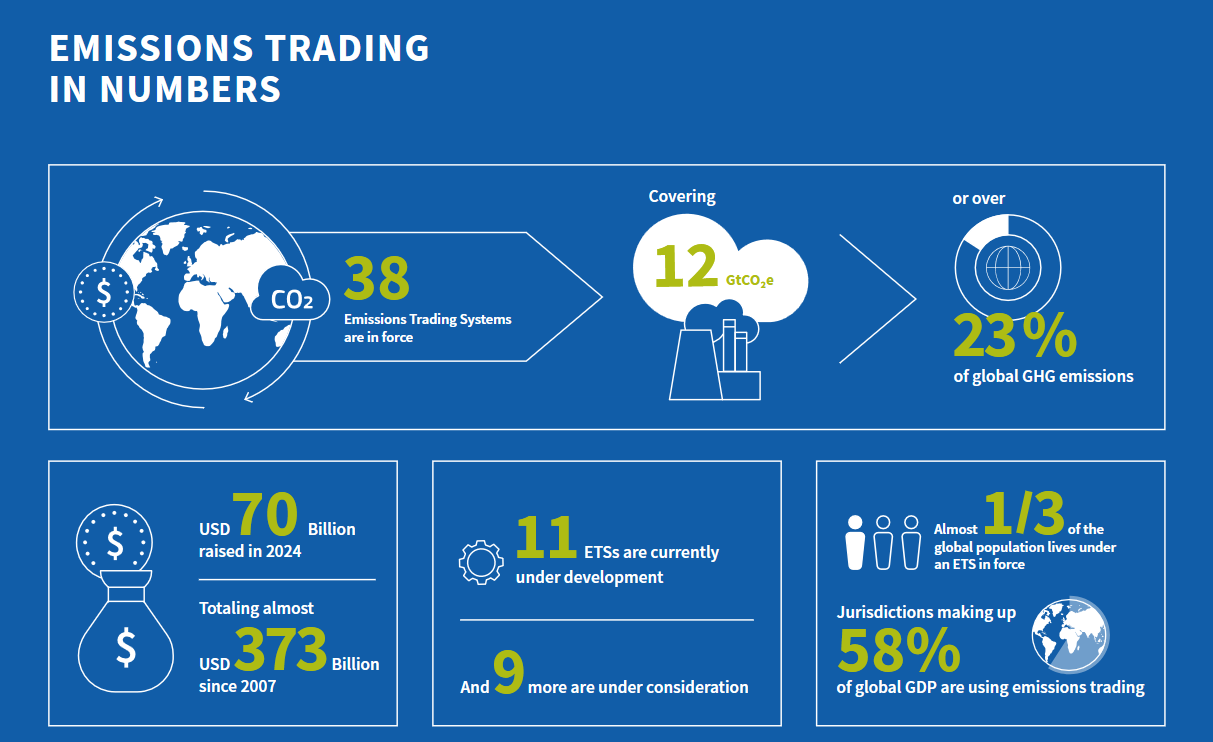
Source: icapcarbonaction.com
Key trends
ICAP analysts have noted that emissions quota trading has finally moved from a niche segment into the mainstream. Today's expansion of the market is primarily driven by large emerging countries with middle-income levels, particularly in Asia and Latin America:
- India and Vietnam are launching national systems this year, while Japan, which has operated a voluntary scheme for several years, is now implementing a mandatory national system.
- In Latin America, Brazil, Chile, and Colombia have adopted legislation on ETS and are preparing for its implementation, while Turkey, on Europe's doorstep, is finalizing preparations to launch its pilot system.
Many countries aim to introduce intensity-based models and define hybrid frameworks that integrate ETS, offset crediting, and carbon taxes into a single, coordinated policy architecture – each tailored to national conditions and objectives.
International cooperation is deepening, with new platforms for dialogue between jurisdictions and an increasingly shared understanding of best practice.
At the same time, existing systems are evolving with renewed momentum:
-
China has published landmark recommendations for moving its national ETS to absolute limits by 2027, with gradual expansion of coverage to all major industrial emitters.
-
Korea has entered a new, more intensive phase with the expansion of auctions and the introduction of a new market stability reserve.
-
California has legislatively anchored its system until 2045.
-
The European Union is preparing to launch ETS2 in 2028, which will cover buildings and road transport.
Experts note that, alongside these reforms, the EU CBAM system has entered the compliance phase, with the United Kingdom following its example. They are becoming a catalyst for more ambitious carbon pricing objectives in partner countries and are also prompting established systems to reconsider the long-term future of free allocation of allowances.
Given that the ETS system operates in 14 G20 countries and many of them cite it as a central tool for achieving NDC 3.0 in compliance with the Paris Agreement, carbon emissions markets are taking center stage in the decarbonization strategies of the world’s leading economies, analysts summarized.
Recently, EcoPolitic prepared material featuring experts' opinions regarding the new EU ETS benchmarks proposed by the European Commission for public discussion. It turned out that the debate around these indicators goes far beyond just the technical review of their values and formulas. It highlights an increasingly deep conflict between two approaches: the desire to protect the competitiveness of European industry and the need to maintain a strict climate signal to ensure the decarbonization of the EU economy.