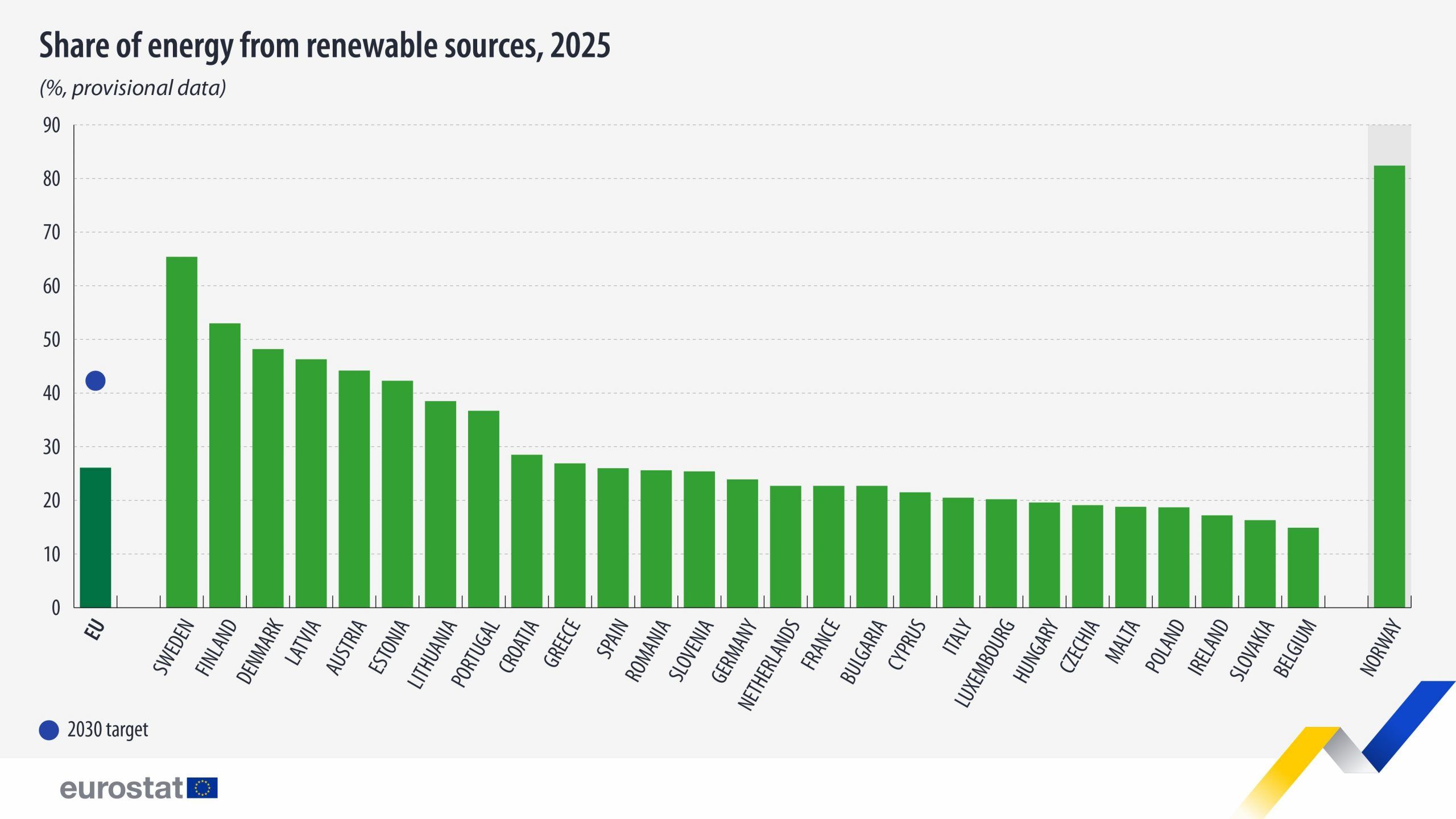
The share of ‘green’ energy consumed by European households in 2025 is estimated to have risen to 26.2 per cent. By way of comparison, in 2024 this figure stood at 25.2 per cent. Despite continuous growth, this is not enough – the European Union had planned to increase the share of renewable energy in final consumption to 42.5 per cent by 2030.
According to Eurostat data, to achieve the pan-European target for renewable energy consumption, it must grow by 3.3 per cent annually.
Trends across individual countries
The top three countries for ‘green’ energy consumption are all in northern Europe. Each has its own priorities among renewable sources:
- Sweden (65.4%) generated clean energy mostly from solid biomass, hydro, and wind power plants;
- Finland (53%) had a similar mix of top renewable sources, but wind power overtook hydro in final consumption;
- Denmark (48.2%) relied on solid biomass, wind, and biogas.
The smallest share of “green” energy in final consumption was recorded in Belgium (14.9%), Slovakia (16.3%), and Ireland (17.2%).
Source: Eurostat
Almost half of generated energy is green
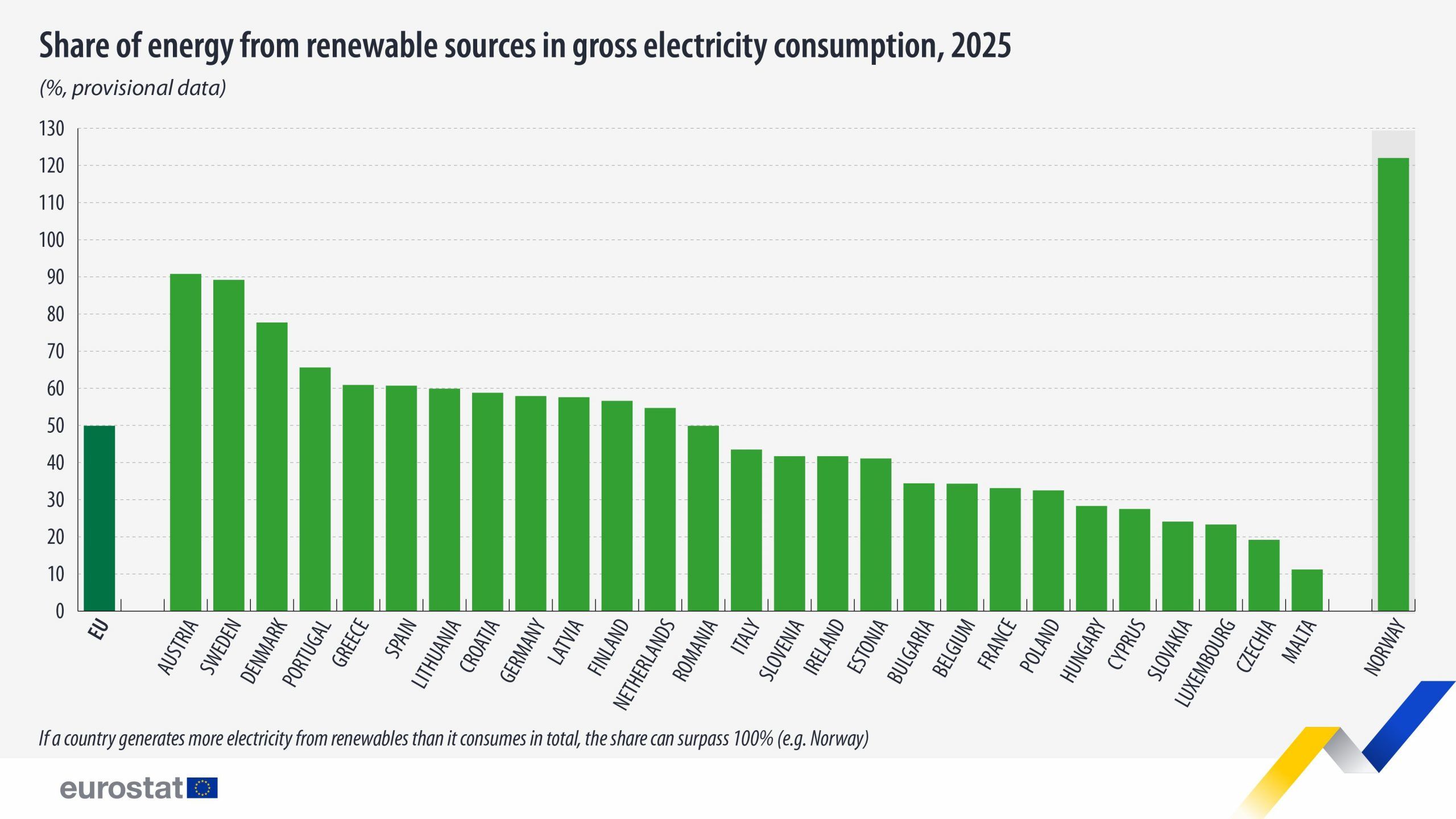
Renewable energy accounted for 49.9% of gross energy consumption in 2025, an increase of 2.4% compared to the previous year. In 2004, this share was 15.9%.
Austria (90.8%), Sweden (89.2%), and Denmark (77.7%) were among the leaders. The share also exceeded 60% in Portugal (65.6%), Greece (60.9%), and Spain (60.7%).
At the bottom of the list were Malta (11.2%), the Czech Republic (19.2%), and Luxembourg (23.3%).
Source: Eurostat
Growth slowdown
The use of clean energy for cooling and heating premises increased to 27.4% in 2025 – only 0.7% higher than in 2024. This increase is below the average annual growth rate from 2004 to 2025, which was 0.75%.
EcoPolitic previously reported that in June, solar became the leading source of energy for the European Union, surpassing all other types of generation – both renewable and fossil fuel-based.
Last year, renewable energy accounted for 11% of Ukraine’s total generation, with solar leading among all “green” sources at 78%.