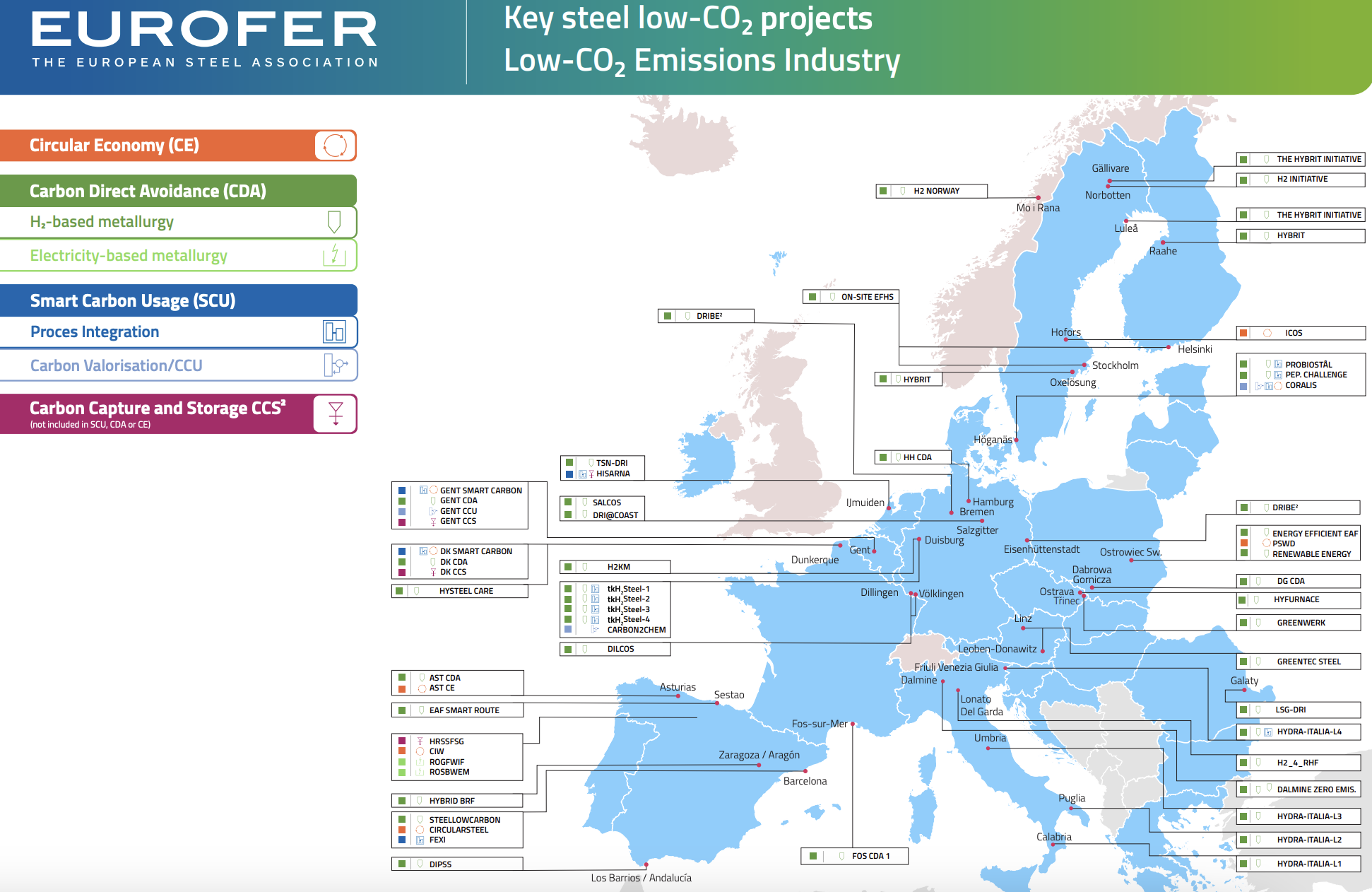
EUROFER specialists have developed a map of 60 key European low-carbon steel projects, reflecting their emission reduction potential, financing and energy needs.
The projects are due to be operational by 2030 and will potentially reduce the sector's annual carbon emissions by 81.5 million tonnes, EUROFER said.
The article emphasized that the EU steel industry must reduce carbon emissions by 55% by 2030 compared to 1990 levels, or by more than 30% from 2018 levels, and achieve climate neutrality by 2050.
It is noted that all these projects have a level of technological readiness of at least 7 out of 9 and will allow avoiding a third of direct and indirect emissions within 8 years.
EUROFER highlighted that the current financial needs up to 2030 amount to €85 billion, including €31 billion for capital expenditure (CAPEX) and €54 billion for operational expenditure (OPEX).
"The successful transition of the EU steel industry to CO2 neutral emissions by 2050 depends on the availability of competitive energy carriers with low CO2 emissions (especially electricity and hydrogen) and the appropriate infrastructure, in particular for the transportation and storage of CO2," the material explained.
It is noted that these projects will require about 165 TWh of decarbonized electricity per year until 2030, including 75 TWh of green electricity and about 2.12 million tons of hydrogen. This is equivalent to doubling the annual consumption of Belgium or doubling the existing electricity consumption of the EU steel industry. Currently, the industry consumes about 75 TWh of electricity, which is partly purchased from the external grid, and partly produced independently from process gases, as well as through overhead gas utilization turbines.
The article emphasized that among the energy-intensive industries, the metallurgical industry has suffered the most due to climate policy and has the greatest risk of carbon leakage.
"In this context, ensuring a level playing field with competitors from third countries is important for the transition to climate neutrality of this sector, – the authors emphasized. – The success of the above low-CO2 steel projects and their expected emission reductions require an enabling legislative framework that effectively addresses carbon leakage both during and after their implementation."
EUROFER will regularly update the project map, taking into account current developments.
Earlier, EcoPolitic wrote, that Europe has become a leader in ensuring carbon neutrality, and its metallurgical industry is at the forefront of building a sustainable economy.
As EcoPolitic previously reported, US Commerce Secretary Gina Raimondo said that the country's trade representative is negotiating with the EU and other trading partners to conclude a new agreement on environmental steel.