In the first four months of this year, European countries bought 24.4 GW of solar modules in China, which is half of what China exported (49 GW).
This was reported by the publication with reference to the consulting company InfoLink RenEn.
According to InfoLink, the volume of deliveries to Europe exceeded last year's figure by 144%, in which Europeans bought Chinese solar modules with a total capacity of 10 GW in the first third of the year.
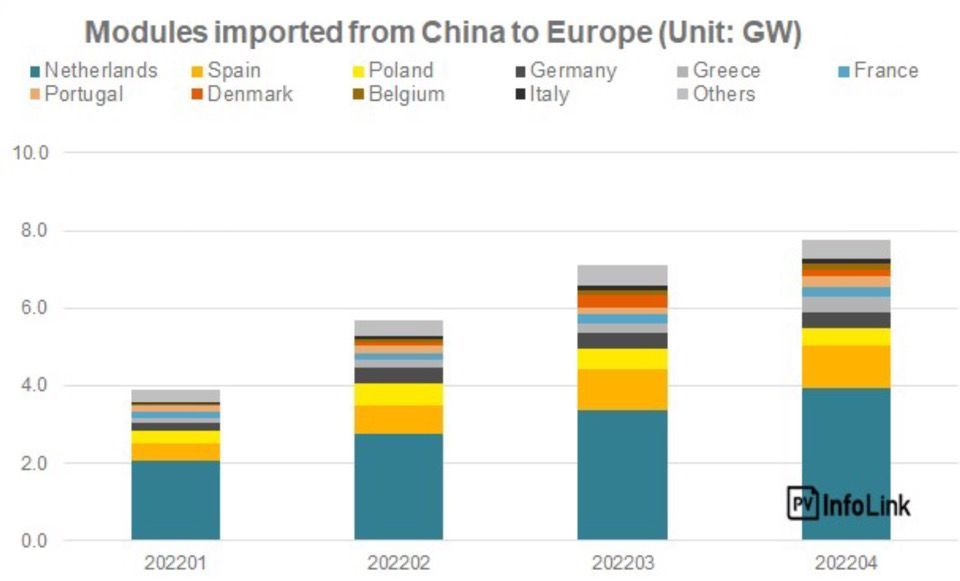
Photo: InfoLink
According to the latest data, Europe has become the largest buyer of Chinese photovoltaic products in the world. Despite rising prices in the solar supply chain, the number of modules exported by China to Europe has been growing every month.
"The shortage of fossil fuels resulting from the Russian-Ukrainian war is accelerating the energy transition and increasing the demand for photovoltaic energy," the InfoLink review said.
Meanwhile, the Netherlands, Spain, Poland and Germany each imported more than 1 GW of Chinese modules. It is noted that the Netherlands, a transportation hub for many European countries, is the largest importer, buying 12.1 GW of Chinese modules.
Spain took second place with 3.3 GW of imported solar panels. Poland and Germany imported 1.9 GW and 1.4 GW, respectively.
Before EcoPolitic reported that the European Union could set itself more ambitious goals for the transition to renewable energy sources, to abandon oil and gas imports from Russia as soon as possible.