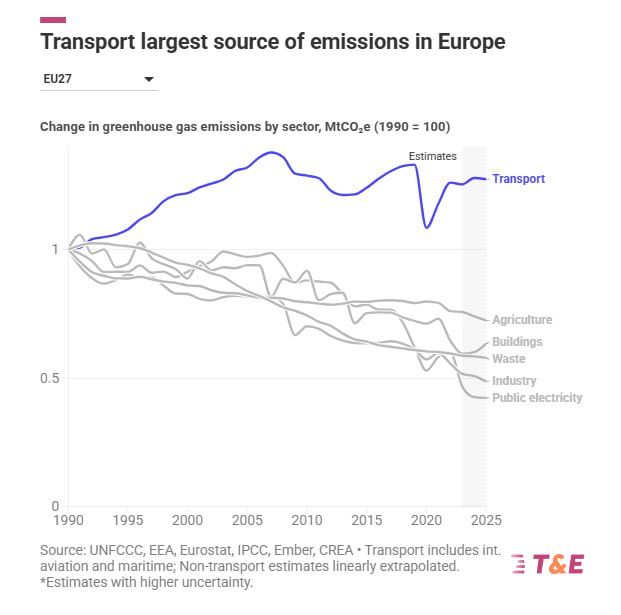
Transport remains the largest source of greenhouse gas emissions in Europe. Whilst sales of electric vehicles are extremely high in some countries, such as the Netherlands and Denmark, other nations are holding back this progress. At the same time, aviation accounts for a significant proportion of emissions, and its negative impact on the climate is becoming increasingly evident for most countries. Nevertheless, there is cause for optimism – the EU is capable of overtaking the leaders in transport electrification in just a few years.
This is evidenced by data from the analytical report ‘The State of European Transport’ by the European Federation for Transport and Environment (T&E).
Source: T&E
The main reason is oil
Virtually all greenhouse gas emissions in the transport sector result from burning oil and oil products.
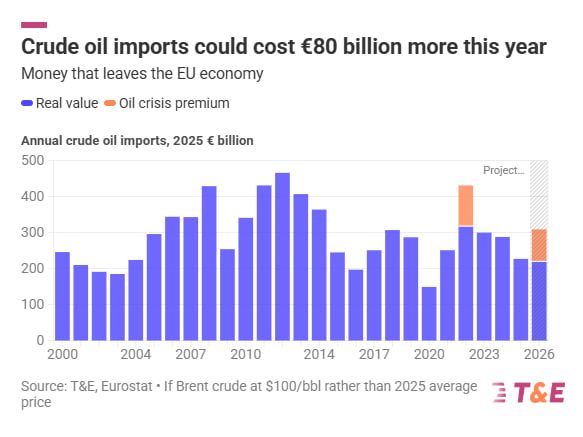
Meanwhile, Europe remains vulnerable-dependent on imported fuel. In 2025 alone, EU countries spent more than €220 billion on imported oil. In 2026, with rising prices, this figure could exceed €300 billion.
Source: T&E
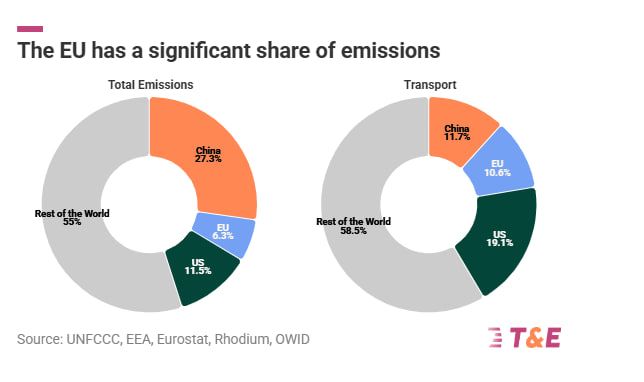
Despite significant efforts to reduce emissions, the European Union produces some of the world’s highest volumes of greenhouse gases-second only to China and the United States. While the EU accounts for 6.3% of global emissions overall, the share in transport reaches 10.6%.
Source: T&E
However, China’s smaller share of transport-related emissions compared to its total emissions should not be misleading. Even though electric vehicle sales are higher there, their charging remains “dirtier” than in the EU.
Leadership in electric transport
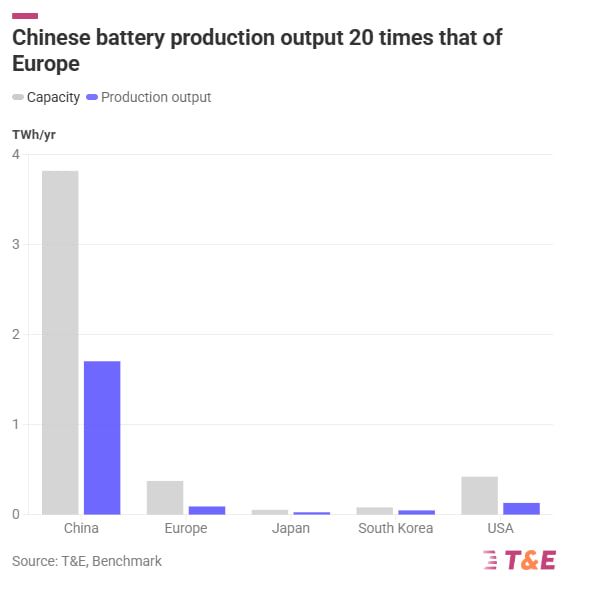
China is the clear leader here by a wide margin. The country produces 60% of the world’s electric vehicles. In the battery segment, volumes are 20 times greater than those of Europe.
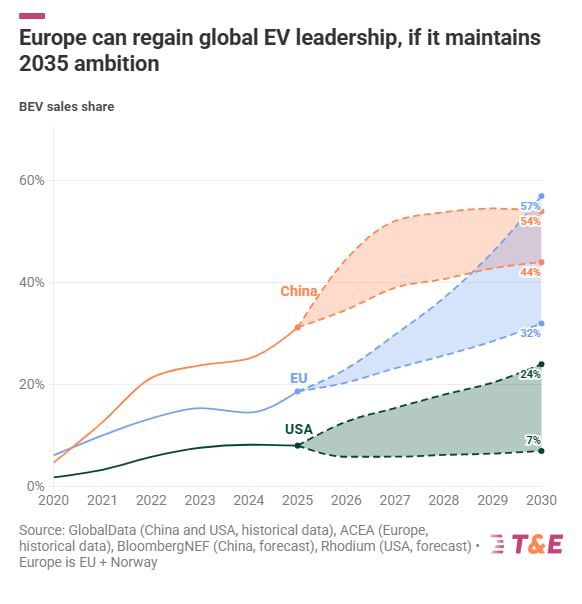
However, the situation in the EU is not so bleak. According to T&E forecasts, the bloc will need only three years to catch up with China. In 2025, electric vehicle sales in China accounted for 31% or 8.5 million vehicles; in the EU-19% or 2 million vehicles. And while it is difficult to compete with densely populated China in absolute numbers, the percentage share may well rise.
Source: T&E
The United States is slightly lagging behind the global pace. However, even there, by 2030 the share of electric vehicle sales will exceed 25%.
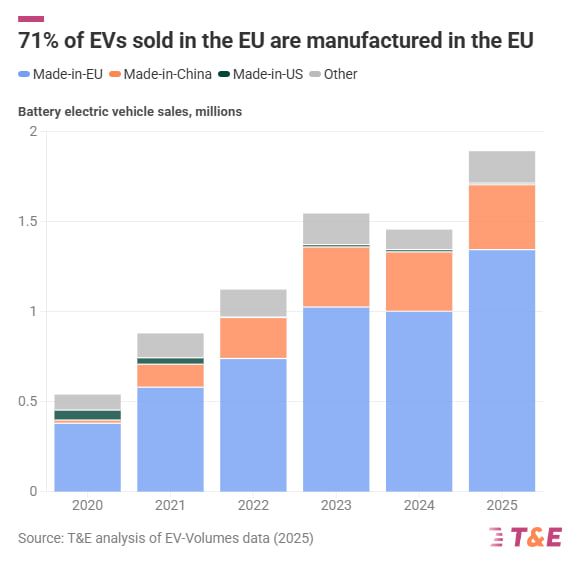
At the same time, Europeans continue to prefer predominantly European-made vehicles. Analysts attribute this to lower prices, a variety of options, and high environmental standards. Last year, 71% of electric vehicles sold in the EU were manufactured within the bloc. In the hybrid segment, the share of European automotive production was 64%, while Chinese brands accounted for 17%.
“European car manufacturers can use their domestic dominance as a springboard to sell electric vehicles in foreign markets. The transition to electric vehicles is a global shift not limited to China alone,” T&E noted.
Source: T&E
Battery production
The European battery market is also gradually strengthening, although it will never be able to catch up with China’s. Nevertheless, with competent EU policy and financial support, the sector could become one of the most critical in the 21st century.
Source: T&E
Electric Trucks
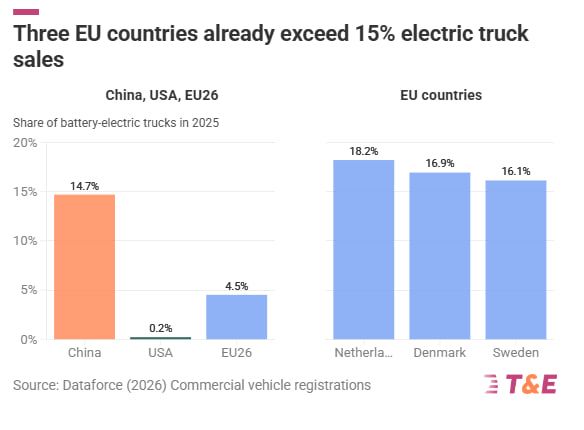
In absolute numbers, China also dominates this segment, but by percentage, individual EU countries even outperform it. In particular, Denmark, Sweden, and the Netherlands have a higher share of electric truck purchases than China.
Source: T&E
Aviation and Shipping
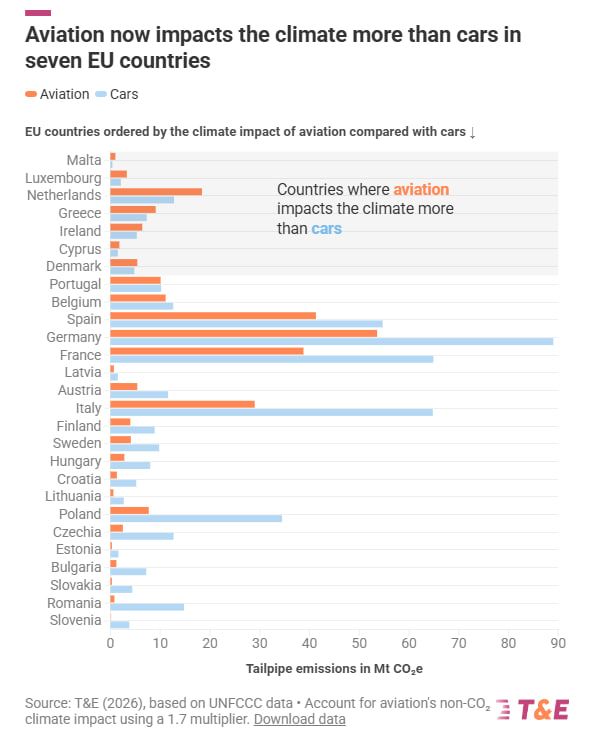
Already, air travel has a greater impact on the climate than road transport in seven EU countries: Malta, Luxembourg, the Netherlands, Greece, Cyprus, Ireland, and Denmark.
Source: T&E
The aviation segment remains the most challenging to decarbonize. Nevertheless, when it comes to sustainable aviation fuel (SAF) projects, the EU is a leader. Out of 64 large-scale SAF production projects, 41 are being implemented in Europe.
The EU also leads the world in the deployment and use of electric ships. In terms of gross tonnage, Europe has surpassed China, while the United States has dropped out of the race altogether.
T&E analysts note that the rapid decline in battery prices has made electrification increasingly attractive for short-distance transport. At the same time, the federation points out that electrification of port infrastructure will play a key role in decarbonizing shipping. For example, the EU’s clean shipping depends on shore-based supplies of “green” energy, where northern ports are significantly ahead of progress in other countries.
EcoPolitic previously reported that in seven years, electric car sales in the EU increased tenfold.
Meanwhile, in Ukraine, the electric automotive market has become isolated. After the reinstatement of VAT during customs clearance, imports dropped fourteenfold. Now, the market survives mainly thanks to the resale of used vehicles on the domestic market.