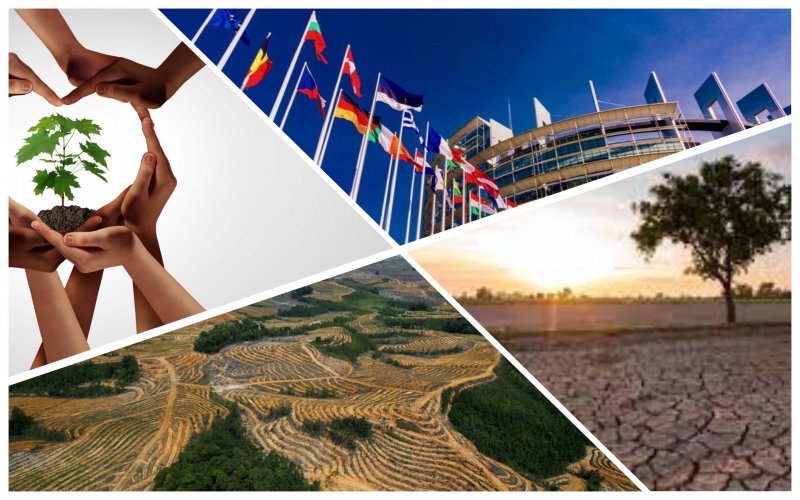
On Tuesday, December 6, the EU agreed to a new law that prohibits companies from selling in the block goods related to deforestation around the world, namely coffee, beef, soy, leather, etc.
Companies will have to report that their supply chains do not contribute to deforestation, reports Reuters.
If the law is officially approved by EU countries and the European Parliament, it could enter into force in 20 days, after which large companies will have 18 months to implement it, and smaller companies – 2 years.
The authors said that EU member states would have to carry out compliance checks on 9% of companies exporting from high deforestation risk countries, 3% from standard risk countries and 1% from low risk countries. The EU will work with affected countries to build their capacity to implement the rules.
Violators of the new rules will face a fine of up to 4% of the company's turnover in an EU member state.
The material emphasized that the destruction of forests is the cause of approximately 10% of global greenhouse gas emissions. This issue will be discussed at the UN COP15 conference, where countries will seek a global agreement to protect nature.
"I hope that this innovative regulation will give a boost to forest protection around the world and inspire other countries at COP15," said the chief negotiator of the European Parliament, Christoph Hansen.
The law will apply to the following goods:
- soy;
- beef;
- palm oil and its derivatives;
- wood;
- cocoa and coffee;
- skin;
- chocolate;
- furniture;
- rubber;
- charcoal.
The authors explained that companies will have to show when and where the goods were produced, as well as provide information that they were not grown on deforested land after 2020. Countries affected by the new rules, including Brazil, Indonesia and Colombia, say they are burdensome and expensive. Certification is also difficult to control, particularly as some supply chains may span multiple countries.
Environmental activists in Brazil, which is responsible for the largest deforestation, praised the law. However, they emphasized that it does not extend protection to wooded lands, where trees do not grow as densely as in the forest.
"This means that 600,000 km2 of forest in the Cerrado Savannah – Brazil's fastest-growing agricultural expansion frontier - is not subject to the law, according to the Brazilian non-profit Cerrados Institute," the article said.
However, the EU statement noted that after 1 year the bloc will review whether to add protection to "other forested lands" and after 2 years – other critical ecosystems.
The article highlighted that Brazil's Ministry of Foreign Affairs expressed concern that environmental protection could be used as a pretext for unilaterally imposing discriminatory trade restrictions. They await the publication of the full text of the law for further examination.
In addition, the country's coffee exporters' association, Cecafe, said it respects global environmental issues but is concerned that the industry's progress towards sustainable production is not being adequately recognised.
As EcoPolitic reported before, due to the Russian gas terror and the cold winter, the energy crisis is approaching Europe at an alarming rate. To survive this heating season, many European governments are simplifying logging regulations and encourage the heating of houses with firewood in every possible way.