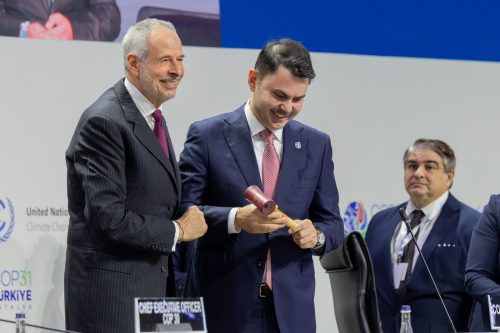
At the UN Climate Change Conference COP31, the Turkish-Australian leadership of the event proposed that countries jointly increase the share of electricity in global energy consumption to 35% by 2035. Earlier, EU member states reached a consensus and agreed to support the global electrification target, which has already been dubbed 35x35. However, in most countries even the very need to set a new target raised questions.
This was reported by Politico.
EU agreement
According to the outlet's reporting, the bloc was divided over whether it made sense to back the new target. However, three diplomats, speaking on condition of anonymity, said that a consensus had been reached during closed intergovernmental discussions.
However, this does not yet mean official support for the electrification target, as many bureaucratic procedures still have to take place for that.
As recently as Monday, there was no talk of unanimous support. Some countries did not want to take on external commitments before the EU's internal energy debate had taken shape. Others stressed that the target lacks specifics on the source of the required energy – renewables or fossil fuels.
A joint decision is still at risk
On Tuesday, 10 November, a ministerial-level meeting on the 35x35 target took place at COP31. So far, only a small number of governments have expressed direct support. According to one diplomat, it is about "a dozen".
The situation may change on 12 and 13 November, when presidents and prime ministers arrive at the conference.
Direct endorsement came from several developed countries and island states, as well as from countries involved in hosting climate summits. Among them are Germany, Norway and Ethiopia.
In turn, fossil fuel producers such as Saudi Arabia, or major polluters such as China and India, remained silent.
Others offered soft support for electrification as a theme of the event or made it clear that their support was conditional.
The main objections to the new target include its alignment with existing efforts to cut emissions, access to finance and whether it makes sense to take on new commitments at all.
The International Energy Agency, which co-organised Tuesday's ministerial meeting, called on countries to back the pledge.
EcoPolitic previously reported that the EU aims to triple its "green" generation capacity by 2030.
Meanwhile, Germany plans to completely phase out oil and gas by 2045.