Ukraine's environmental policy for the coming decades is being decided right now in strategic documents prepared by government institutions. These documents will shape not only environmental priorities, but also the country's economic development model.
EcoPolitic has prepared an overview of five fundamental documents that will determine the country's environmental development vector for years and even decades to come.
Long-term strategy for low-carbon development of Ukraine until 2050
This is one of our country's key climate documents. Its updated version began to be developed back in 2024 during the time of the Ministry of Environmental Protection and Natural Resources of Ukraine. The main elements of the Strategy were first presented at the international level at the UN Climate Change Conference (COP29) in Baku.
The main goal is to transition the economy to a low-carbon development model and achieve climate neutrality by 2050.
Development of the first version of the document: 2018.
Publication of the latest draft version: December 2025.
What the Strategy provides for:
- reduction of greenhouse gas emissions;
- development of renewable energy;
- decarbonization of industry;
- improvement of energy efficiency;
- development of innovative technologies;
- increase in carbon sequestration by natural ecosystems (including through afforestation).
Why this matters:
- fulfillment of Ukraine's commitments under the Paris Climate Agreement;
- alignment with the climate policy of the European Union;
- laying the groundwork for a "green" recovery of the economy after the war.
Three modeling scenarios
The Strategy considers three main scenarios that model different paths of economic development for Ukraine:
- The With Existing Measures scenario (WEM) reflects the emissions trajectory in the absence of any new climate policies after 2025.
- The With Additional Measures scenario (WAM) envisages the implementation of ongoing plans, such as modernization of heat supply and improvement of energy efficiency, as well as the realization of planned but not yet implemented measures.
- The Net-Zero Emissions scenario (NZE) enables Ukraine to achieve climate neutrality, taking into account absorption from the land use and forestry sector, which is forecasted to increase to 30 million t per year.
Forecast figures for 2050
- Under the WEM scenario: emissions could amount to 285.4 million t CO2-eq, or 31.1% of the 1990 level.
- Under the WAM scenario: Ukraine could cut emissions to 92.0 million t CO2-eq by 2050, or 10.0% of the 1990 level.
- Under the NZE scenario: achieving climate neutrality.
Amendments to the Law of Ukraine "On the Basic Principles (Strategy) of the State Environmental Policy of Ukraine for the Period until 2030"
This is a framework document that defines the direction for the country’s environmental protection activities and use of natural resources, as well as the trajectory of environmental reforms.
Approval of the previous version of the document: 2024.
Start of work on amendments: December 2025.
The draft document is still being worked on and has not been presented to the public.
Why amendments are needed
The document is planned to be updated to:
- bring Ukrainian legislation in line with EU environmental law;
- integrate the principles of “green” recovery into strategic documents;
- take into account the environmental consequences of the war;
- ensure the integration of environmental protection priorities into sectoral policies;
- add clear effectiveness indicators needed to evaluate the results of such measures and attract international financial support;
- establish a modern European environmental governance framework;
- integrate new environmental management tools.
Strategy for the Development of a Circular Economy in Ukraine until 2035
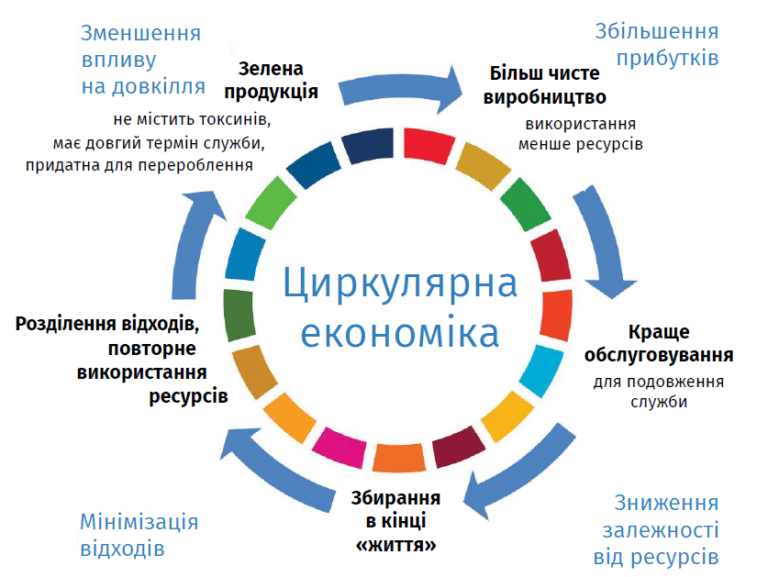
This Strategy aims to change the very model of the country’s economic development: we must shift from a linear economy (“take – use – dispose”) to a circular economy (“make – use – reuse – recycle” and so on in a continuous cycle).
The European Union adopted its own Circular Economy Action Plan in 2020.
Source: recpc.org
Publication of the latest version of the draft: January 2026.
Why Ukraine needs this document
The circular economy is one of the key concepts of the European Green Deal.
The essence of the approach
Instead of the “take – use – dispose” model, a system is proposed where:
- resources are reused;
- waste is converted into new raw materials;
- products are designed for longer service life.
Strategic objectives:
- development and harmonization of legislation for EU integration;
- business development;
- public awareness and corporate social responsibility;
- promotion of innovative development and the “green” transition.
Main operational objectives:
- reducing the amount of waste generated;
- development of reuse and recycling;
- increasing the resource efficiency of the economy;
- adaptation and adoption of the EU regulatory framework;
- achieving by 2027 a share of recycled waste in the total waste generated of 15%;
- development of the circular bioeconomy;
- reduction of electronic waste generation;
- creation of a market for secondary construction materials;
- implementation of circular public procurement.
Plans in numbers
The infographic below shows the main indicators the state plans to achieve by 2035; more detailed explanations are provided beneath it.
In our opinion, these declared intentions are very ambitious given that for almost four years now, officials in the environmental sector have not been able to resolve even the waste management reform.
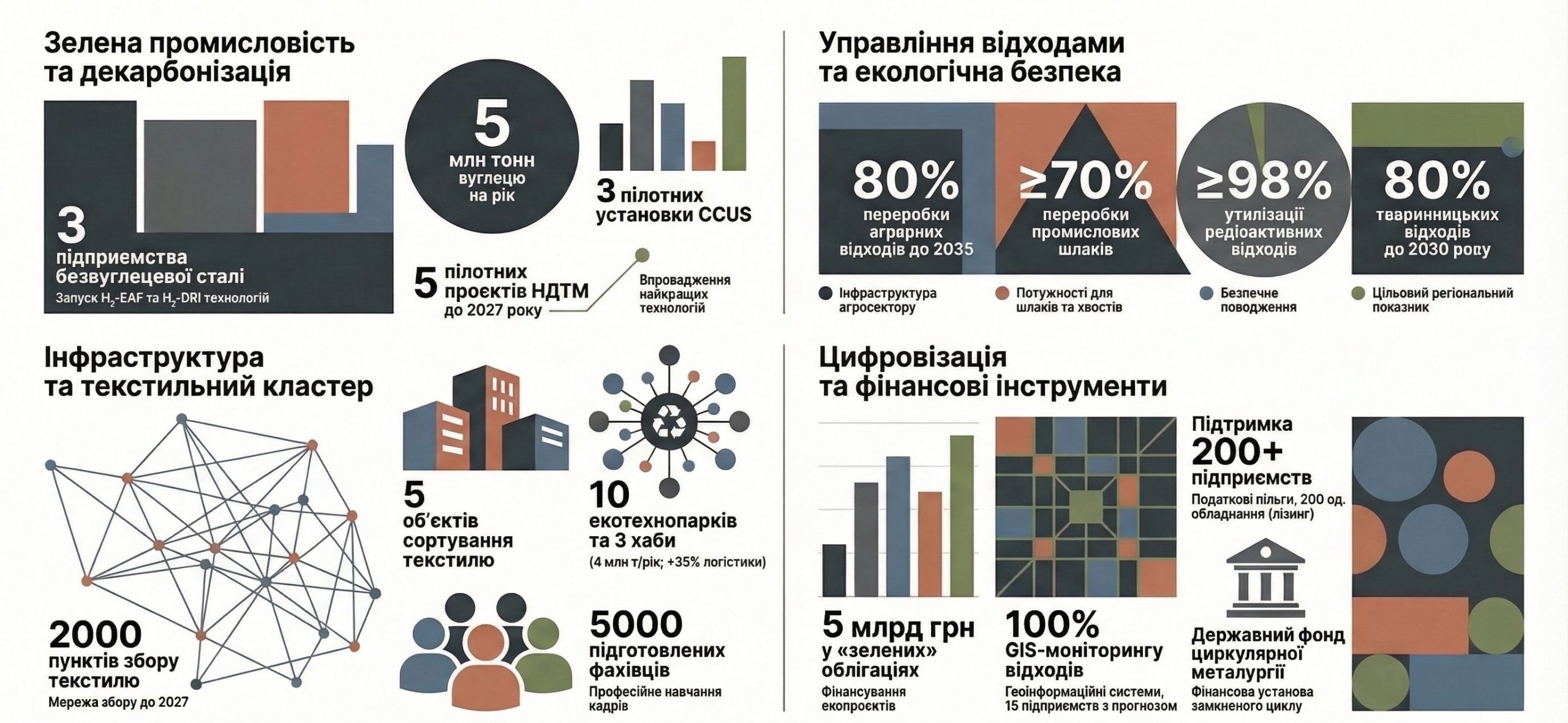
“Green” industry and decarbonization:
- Launch at least 5 pilot projects for the implementation of Best Available Techniques and Management Practices (BAT/BEP) by 2027.
- Introduce an online biofuel trading platform, with at least 50% of biofuel producers registered on it by 2027, and increase biofuel usage by 30%.
- Launch at least 3 facilities using H₂-EAF and H₂-DRI technologies, enabling near-zero carbon steel production.
- Install 3 pilot carbon capture, utilization, and storage (CCUS) units with a capacity of 5 million t/year.
- Establish a State Circular Metallurgy Fund, issue “green” bonds worth 5 billion UAH, grant tax incentives to over 200 enterprises, and implement compensation and leasing mechanisms for 200 units of equipment.
Waste management and processing:
- By 2030, process at least 80% of livestock waste in the target regions.
- By 2035, create infrastructure for processing agricultural waste, covering 80% of the agri-industrial sector's needs.
- By 2027, establish at least 2,000 textile collection points.
- The share of recycled raw materials in textile production should reach at least 30% by 2030.
- Establish and modernise at least 5 facilities for sorting and processing textile waste.
- Develop capacity to process ≥70% of slags and tailings.
- Safely dispose of ≥98% of radioactive waste.
- Create 3 industrial hubs with a total capacity of 4 million t/year, logistics hubs for scrap collection (with a 35% increase in scrap collection), 10 ecotechnoparks, and train 5,000 specialists for them.
- Achieve GIS monitoring coverage of 100% of all waste.
Certification and licensing:
- certify 70% of total steel production;
- issue 100% of new licenses in line with “green” criteria and update the conditions of 85% of current licenses;
- implement predictive analytics at 15 enterprises.
Why this matters
The transition of Ukraine to a circular economy will help:
- reduce the environmental burden on ecosystems;
- lower environmental risks;
- increase the competitiveness of Ukrainian companies;
- integrate Ukraine into the EU;
- shape a new model of economic development;
- support the post-war recovery of the economy.
Update of the National Energy and Climate Plan (NECP) for the period up to 2030
This is a strategic document in the field of Ukraine’s energy transition. It determines the pace at which Ukraine will reduce emissions, develop renewable energy, and increase energy efficiency.
It is a key tool for achieving climate neutrality and energy security, in line with the requirements of the European “Green Deal.” The plan must be aligned with the country’s Long-term Low Emission Development Strategy.
Updating the NECP was one of the recommendations made by the European Commission in its Report on Ukraine’s progress within the EU Enlargement Package for 2025. The Ukrainian government has heeded the opinion of its partners and earlier this year established a unified procedure for preparing this document, which stipulates its revision every five years.
Approval of the previous version of the document: June 2024.
Publication of the latest draft version: January 2026.
What the NECP Covers
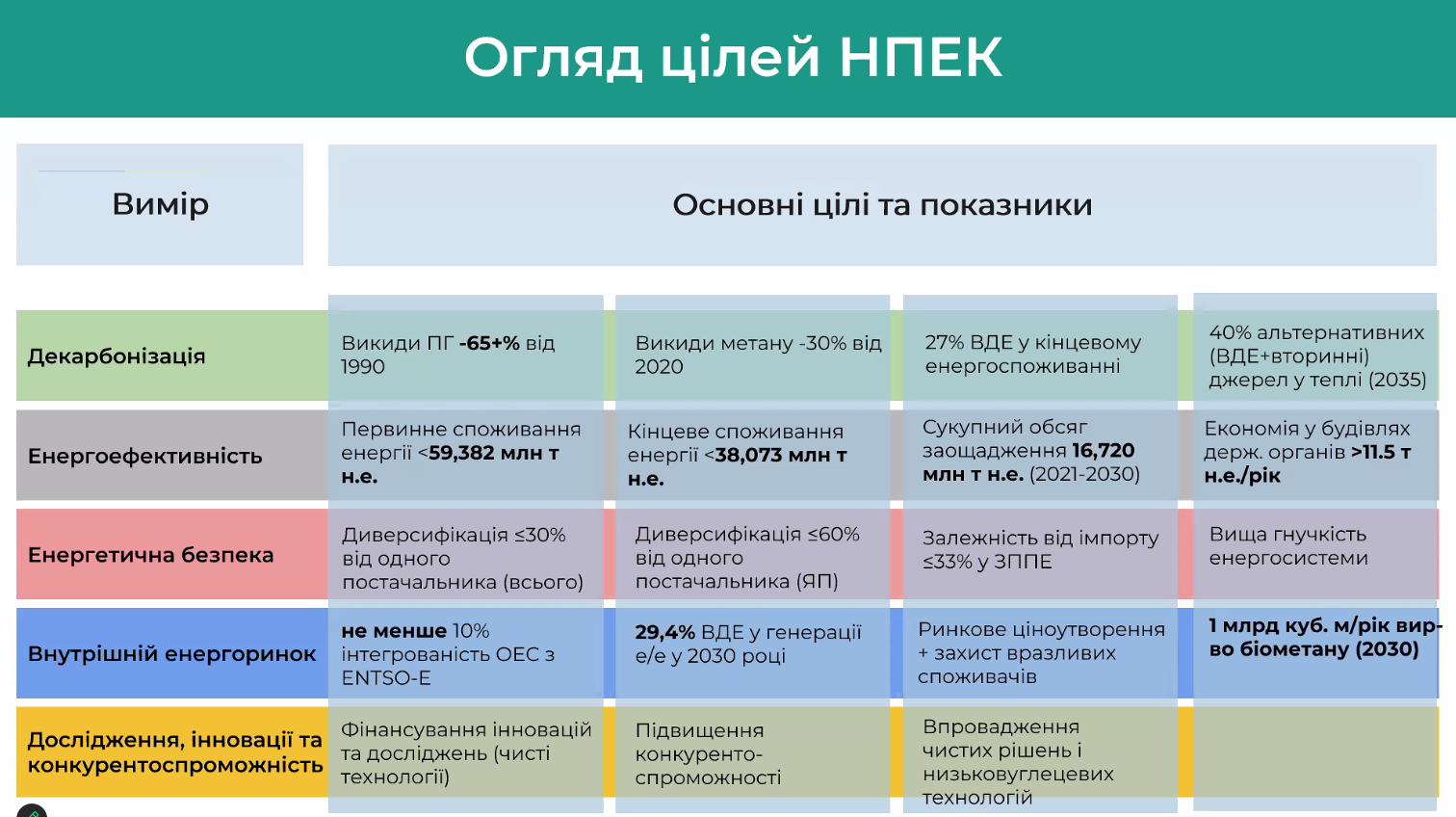
The document sets targets in the following areas:
- decarbonisation;
- energy efficiency;
- energy security;
- internal energy market;
- research, innovation, and competitiveness.
The NECP’s update requires making changes across all five dimensions.
Source: presentation of the updated NECP by the think tank Dixi Group
Why this document is important:
- it forms part of Ukraine’s international obligations, in particular as part of the Ukraine Facility program;
- defines medium-term objectives for state climate policy;
- synchronizes national and European policies.
Why it is being updated
Experts from Dixi Group note that Ukraine’s case is unique because the country is updating its NECP already after the first year of implementation.
The plan is being adjusted to:
- Take military realities into account. In particular, the first version of the NECP could not fully reflect the scale of destruction and damage to the energy system that occurred during 2024–2025.
- Align the NECP with new key documents adopted in Ukraine after the first version of the plan, including the framework Law “On the Fundamentals of State Climate Policy” and the State Target Program for the Just Transformation of Coal Regions until 2030.
- Update targets and data on decarbonisation.
- Secure international funding and attract investment.
- Accelerate the energy transition and enhance energy security.
Biodiversity Conservation Strategy of Ukraine until 2035
The main goal of this document is to protect Ukraine’s natural ecosystems and biodiversity. The Strategy is based on the Kunming-Montreal Global Biodiversity Framework and its 23 global targets for urgent action described therein.
The European Commission, in its “Ukraine 2023” report, stressed that domestic policymakers need to draft this visionary document.
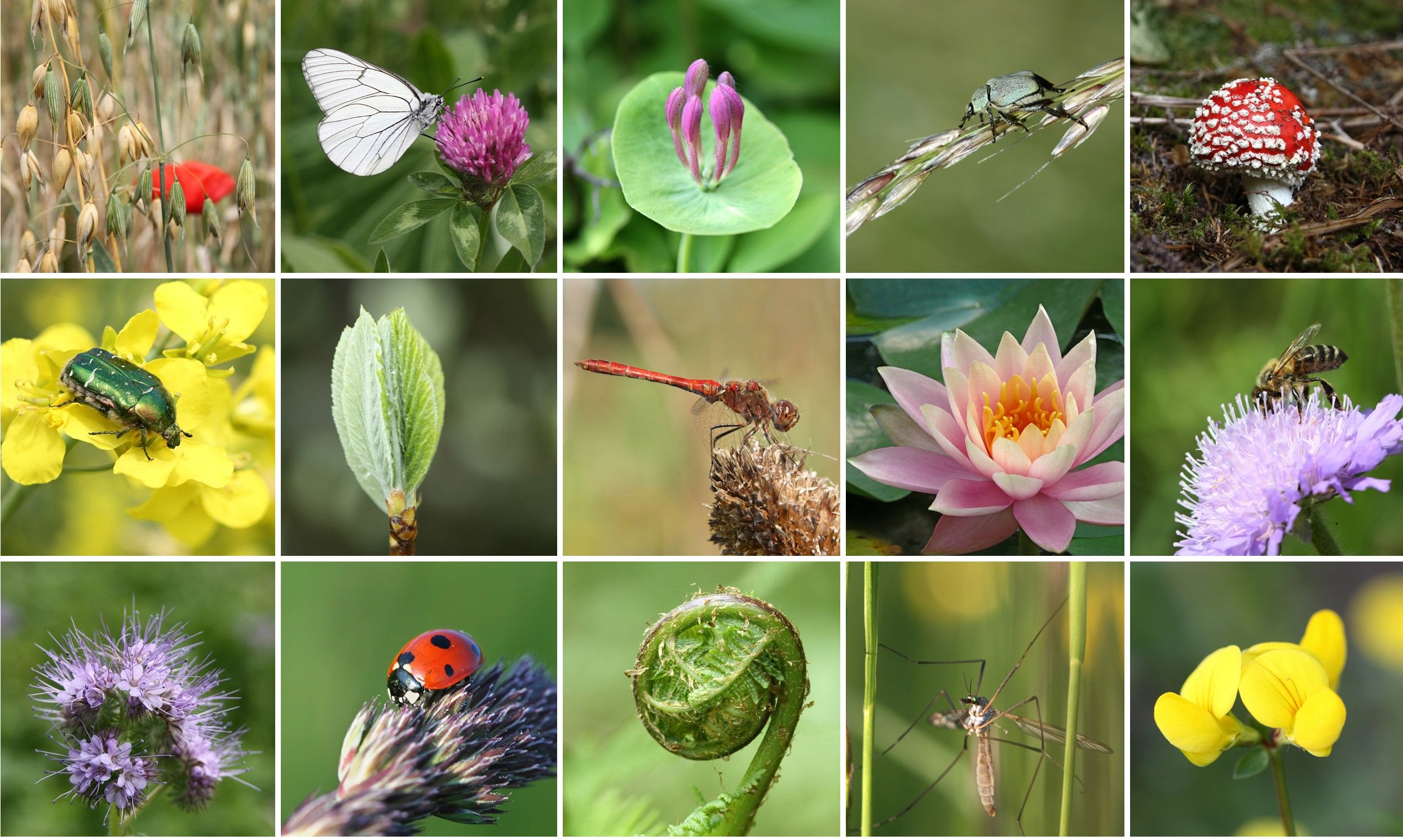
Start of work: August 2024.
Publication of the draft document: December 2025.
The draft Strategy contains 23 strategic goals and an Operational Plan for their implementation during 2026–2028.
Main tasks:
- ensuring the protection, conservation, restoration, and sustainable use of biodiversity;
- prevention of the destruction and degradation of natural landscapes and ecosystems, their protection, restoration, maintenance of integrity and resilience;
- reducing the negative impact of pollution and climate change on biodiversity;
- preventing the introduction of invasive alien species into Ukraine's natural environment;
- supporting and preserving the genetic diversity of species and their adaptive potential;
- developing a national ecological network, restoring and expanding the area of valuable natural territories and sites;
- ensuring the protection of animal and plant species as well as their natural habitats.
Why this is relevant
The war has caused significant damage to Ukraine's natural environment, making the issue of ecosystem and biodiversity restoration particularly important. Moreover, Ukraine has committed itself to aligning its legislation with international and European standards for the protection of wildlife, including within the framework of accession to the EU.
In fact, Ukraine now faces the task of designing a new architecture for environmental and climate policy. This must combine economic recovery, integration into the EU, and the protection of natural resources. The content and practical implementation of these strategic documents will determine the country’s development over the coming decades.