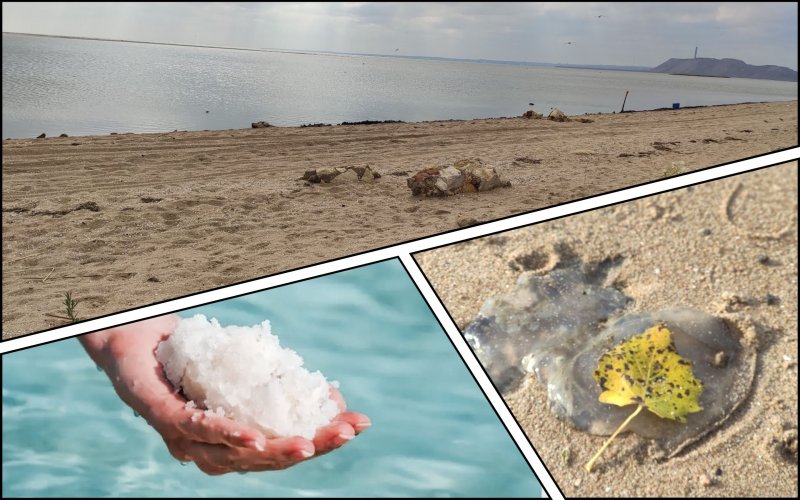
Russian scientists have confirmed the rapid increase in the salinity of the Sea of Azov, which has almost equaled the indicators of the Black Sea.
They warn of an approaching eco-catastrophe and anomalous mass reproduction of jellyfish, reports the adviser to the mayor of Mariupol Petro Andryushchenko in Telegram.
"The Russians spent a lot of resources and airtime to refute our claims about ecocide – And now the Russian institutions themselves say that it's a disaster. That the salinity of Azov is equal to the salinity of the Black Sea."
Andryushchenko emphasized that the salinity of the Sea of Azov increased rapidly due to the blocking of rivers during the occupation. This led to an abnormal distribution of jellyfish in October.
He added that the consequence of ecocide will be the destruction of flora and fauna of the sea. This repeats the trend of destruction of the Caspian and Aral seas.
As you know, the salinity of the Black Sea reaches 18‰ (ppm) , the Sea of Azov – 10–12‰.
Earlier, Ecopolitic wrote, that in occupied Mariupol, local residents recorded an invasion of jellyfish in October, which is absolutely not characteristic of the Sea of Azov. The likely reason for this was a three-fold decrease in the flow of fresh water into the Sea of Azov.
As EcoPolitic reported earlier, in occupied Mariupol, the Kalchika River was completely filled in with slag in the area of the destroyed bridge on Kuindzhi Street. Earlier, the occupiers filled Kalchyk near the Extreme Park, and the water pipe was routed through a pipe.