Ineffective functions of the EcoSystem, protracted procedures, and discrepancies between old and new classifications — businesses face a number of obstacles simply in carrying out their waste management activities. The Ministry of Economy has put forward its vision for removing some of these obstacles in a draft resolution ‘On Amendments to Certain Resolutions of the Cabinet of Ministers of Ukraine in the Field of Waste Management’.
EcoPolitic reports on the key changes following the presentation of the document, which was held by the Ministry of Economy and the Environment on 2 September.
New deadline for obtaining a permit
On Friday, 4 September, a two-year pilot scheme under which businesses were able to carry out safe waste treatment operations without special permits comes to an end.
However, by now, far from all businesses have managed to complete the environmental impact assessment procedure and obtain the permit that was supposed to allow them to operate once the trial period had ended. On the one hand, the procedure is very lengthy and bureaucratically cumbersome due to the need to resubmit all documents from scratch even for the slightest amendment. The Ministry acknowledges this problem and is therefore preparing technical updates and corresponding amendments to the Law ‘On Waste Management’. However, on the other hand, not even all businesses have begun the EIA procedure over the past two years.
The Ministry is proposing to give businesses a further seven months to complete the necessary procedures. The document introduced amends Government Resolution No. 1328 ‘On the Approval of the Procedure for the Issuance, Refusal to Issue and Revocation of Permits for Waste Treatment Operations’. The deadline by which participants in the pilot scheme must obtain a permit for waste treatment operations is 1 April 2027.
"This is the time for them [businesses] to submit their applications and begin the EIA procedure in order to obtain a permit in accordance with the established procedure. To be perfectly clear — this is the final extension," emphasised Olena Kalashnyk, head of the Ministry’s Department for Waste Management.
Самостійне визначення кодів відходів
Новою постановою Мінекономіки хоче розв’язати й іншу актуальну проблему — невідповідність класифікації процедур поводження з відходами до та після набуття чинності Законом "Про управління відходами". Щоправда, це розв’язання віддають на відкуп самим суб’єктам господарювання.
Колізія полягає в тому, що встановлення нових законодавчих правил у 2023 році змінило класифікацію операцій. Тож у виданих до того часу висновках з ОВД вона є застарілою. Наприклад, раніше діяв термін "утилізація", який охоплював низку нині окремих процесів.
Мінекономіки залишає такі висновки ОВД чинними й актуальними для отримання дозволу на оброблення відходів. Однак відповідальність за те, що визначені операції та коди відповідають нинішній діяльності, має взяти на себе суб’єкт господарювання. Тобто поданням такого висновку бізнес підтверджує, що нічого не міняв і не додавав до своєї діяльності інших операцій. Відповідну норму пропонують внести до постанови № 1328.
Ця пропозиція здалася учасникам зустрічі доволі спірною. Зокрема президентка Асоціації професіоналів довкілля (PAEW) Людмила Циганок наголосила, що це — перекладання відповідальності на підприємства, звернувшись із запитом на оприлюднення офіційного механізму зіставлення старих кодів і операцій із новою класифікацією.
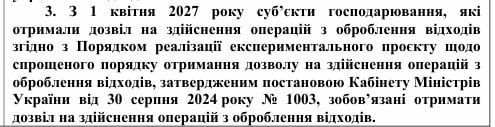
Фрагмент порівняльної таблиці до проєкту постанови
Reclassification as by-products
The current procedure for classifying substances and items as by-products involves the use of a waste management information system. However, the By-product Register is not yet operational.
In order to avoid creating an additional obstacle, the new resolution aims to allow the necessary data to be submitted in paper form until the Register becomes operational. The relevant amendments will be made to Cabinet of Ministers Resolution No. 1214, ‘Certain Issues Concerning the Classification of Substances or Articles as By-products’.
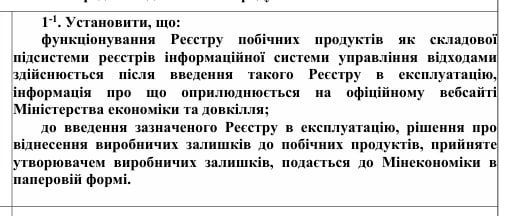
Фрагмент порівняльної таблиці до проєкту постанови
Transboundary transport of waste
In Ukraine, there is a regulation stipulating that, for waste to be exported across the border, the competent authority of the country of origin must confirm that it lacks the capacity to process this waste itself.
However, in practice, the production activities of enterprises require materials that can be processed in the country of origin. This applies in particular to RDF.
The new resolution therefore aims to clarify this provision in Resolution No. 1067, specifying that it applies only to hazardous waste.
Business challenges
The most pressing concern among business owners relates to the environmental impact assessment procedure. Business representatives are complaining en masse about the length of the process. At the same time, representatives of businesses located near the front line and those that have been relocated are asking for the process to be postponed until the end of the state of emergency.
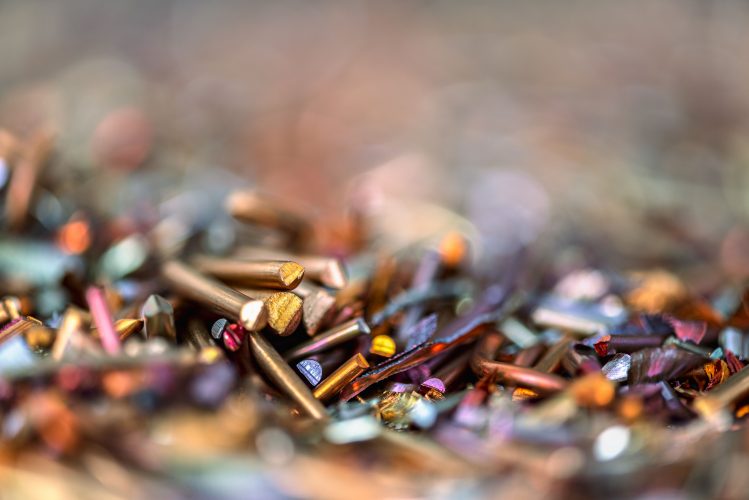
There are also concerns regarding its overall feasibility, particularly for businesses that collect and sort scrap metal without processing it. Given the damage suffered by the main enterprises that accept scrap metal – namely ‘Zaporizhstal’ and ‘ArcelorMittal Kryvyi Rih’ – businesses regard spending hundreds of thousands of hryvnias on the EIA procedure as a direct threat to their operations.
Deputy Minister for the Economy Oleksandr Krasnolutskyi emphasised that matters relating to the State Environmental Service do not fall within his remit, but that comments from the business community would be forwarded to the relevant deputy minister.
As reported by EcoPolitic, the Waste Management Act was passed in June 2022 and came into force a year later.