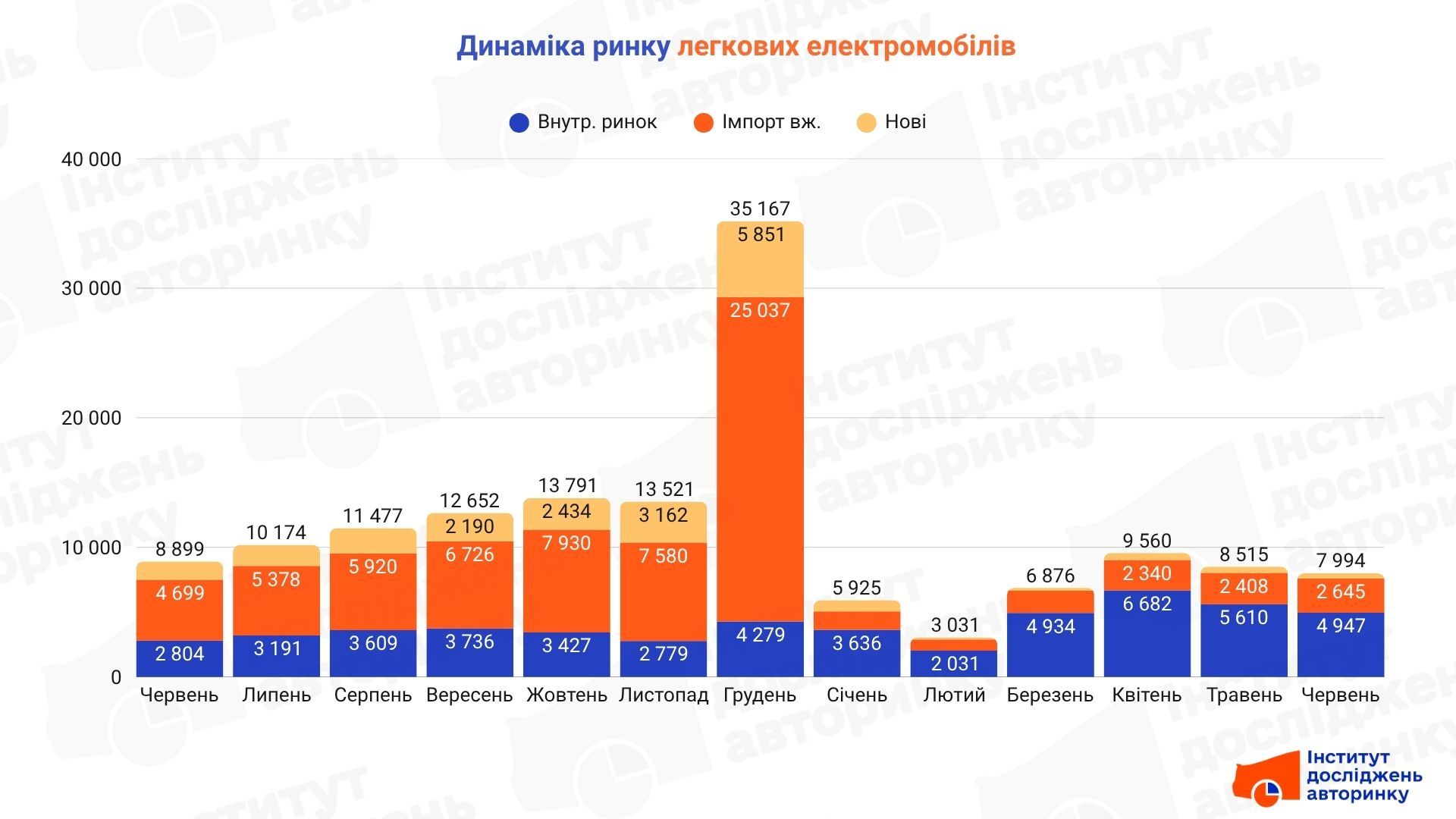
In June, the total number of registrations on the Ukrainian electric vehicle market reached almost 8,000 transactions. This figure falls within the range seen last year, but there is an important caveat – the market structure has changed dramatically. For half a year now, VAT has been payable on imported electric vehicles, so virtually all market activity has shifted towards the domestic resale of used cars.
This is evidenced by data from the Automotive Market Research Institute.
Trends in individual segments
Last month’s statistics confirmed the shift in consumer interest that began to be recorded at the start of 2026.
- Domestic resales of used electric vehicles – 4,947 cars. This segment dropped by 11.8% compared to the previous month, yet it still shows a 76.4% increase compared to June 2025.
- Import of used electric vehicles – 2,645 cars. Compared to May, this segment added 9.8%. However, on a year-on-year basis, there has been a significant decline – 43.7%.
- Import of new electric vehicles – 402 cars. Here, declines continue. In the monthly comparison, the drop is 19.1%, and 71.2% year-on-year.
Source: Institute of Automotive Market Research
Experts note that Ukrainians had a kind of financial reserve for importing electric vehicles at the end of 2025 in order to beat the VAT introduction deadline. This explains the sharp surge in these segments during the last 2-3 months of the previous year.
The artificial reserve has already been used up, and the market has stabilized at an average of 7,000–8,000 electric vehicles. Nevertheless, movement is occurring mainly due to domestic resales rather than an influx of new cars.
Leaders of the domestic market
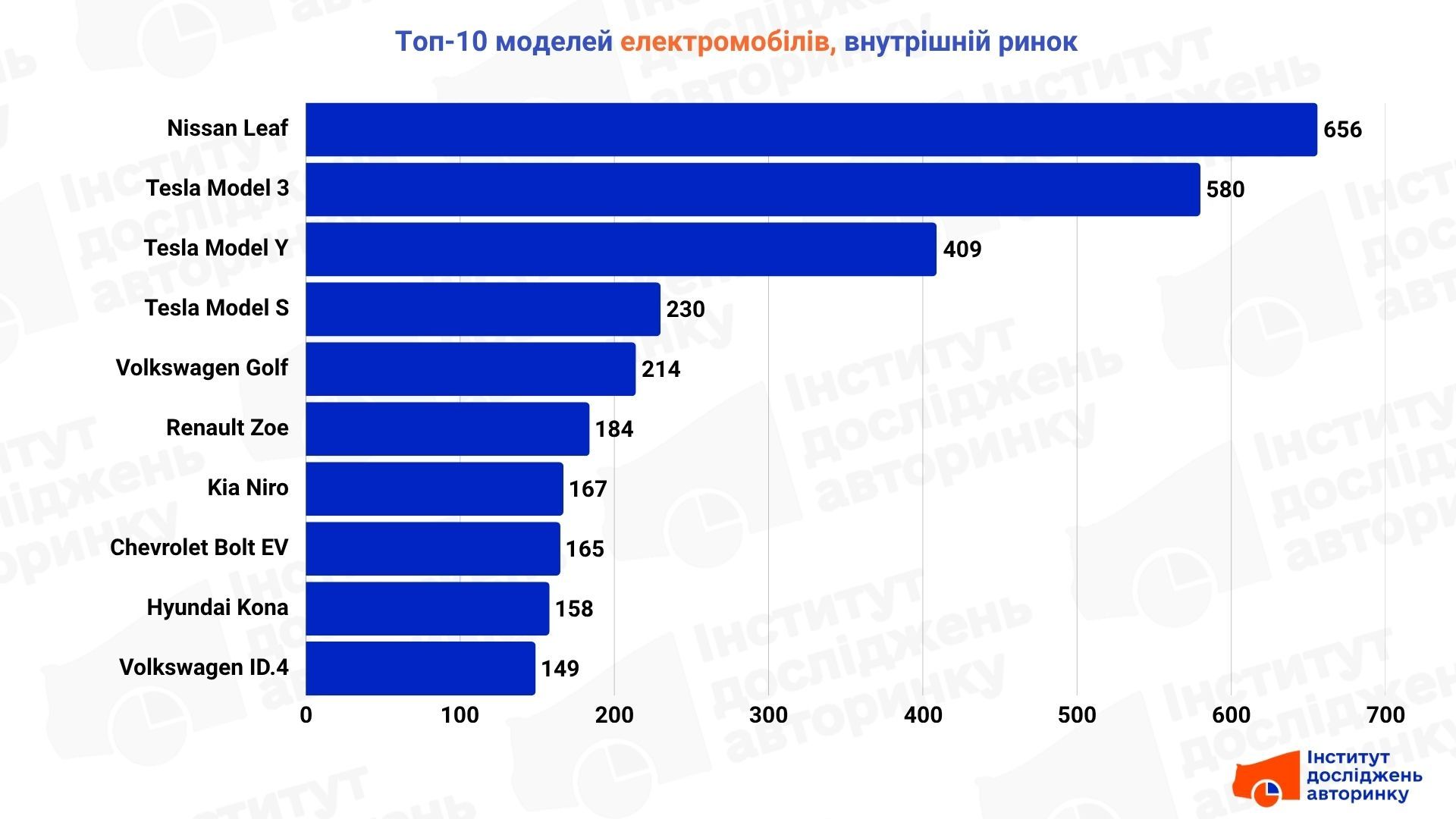
More than 60% of electric vehicle purchase transactions were made in the domestic resale market. The main player in the secondary market is the Nissan Leaf. Its fairly modest battery is offset by a low entry cost, so the trend of buying this electric car continues, though mainly for short city trips.
Source: Institute of Automotive Market Research
The next three positions in the budget segment are occupied by Tesla models. They are actively changing owners within the country. Buyers are increasingly opting for batteries with a capacity of 50–60 kWh.
Which used cars are Ukrainians importing
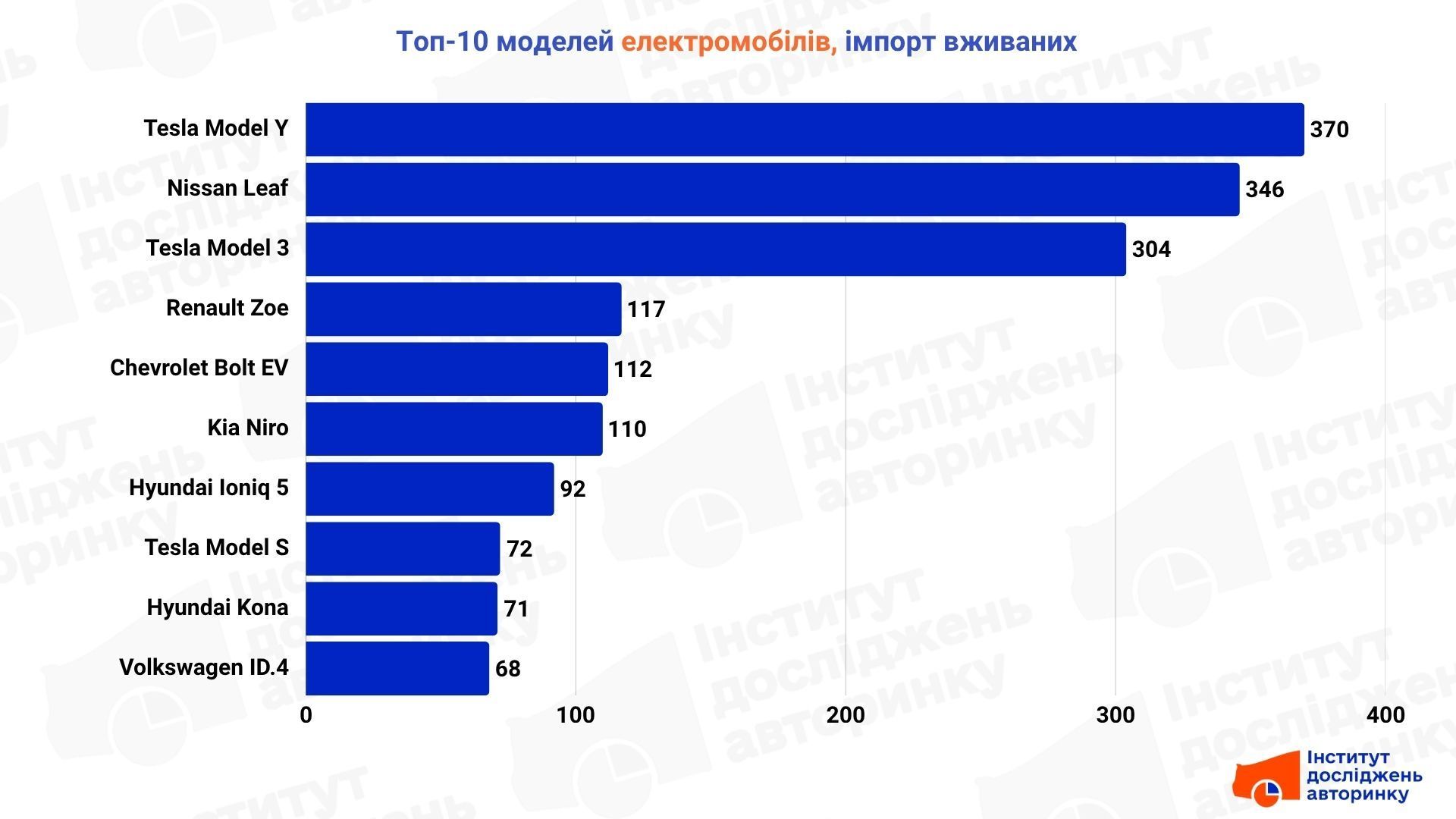
The top spot is firmly held by the electric Tesla Model Y. The three most popular cars in the used import segment are the Nissan Leaf and Tesla Model 3 as well. Overall, the top ten includes many quite practical cars with a long range.
Source: Institute of Automotive Market Research
Analysts at the Institute of Automotive Market Research have noticed a new trend: Ukrainians no longer view electric vehicles as a second family car. Most often, they are considered a fully-fledged universal mode of transport – with a large trunk and capable of covering hundreds of kilometers. This is evidenced by the decrease in the number of small city electric cars among the top imported vehicles.
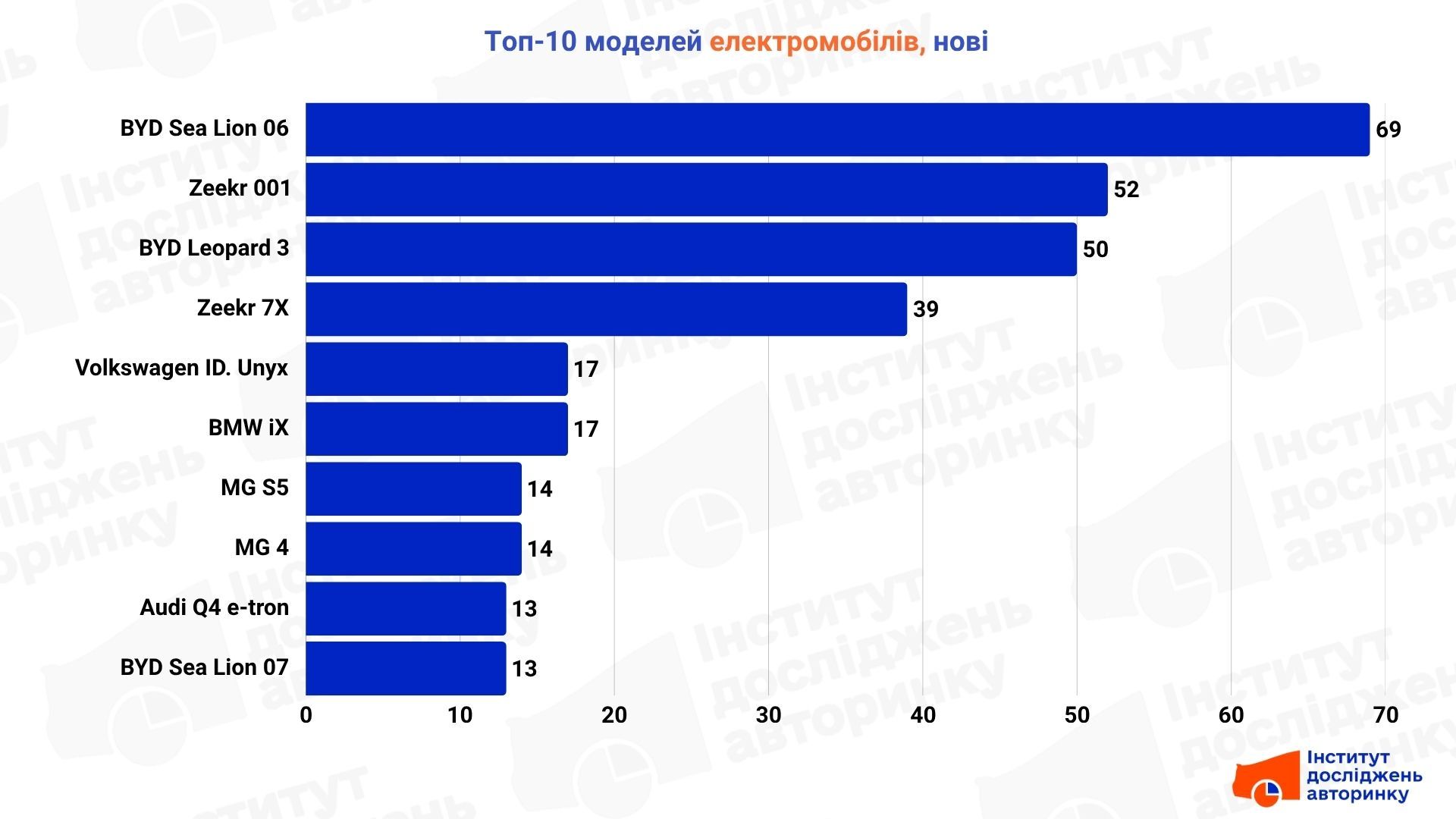
Chinese newcomers
Over 60 per cent of electric car sales take place on the second-hand market. The star of the second-hand market is the Nissan Leaf. Its rather modest battery capacity is offset by its low entry price. Consequently, the trend towards buying this electric car continues, albeit mainly for short city journeys.
Source: Institute for Automotive Market Research
The reason is straightforward – the combination of price and additional functionality, making it impossible for European dealers to compete with direct imports from China.
EcoPolitic reported that after the reinstatement of VAT, the dynamics of the electric vehicle market plummeted fourteenfold.
Meanwhile, in the European Union, as many as 750,000 electric vehicles were sold during just the first four months of 2026. Despite concerns, the share of Chinese electric vehicles accounted for only 20%.
Automakers from the United Kingdom and the EU urged the European Union authorities to postpone the introduction of tariffs on electric vehicle imports. The problem lies in the so-called rules of origin. Starting from January 1, 2027, vehicles may be sold between the bloc and Britain only if a significant portion of their value and batteries is produced in Europe.