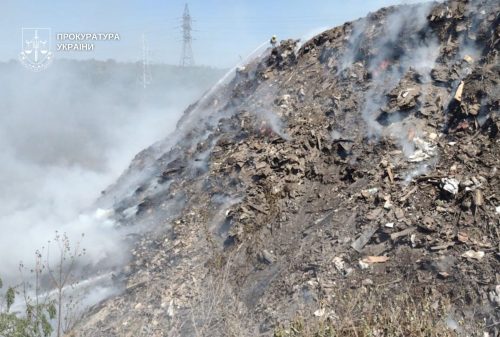
In the Mykolayiv region, 620 hectares of the territory of the regional landscape park Vysunsko-Inguletskyi were plowed up and given to private ownership.
Destruction of land is carried out with the permission of the State Geocadastre and the State Geocadastre, reports the Ukrainian Nature Conservation Group – UNCG on Facebook.
The park was created in 2011 to protect 30 valuable steppe areas of the Berezneguvat community in the basin of the Vysun and Ingulets rivers with endemics, that is, species that grow only in this place and nowhere else in the world.
However, during the 10 years of existence of the administration, the park was never created. When the park was state-owned land, there could be no threats other than self-grabbing of land. However, land reforms changed everything.
Whole reserves and natural attractions, included in the park without canceling their status, turned out to be privatized. That is, lands that have long had protected status and communities are responsible for their preservation. In the park, plots with an area of more than 150 hectares fell under privatization.
Thus, the natural monuments Pryshyb and Balka, which are part of one of the separate plots of the Vysunsko-Inguletsky park, are now private property.
In the material, it was noted that at the end of 2021, the Berezneguvat community, by decision of the session, removed valuable steppe plots from land auctions based on UNCG proposals
"Such ecocide is fully equal to the ecocide committed by Russia during the war and cannot be justified," environmentalists noted.
Within the park and between the village Berezneguvate et al. Vysunsk grows a narrowly localized endemic species Astragalus visuniacus, which is currently under the greatest threat of extinction, since the southeastern parts of the park are the front line, and Berezneguvatsk community regularly suffers from constant shelling by the aggressor.
"However, surprisingly, the biggest risk for this species is the actions of the local authorities, which do not see obvious violations," UNCG emphasized.
Currently, it is not possible to investigate the state of the populations of the astragalus vysunsy and the park in general on the spot, because the territory is on the front line. This also applies to the possibility of control authorities to visit the park and record violations. In addition, obtaining any additional information is complicated by the absence of a special administration in the park.
The Vysun sections of the park suffer the most from illegal privatization and devastation, and the Ingulets sections from military aggression, as they are located closest to the front line on the border of the Mykolaiv and Kherson regions.
Earlier EcoPolitic wrote, that the most valuable natural habitats of the Buzky Gard National Park were located in the Mykolaiv region at risk of flooding due to the plans of Energoatom to raise the level of the Oleksandriv reservoir.
As EcoPolitic previously reported, in the Tuzlivski lymany NPP, located in Odesa, from the beginning of the full-scale invasion dolphins die en masse, migration routes of migratory birds are changing, nesting sites of rare species are being destroyed.