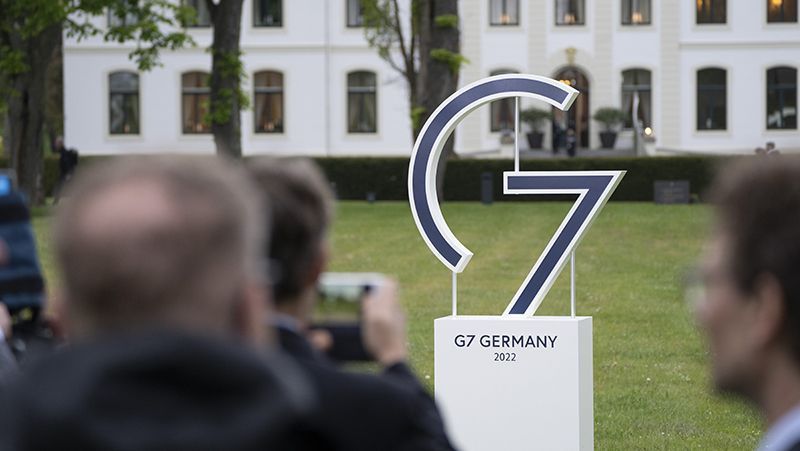
G7 climate and environment ministers have agreed to end fossil fuel subsidies by 2025 and substantially decarbonize their economies by 2035.
G7 plans to reduce carbon dioxide (CO2) emissions were announced by German Minister of Economics and Climate Protection Robert Habeck, reports Reuters.
"A significant step has been taken in the decarbonization of the energy sector. The commitment now taken suggests that the energy sector in 2035 in all G7 countries - and this is the first innovation - should be predominantly decarbonized ... Moving away from coal is a common goal of the G7" - said the Minister of Germany.
In his statement, Habeck noted that the meeting participants also agreed to cut funding for fossil fuels until 2025. The minister noted that this is a difficult but doable task.
The German minister recalled that the amount of carbon dioxide in the atmosphere would lead to an increase in the planet's temperature by 1.5 degrees. Scientists call this threshold critical, capable of leading to serious climate change.
While global warming can no longer be stopped, the challenge now is to slow it down, the German representative said.
The communiqué issued at the end of the meeting states that the G7 countries intend to abandon the use of coal for electricity generation. But there are no specific dates.
At the same time, the decision to decarbonize leaves the possibility of further use of fossil fuels if emissions from its use are significantly reduced.
The communiqué also mentions commitments to achieve carbon neutrality for the road sector by 2030 and increase sales of electric vehicles.
Recall that the G7 includes the US, Canada, France, Germany, Italy, Japan and the UK. In 2022, the G7 will be chaired by Germany.
Before EcoPolitics reported that Italian Prime Minister Mario Draghi said that the world could not solve climate problems without three countries.