The much-suffering Kherson region, despite partial occupation and shelling, has developed its own environmental protection plans. These plans are fairly typical for all of Ukraine, as wastewater and waste management measures are the most extensive and, moreover, the most expensive. However, both their implementation and funding remain in question due to the war.
EcoPolitic continues its review of environmental programs in Ukraine’s regions and how effectively they use funds from polluting enterprises.
Currently, over 70% of the territory of Kherson region is under temporary Russian occupation. Several communities suffer daily from enemy attacks. Under such circumstances, it would be unrealistic to expect that the environmental tax collected from enterprises in the region amounts to a significant sum.
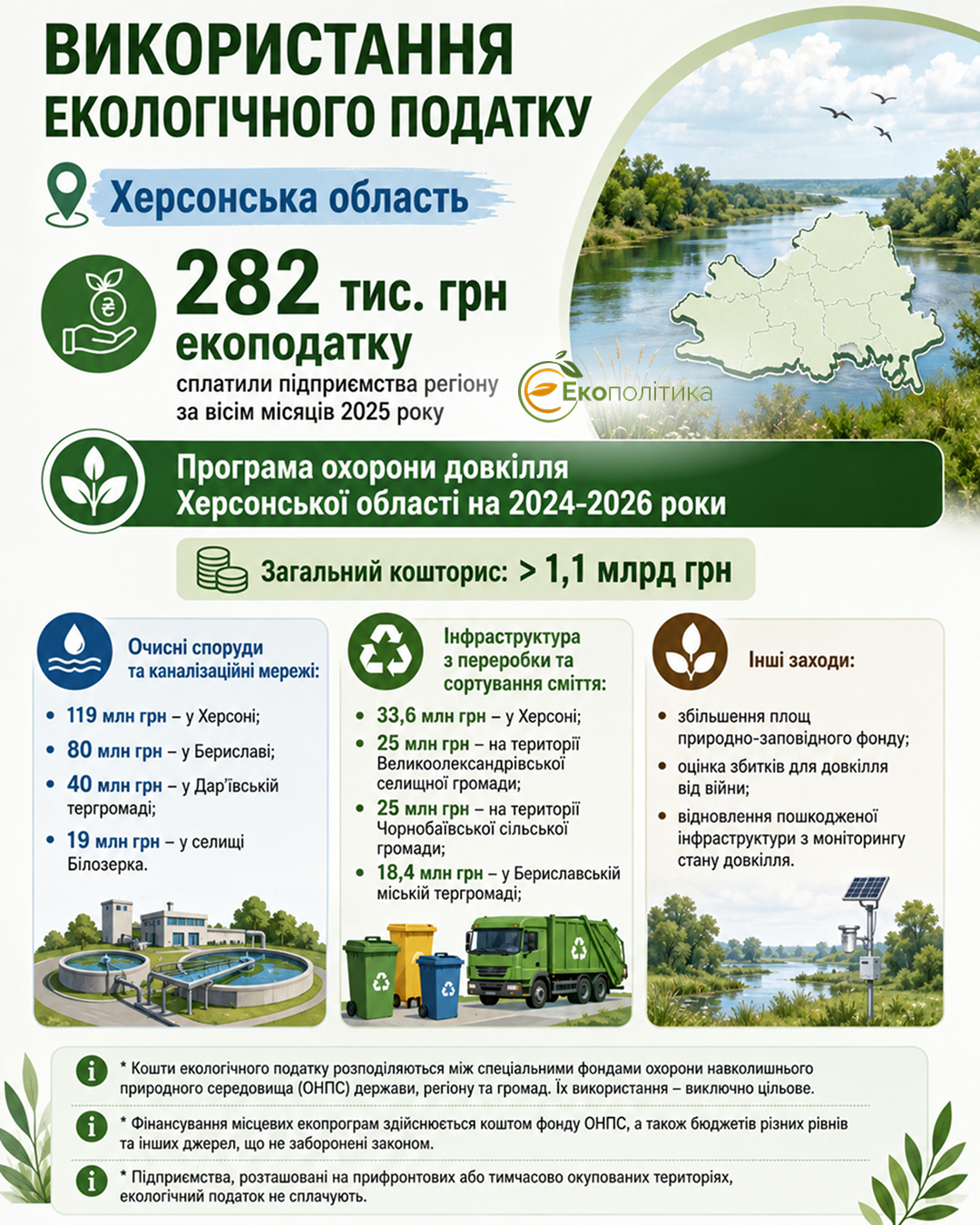
According to data from the State Tax Service, during the first eight months of 2025, polluters in Kherson region paid about UAH 282,000 in environmental payments. Of this, UAH 200,200 remained in local budgets, specifically in the special Environmental Protection Fund (EPF).
At the same time, the State Tax Service reminds that businesses located in frontline or temporarily occupied territories do not pay the environmental tax.
So what are the plans for the environment under such circumstances?
Regional Focus: Wastewater and Solid Waste
The current environmental protection program for Kherson region was approved by the regional administration after the de-occupation of the regional center, in November 2024. It covers the period from 2025 to 2027 and has a total budget exceeding UAH 1.1 billion.
It is planned that UAH 674.2 million will come from the state budget, nearly UAH 303 million from local budgets, and another UAH 158.9 million from other sources. The regional budget plans to allocate only UAH 2.15 million for environmental measures. Notably, the EPF as a separate funding source is not mentioned.
Kherson region is not unique in its approach to environmental issues. Some of the region’s most expensive measures concern sewage systems. The region has even planned works in communities currently under occupation, though with a note that implementation is possible only after the territories are liberated.
For reconstruction, capital repairs or new construction of networks and treatment facilities over three years, the planned expenditures are:
- UAH 119 million in Kherson;
- UAH 80 million in Beryslav;
- UAH 40 million in the Daryivka territorial community;
- UAH 19 million in the village of Bilozerka.
Hundreds of millions are also earmarked for waste management. Specifically, UAH 203 million are planned for the collection and storage of obsolete pesticides in the Daryivka community.
A set of measures is dedicated to creating waste processing infrastructure:
- UAH 33.6 million for the construction of a waste processing plant in Kherson;
- UAH 25 million for the construction of a waste transfer facility in the territory of the Velykooleksandrivka settlement community;
- UAH 25 million for the construction of a waste sorting station in the Chornobaivka village community;
- UAH 14.2 million for the arrangement of a composting station in Kherson;
- UAH 18.4 million for the arrangement of a composting station in the Beryslav city territorial community;
Also included in the ‘waste’ section of the environmental programme is the development of local waste management plans and sanitation schemes for settlements.
Other sections of the programme include plans to increase the area of the nature reserve fund, assess the environmental damage caused by the war and the need for restoration, restore damaged environmental monitoring infrastructure, and develop a regional plan for establishing an ecological network.
Environmental Program of the Regional Center
Nature protection in Kherson is regulated by the city’s target program “Ecology.” Approved in September 2024, it is valid through 2026 inclusive. The document emphasizes that the implementation of initiatives is possible only if the security situation in the city stabilizes. Regarding funding, UAH 132,000 are allocated from the city budget, including the Environmental Protection Fund (EPF), as well as from partner funds-the European Union and Japan.
The environmental program defines the vector for conservation efforts but does not provide clarity on funding volumes or implementation periods. Therefore, let us briefly list what Kherson intends to do for the city’s environment.
- determine the morphological composition of municipal solid waste;
- develop a “zero waste” transition strategy and a local waste management plan;
- organize a facility for temporary storage of demolition waste and arrange a site for its sorting;
- engage entrepreneurs in the recycling of demolition waste;
- install a waste sorting line;
- strengthen control over illegal logging of green spaces;
- carry out landscaping activities;
- continue the inventory of green spaces.
For 2024, funding was planned from the EPF for a single initiative-conducting an environmental impact assessment and a strategic environmental assessment. UAH 132,000 were allocated for this.