An interactive dashboard has been launched in Ukraine, allowing users to track the progress of the National Energy and Climate Plan for the period up to 2030. It provides information on the implementation of the NECP’s policies and measures, as well as the progress made and a ranking of implementing bodies amongst government authorities.
This was reported by the Ministry of Economy and the Environment.
The dashboard was launched as part of the regular monitoring system for the National Economic Recovery Plan. It is an attempt to make this information more transparent and to organise the data in order to improve coordination between the executive authorities, each of which is responsible for its own part of the Plan.
"The introduction of a digital monitoring system is intended to ensure that information on the implementation of the Plan is regularly updated and to improve the accessibility of data for public authorities, international partners, the expert community, the business sector and the general public," the Ministry of Economy added.
As a reminder, the NEEAP is a strategic document that brings together the key objectives of the state’s climate and energy policies. It sets out the main measures required to achieve these objectives by 2030.
The dashboard covers NPEK’s policies in the following key areas:
- decarbonisation;
- energy efficiency;
- energy security;
- the internal energy market;
- research, innovation and competitiveness.
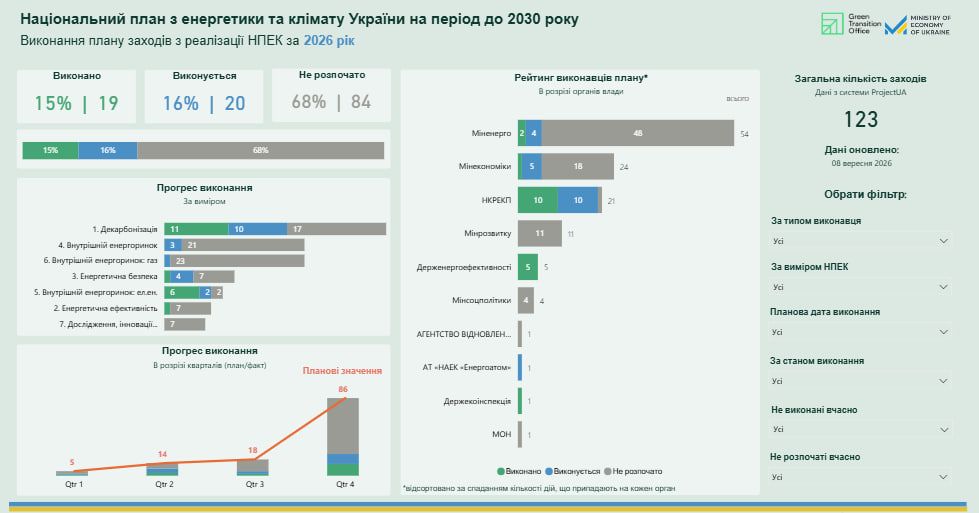
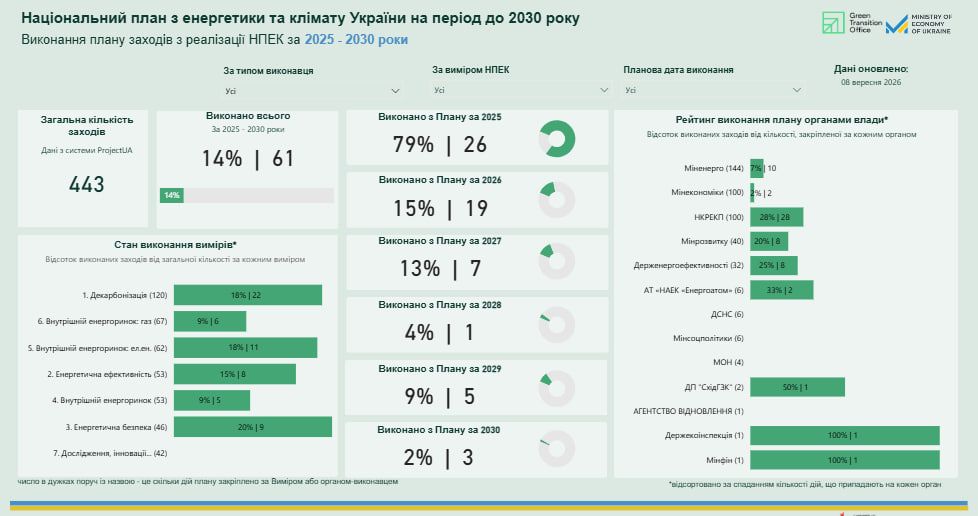
The latest data from the dashboard shows that in 2025, 79 per cent of the NPEC’s policies were implemented, whereas in 2026, only 15 per cent have been implemented so far. Work on 68 per cent of the plans has not even begun yet.
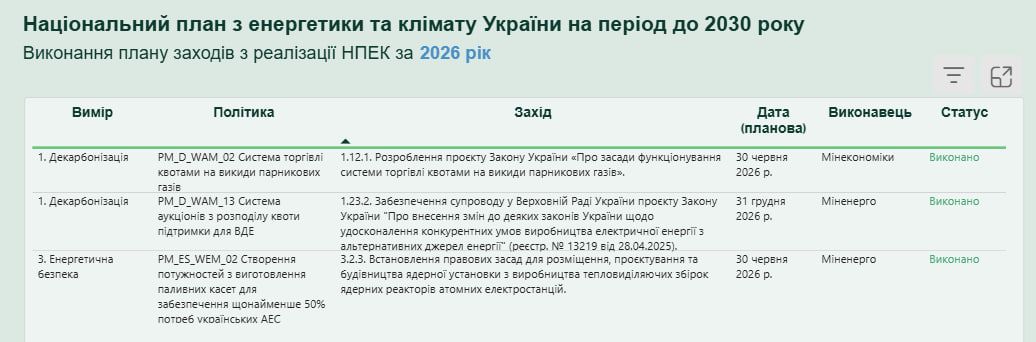
In fact, the ministries implemented three measures:
- The Ministry of Economy has drawn up a draft law ‘On the Principles Governing the Operation of the Greenhouse Gas Emissions Trading Scheme’;
- The Ministry of Energy “provided support” in parliament for Bill No. 13219 “On Amendments to Certain Laws of Ukraine Regarding the Improvement of Competitive Conditions for the Production of Electricity from Alternative Energy Sources”;
- The Ministry of Energy has also established the legal framework for the siting, design and construction of a nuclear facility for the production of fuel assemblies for nuclear reactors at nuclear power stations.
Overall, by 2030, the Ministry of Energy is set to implement the largest number of measures — 144. To date, only 10 of these (7 per cent) have been completed. A further 100 measures are to be implemented by the Ministry of Economy, which has implemented only 2 (2%) of them. The National Commission for Energy and Public Utilities (NKREKP) has implemented 28 out of 100 planned measures (28%).
Regarding the action to draft a bill on the quota market, which is marked as ‘completed’ on the dashboard, we must point out that the draft bill prepared by the Ministry of Economy and Environment has simply disappeared from the ministry’s website. Instead, three alternative draft bills have appeared on the Verkhovna Rada’s portal without any public consultation. You can read EcoPolitics’s analysis of their provisions via this link.
As a reminder, the Cabinet of Ministers approved the National Energy and Climate Policy back in 2024. In January 2026, it was slightly updated, with provisions made for a review every five years.