Ukraine has the technical capacity to utilize 2.15–3.08 billion cubic meters of methane per year. At current European prices, this volume could be sold for €750–1,100 million.
These figures are cited by the authors of the study “Methane Emissions in Ukraine’s Energy Sector: Underestimated Challenges and Opportunities,” conducted as part of the Green Deal Ukraine (GDU) project.
They note that this volume could replace 10–15% of total natural gas consumption in our country.
Structure of methane emissions
In 2023, methane accounted for approximately 27% of total greenhouse gas emissions in Ukraine. The largest share—≈71%—came from the energy sector, primarily from oil and natural gas extraction activities. In second and third place were the waste management sector (about 19%) and agriculture (approximately 10%).
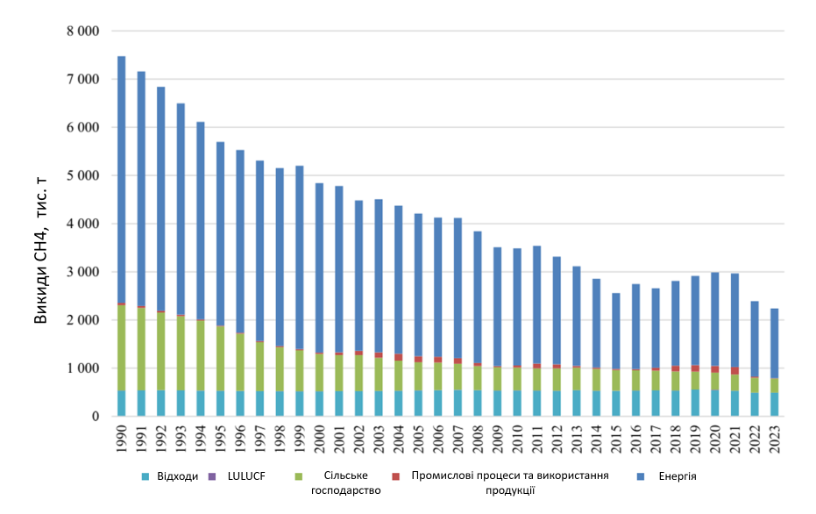
Methane emissions in Ukraine from 1990 to 2023. Source: National Inventory of Anthropogenic Greenhouse Gas Emissions in Ukraine for 2025
The authors of the study note that after 2022, there was a sharp reduction in methane emissions due to decreased production and consumption of energy resources caused by the war. If Ukraine does not introduce targeted regulation and investment in methane utilization, emissions are likely to rise again during the post-war reconstruction period.
Which areas are potentially attractive for the utilization of this energy gas
The distribution of methane utilization potential in Ukraine is as follows:
- approximately 58% comes from the oil and gas sector (1.3–1.8 billion m³);
- 26% from coal mine methane (0.5–0.8 billion m³);
- 13% from landfill gas;
- 3% from wastewater biogas.
What financing is necessary
To realize this potential, Ukraine will require investments of €2.4–3.6 billion over 10 years, or €240–360 million per year. Comparing the figures points to an obvious economic benefit: revenues from the sale of captured methane will be three times higher than the investments in measures to eliminate leaks and utilize methane.
Thus, this is an atypical case where we are not talking about an environmental subsidy, but about a real investment project with substantial profits.
“From an economic perspective, reducing methane emissions pays off quickly. Many measures to reduce emissions in Ukraine have almost zero or even negative cost, as the captured gas has immediate commercial value. Measures in the oil and gas sector (including LDAR, improved maintenance, and equipment modernization) can pay off in less than one year. More capital-intensive projects, such as converting landfill gas to energy or utilizing coal mine methane, provide a payback period of 1 to 4 years, while the internal rate of return is 15–30% or more. This makes reducing methane emissions one of the few climate initiatives that generate net revenue for operators while also reducing fiscal risks for the state,” the authors of the study remark.
The oil and gas sector has the largest capital investment needs-€1.55–2.2 billion over the next 10 years. Therefore, most key decisions will be made by a few major operators, which greatly simplifies the implementation and administration of methane policy.
What sectors are potentially attractive for the utilization of this energy gas?
Analysts consider the main obstacle to reducing methane emissions to be the current fiscal model. They provide the following comparison: the Ukrainian tax on methane is €0.04 per ton of CO₂-equivalent, compared to €65 in Norway. This indicates that, as of today, there is no internal economic incentive in Ukraine to reduce methane emissions.
State support only covers companies’ operating expenses and does not contribute to capital investments aimed at emission reductions. The authors of the study also claim there are no mandatory requirements for measurement-based monitoring systems. Reporting relies primarily on calculated coefficients that systematically underestimate the real volume of gas losses, especially in the oil and gas production segment.
Thus, clear regulatory rules from the government are needed to make participation in methane capture and utilization attractive and predictable for businesses.
As previously reported by EcoPolitic, the sixth international newsletter of the BIOMETHAVERSE project confirmed insufficient growth rates of the biomethane sector in Europe. Investors have allocated €28 billion to the development of this sector, which indicates strong interest in it. However, even rather high figures are still insufficient and demonstrate a slowdown in biomethane production growth.