At the end of 2025, the Interdepartmental Working Group on Coordination of Climate Change Mitigation approved a draft of the updated Long-Term Low-Carbon Development Strategy of Ukraine (LTLCDS) until 2050. According to information obtained by EcoPolitic from its own sources, the document has been heavily criticized.
We decided to analyze how successfully Ukraine is coping with the transition to climate neutrality. For each component of this transition, we will look at the existing legislative framework, the plans of the Ukrainian authorities, the planned funding, and the actual results to date.
What is climate neutrality and why is it relevant?
As the world tries to curb global warming, the concept of "the path to climate neutrality" is increasingly sounding less like a nice declaration and more like a pressing necessity. This is no longer a story about a distant eco-agenda for the future — it is about the economy, security, energy bills, and competitiveness here and now.
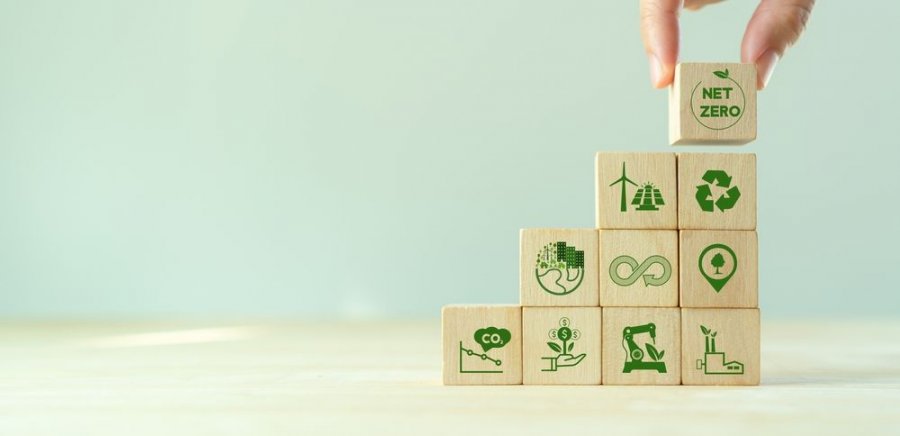
The global Paris Climate Agreement seems simple and straightforward: to avoid the worst-case scenario of climate change, humanity must reduce greenhouse gas emissions to zero by the middle of the century. In practice, this path is a complex puzzle consisting of politics, technology, financing, and the human factor.
European context
In 2020, the European Union set its own target: to become the first climate-neutral continent by 2050. To achieve this, the bloc adopted the European Green Deal, introduced an emissions trading system, and established “green” standards for industry and transport.
This is not just a political declaration, but an entire stack of mandatory rules that are transforming the economy at all levels-from households to metallurgical plants.
Today, the European Green Deal is facing challenging times. Some requirements have to be revised or relaxed-not due to a loss of ambition, but because of political and economic pressures within the EU. Even the adoption of a collective target to reduce emissions by 2040 proved to be very difficult for Europeans, as member countries argued extensively about the level of commitments and mechanisms for their implementation.
Ukraine's commitments
The Law of Ukraine “On the Principles of State Climate Policy” provides the following definition of climate neutrality: it is a state in which the total volume of anthropogenic greenhouse gas emissions is equal to, or compensated by, the total volume of removed greenhouse gases.
Ukraine is a party to the Paris Agreement and, under its Second Nationally Determined Contribution (NDC2), has committed to reducing emissions by at least 65% by 2030. It also plans to achieve climate neutrality by 2050, which aligns with the EU’s objective.
How to achieve a “neutral” future
The authors of the LEDS have outlined in Section 2 “The path to climate neutrality by 2050” the following points:
- Overall reduction of greenhouse gas emissions and increased absorption by sinks.
- Renewable energy sources (RES).
- Energy efficiency.
- Sectoral measures.
Let us review the successes of Europe and Ukraine regarding each of these components.
Decarbonization: mission possible?
EU
The European Union is gradually reducing greenhouse gas emissions, while the bloc's economy continues to grow. In the second quarter of last year, these emissions were estimated at 772 million tonnes CO2 equivalent, which is 0.4% less than in the same quarter of 2024. The EU's gross domestic product increased by 1.3% in the second quarter of 2025 compared to the same quarter a year earlier. This trend has persisted for a long time.
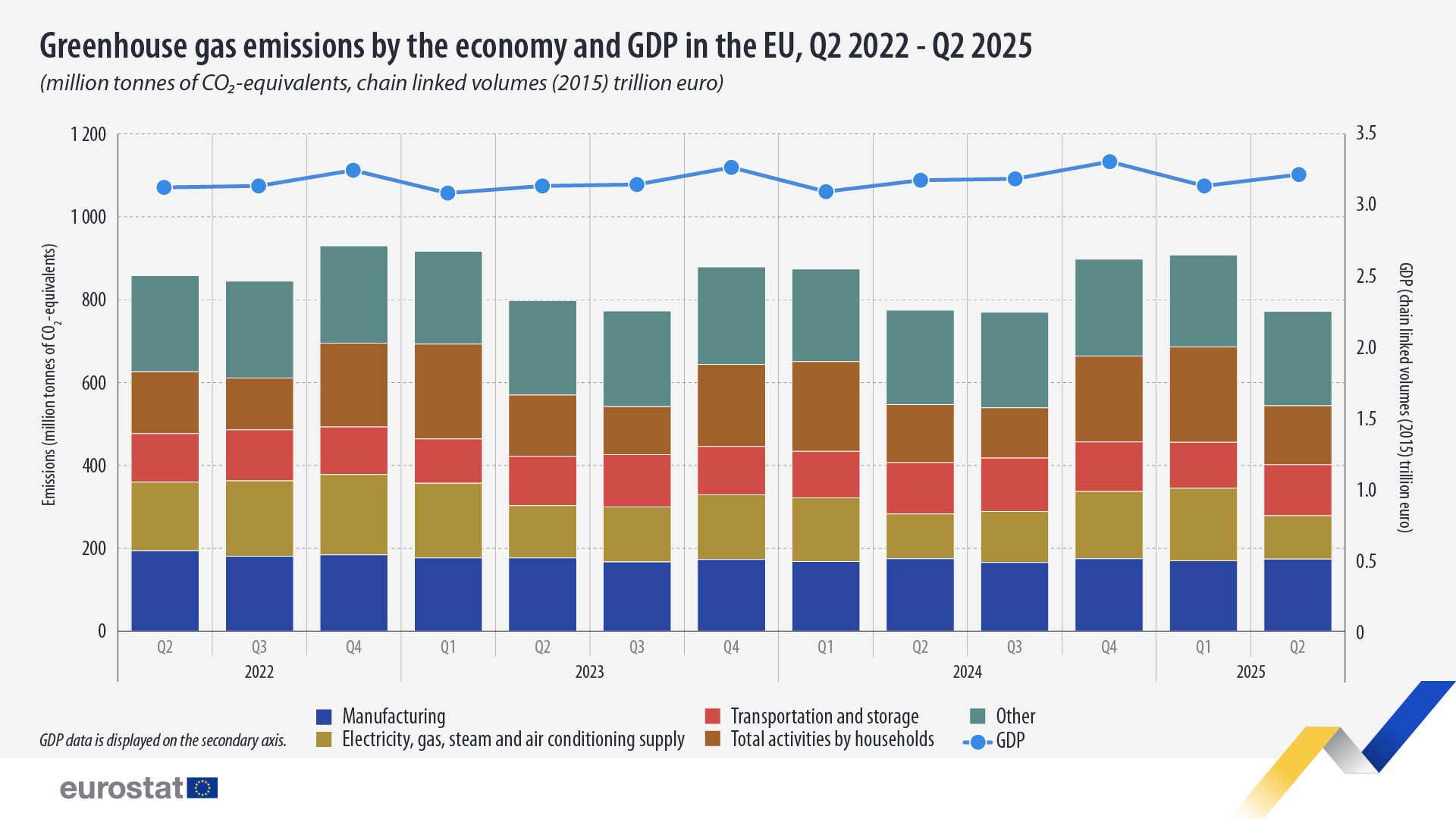
Source: ec.europa.eu / eurostat
One of the tools enabling Europeans to grow the economy while reducing emissions is the European Union Emissions Trading System (EU ETS). The funds raised within this mechanism are used by the European Union to help its industry decarbonize.
For example, the total revenue from allowance sales under the EU ETS in 2023 amounted to €43.6 billion. This money was divided into two parts:
- €10.3 billion went to special funds financing the “green” transition (Innovation Fund, Modernization Fund, Recovery & Resilience Fund);
- €33.3 billion was received by member states. They are obliged to spend revenues from the emissions trading system exclusively on climate-related projects.
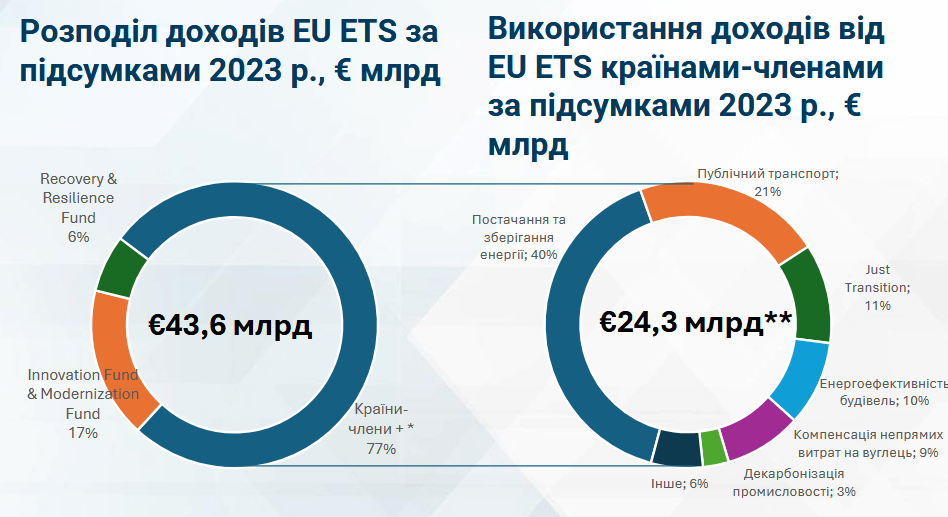
* – including Iceland, Norway, Northern Ireland, and Liechtenstein
** – used by member states from the total revenue of €33.3 billion in 2023, including the amount of compensation for indirect carbon costs
Source: gmk.center
Needless to say, domestic enterprises can only dream of such volumes of eco-modernization financing.
Ukraine
In early July of last year, then Minister of Economy of Ukraine Yulia Svyrydenko also announced a success: more than 75% of the target greenhouse gas emission reductions under the National Energy and Climate Plan (NECP) had been achieved by 2030. There is one crucial point: this significant decrease in emissions occurred not due to industrial modernization, but because of deindustrialization caused by full-scale war and difficult economic conditions.
The emissions trading system in Ukraine exists only as a plan. The current environmental tax gets lost in budgets at various levels and is not used to decarbonize the processes of the enterprises that pay it.
The only dedicated state fund – JSC “Decarbonization Fund of Ukraine” – has extremely low funding compared to the needs of industry. While the estimated investment requirement for the “green” transition of domestic industry is €102 billion, the planned financing for this fund is only €182 million, which is 0.17% of the required amount.
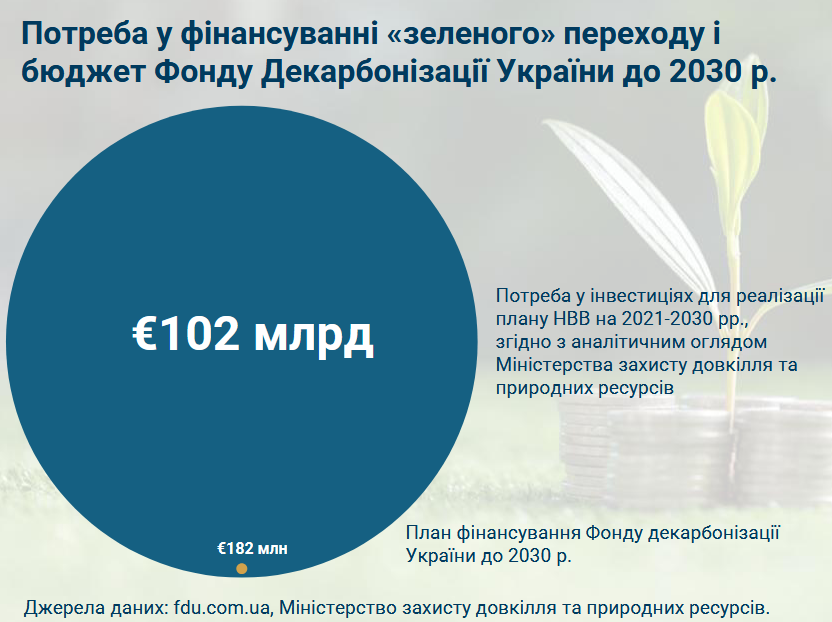
Infographic: gmk.center
A portion of these funds is diverted to energy efficiency projects for communities rather than the industrial sector.
The role of green energy: from declarations to specifics
The Russian-Ukrainian war has become a powerful catalyst for the transition of the entire European continent to renewable energy sources. The speed of the transition increased exponentially only when it became a matter of survival. For Ukraine, it was a matter of survival in the context of an energy war; for Europe, it was a matter of getting rid of its critical dependence on an inadequate and unpredictable aggressor.
EU
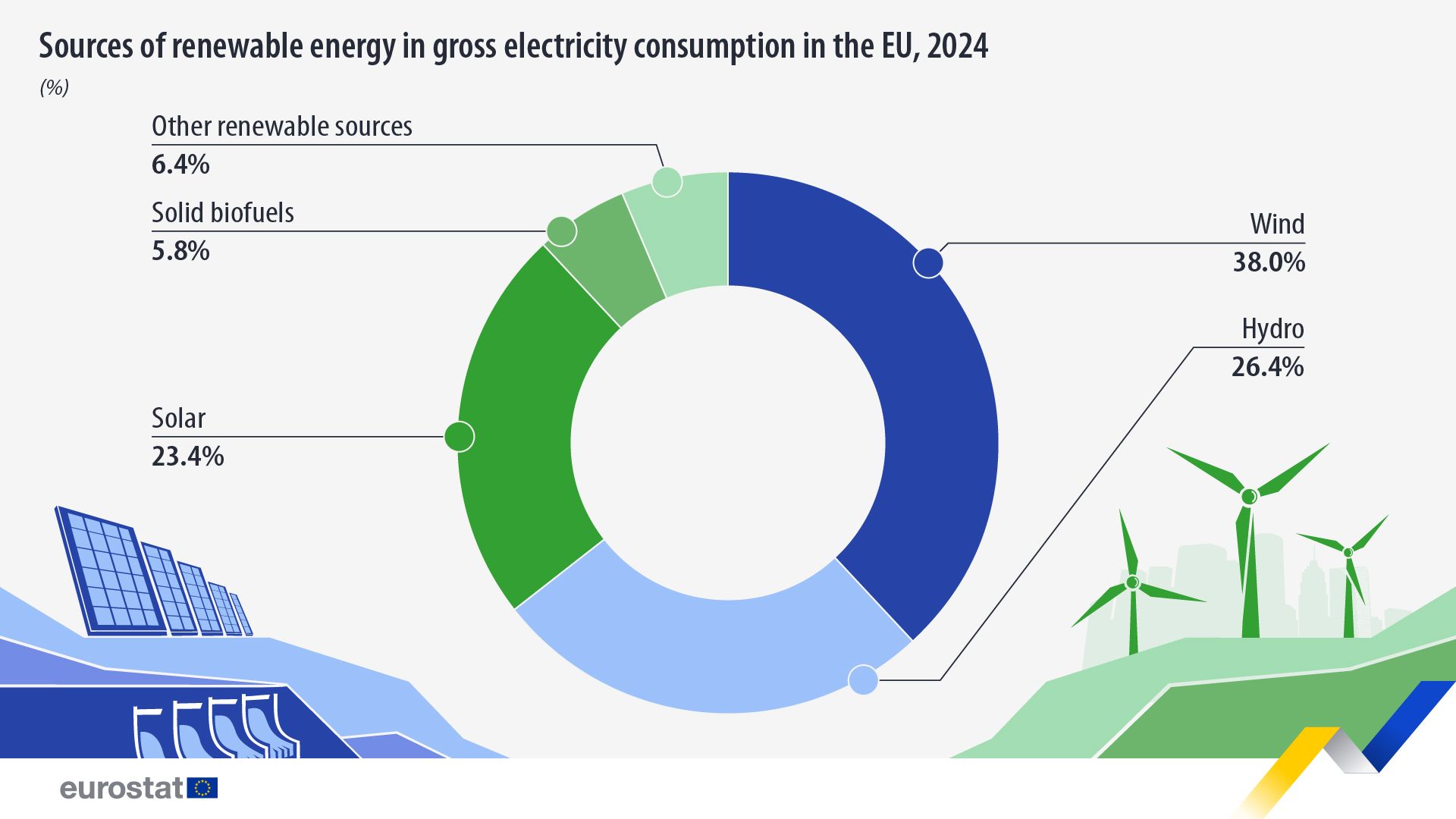
According to the latest data from Eurostat, during 2024 the share of renewable energy sources (RES) in gross electricity consumption in the European Union was 47.5%. Since 2004, it has almost tripled.
The largest share of RES generation (38%) is provided by wind energy, followed by hydropower and solar energy, with shares of 26.4% and 23.4% respectively. The share of energy generated from solid biofuels is significantly lower, at just 5.8%.
Source: ec.europa.eu
Analysts note that solar energy is currently the fastest-growing source.
During the past decade, the European Union has increasingly focused on the use of clean energy: in 2025, investments reached nearly $390 billion.
Ukraine
Legislative Framework
- The National Energy and Climate Plan was adopted in June 2024;
- The National Renewable Energy Action Plan up to 2030 and the implementation roadmap were approved in August 2024.
Plans
The NECP provides that the share of RES in total final energy consumption must reach at least 27% by 2030. It is planned that the share of RES in total electricity generation will be approximately 25%.
According to the Ministry of Energy, as of mid-2025, the share of renewable electricity in Ukraine increased to 17.3%. It is important to note that this occurred not due to a rapid expansion of domestic renewables, but as a result of significant destruction of other types of generation facilities.
Financing
Immediately after the NECP was adopted in June 2024, Prime Minister of Ukraine Yuliya Svyrydenko, who at the time served as Minister of Economy, announced that the investment needs for its implementation amounted to at least $41.5 billion.
In April 2025, Deputy Minister of Economy Andriy Telyupa stated a lower figure. According to him, to achieve the goals specified in the plan by 2030, approximately $40 billion would be required.
The official noted that the leading sources of funding for the implementation of the NECP are:
-
the Ukraine Facility program. This involves nearly €9.3 billion in grants and loans under Component II – Pillar II Ukraine Investment Framework (UIF);
-
bilateral agreements;
-
programs of international financial organizations;
-
government initiatives.
Andriy Telyupa did not provide any information regarding potential agreements, programs, or initiatives, nor about the estimated amounts that could be attracted through them. More than 75% of the required financing remains up in the air. This is concerning, as at events dedicated to monitoring Ukraine's progress in implementing the NECP, experts emphasize the crucial role of financing in the successful realization of Ukraine’s ambitious energy and climate goals.
There has been some progress: In mid-November, the Ministry of Economy, Environment, and Agriculture of Ukraine presented the online catalogue "Green Platform". It features more than 100 “green” financing programs for Ukrainian businesses, state and municipal enterprises, communities, and startups.
Real achievements
Solar and wind energy are developing most actively in Ukraine. Power plants of this type have become a real support for communities and industry under the conditions of Russia's energy war.
As of February 2025, approximately 7 GW of renewable energy capacity (mainly solar) was in operation, providing up to 15–20% of electricity during sunny daylight hours. During 2025, more than 1,000 MW of solar generation was also brought online.
According to experts’ estimates, the total installed wind energy capacity in Ukraine currently stands at approximately 2.3 GW, of which 1.3 GW remain in temporarily occupied territories.
From 2022 until the beginning of the first quarter of 2025, 248 MW of new wind capacity and an additional 38 MW of used wind turbines were brought online in the government-controlled territory of Ukraine. The Ukrainian Wind Energy Association stated that by the end of 2025, the total increase in wartime capacity additions would reach 324.4 MW.
Ukraine is actively building energy storage facilities (ESF). A total of 534 MW of ESF are already in operation, and experts note the formation of a brand-new segment of the domestic energy market.
According to the results for 2025, the Ministry of Energy reported that the largest number of solar power stations was built by households using their own funds, but with state support – through the use of zero-interest loans.
Last year, three Ukrainian biogas producers took an important step – they began exporting it to Europe for the first time. Over 11 months, they sold more than 11 million cubic meters of biomethane to customers.
Find out how Ukraine and the EU are faring with another crucial cluster for achieving climate neutrality – energy efficiency – in the second part of our article, which will be published soon.In it, we will also outline the key challenges and barriers Ukraine faces on the path to climate neutrality, discuss who and what is hindering progress, and suggest ways to address these issues.