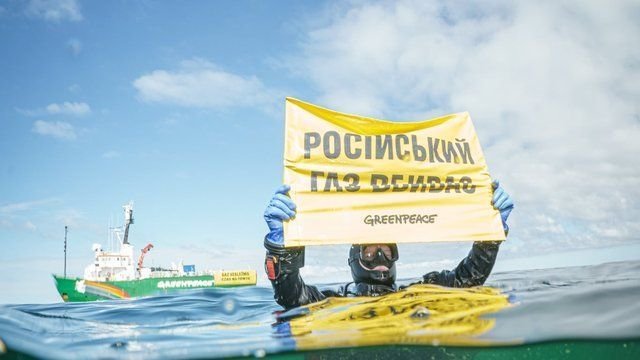
Polish Greenpeace activists dived into the Nord Stream gas pipeline, which runs along the bottom of the Baltic Sea, to protest against its restoration.
According to the press service of Greenpeace Ukraine, they demanded to accelerate the development of renewable energy sources so that Europe could become independent of Russian gas.
The protesters dived into the Baltic Sea at the spot where the gas pipeline was blown up almost three years ago. They also unfurled a banner on the surface of the water with the words: “No to Nord Stream, no to fossil gas.”
The activists also emphasize climate security, as the extraction and transportation of gas causes large emissions of methane. Even one ton of methane is 80 times more harmful to the environment in the short term than the same amount of carbon dioxide.
“The export of fossil fuels finances the Russian war... Ideas about restoring the Nord Stream gas pipeline are unacceptable! We must close this discussion once and for all and make it impossible to return to Nord Stream,” said Natalia Gozak, director of Greenpeace Ukraine and participant in the action.
According to her, despite the Russian-Ukrainian war, European countries continue to buy Russian gas in large volumes. By doing so, they are financing the aggressor country, as last year alone, EU countries paid Russia €22 billion for resources, which is 15% of Russia's annual military budget.
Greenpeace Ukraine noted that a complete ban on imports of fossil fuels from Russia is not expected to take effect in the EU until 2027. Therefore, Europe should focus on renewable energy sources right now, as their absence poses a threat to Europe. Europe may face an energy crisis, and the war in Ukraine will continue due to the constant flow of money from Europe to Russia.
Earlier, EcoPolitic wrote that the EU had doubled its target for the development of renewable energy sources by 2030 (42.5%) after Russia stopped supplies through Nord Stream.