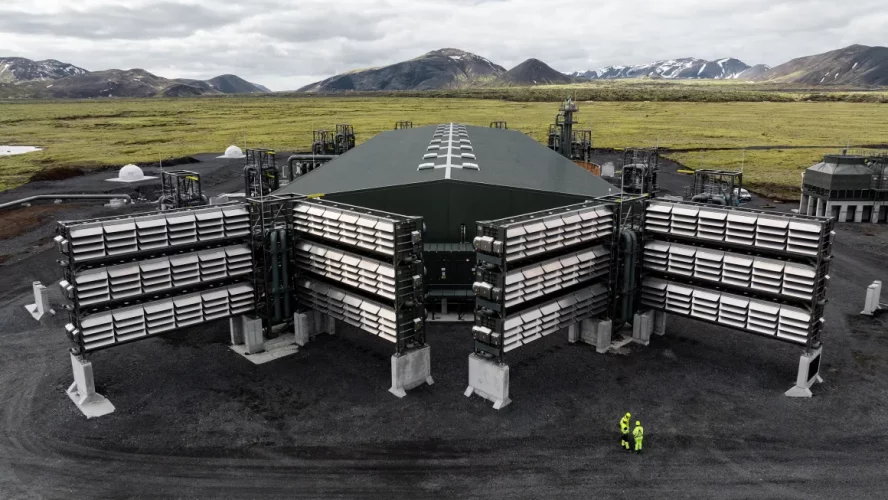
On May 8, Climeworks launched the Mammoth plant, which will capture CO2 emissions from the air and transport them underground, where they will eventually turn into stone. It is ten times larger than its predecessor, Orca, which was launched in 2021.
This was reported by Reuters.
Direct air capture (DAC) is a technology that allows you to suck in air and remove carbon from it using chemicals.
Climeworks plans to transport the carbon underground, where it will naturally turn into stone, permanently sequestering the carbon. For this process – sequestration – the company is working with Icelandic Carbfix. The energy for carbon sequestration will come from Icelandic geothermal sources.
"Mammoth" has a modular design. It accommodates 72 "container-collectors" – vacuum parts of machines that capture carbon from the air. They can be placed on top of each other and easily moved. So far, 12 such containers have already been installed, and more will be added in the coming months.
Climeworks claims that Mammoth is capable of sequestering 36,000 tons of carbon from the atmosphere per year when operating at full capacity. This is equivalent to taking about 7,800 cars off the road for an entire year.
The company has not yet released the exact cost of each ton of carbon removed, but said the number is closer to $1,000 per ton than $100 per ton.
The use of next-generation climate solutions, such as DAC, is becoming increasingly relevant as the concentration of CO2 in the atmosphere, which causes the warming of the planet, has reached a record level in 2023.
Earlier, EcoPolitic reported that an energy-efficient CO2 capture technology for metallurgy was developed in India.