The Turkish Parliament has passed the country's first ever climate law, which establishes a broad legal framework for combating climate change, creating a national emissions trading system (ETS), and strengthening the powers of the Directorate for Climate Change (DCC) to ensure compliance with environmental standards.
This was reported by the Turkish publication Daily Sabah.
Under the new law, companies covered by the ETS will have to obtain greenhouse gas emission permits within three years of the law coming into force.
During the transition period, these companies will be considered to have temporary emission permits. The SEB will also have the right to extend this period for up to two years if necessary. In other words, the Turkish authorities are maintaining flexible deadlines for the introduction of the ETS depending on the pace of the process.
The law also introduces a pilot phase for the ETS before it becomes fully operational. It will be monitored by the Carbon Market Board. During the pilot period, penalties for non-compliance will be reduced by 80%.
According to the statistical service SteelData, greenhouse gas emissions in Turkey by sector from 1990 to 2023 had the following dynamics:
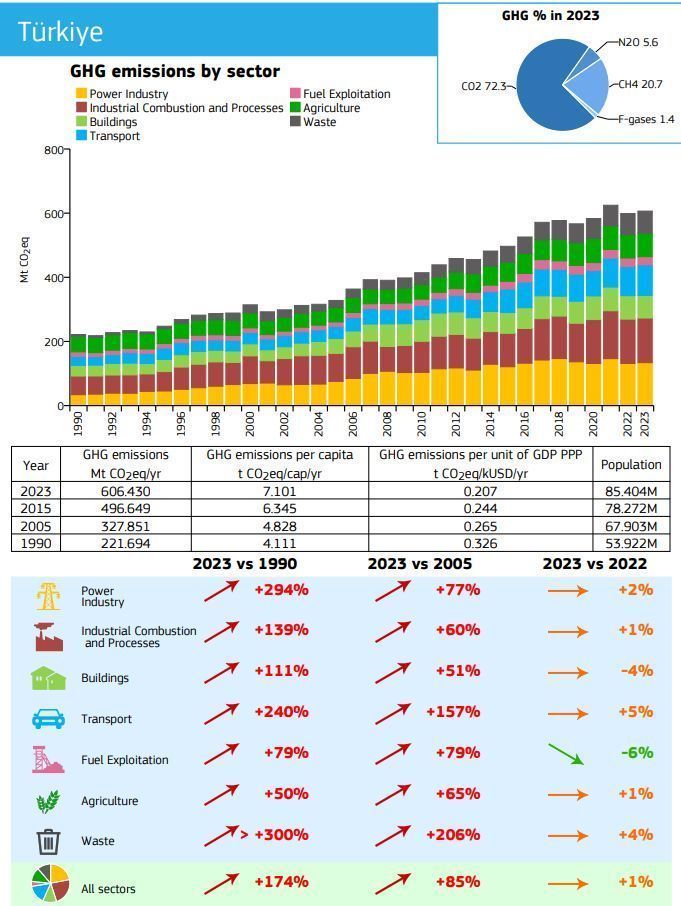
Source: linkedin.com/company/steeldataturkey.
Compliance rules
The law authorizes the DCC to monitor compliance, impose administrative sanctions, and coordinate inspections, which may be carried out in cooperation with the Ministry of Environment, Urbanization, and Climate Change. Institutions and enterprises are required to provide inspectors with access and documentation upon request.
Significant changes have been made to the Environmental Protection Law, giving the Directorate the power to verify compliance with the provisions of this regulatory act. Previously established penalties for violations related to greenhouse gas emissions tracking have been abolished and are now subject to the new legislation.
If climate projects are not registered in the national carbon credit registry within the deadlines set by the DPZ, this will result in administrative fines of 120,000 Turkish lira (approximately $3,010).
The Energy Market Regulatory Authority (EPDK) will supervise activities related to STV in the energy market.
The planning and regulatory changes introduced by the new law must be completed by December 31, 2027. It is expected that the president will be able to extend this period by another year by decree. In other words, we are again seeing flexibility in the approaches.
At the end of February, EcoPolitic reported that Turkey was preparing to launch the pilot phase of its own ETS and was developing its own CBAM model. As a reminder, the country plans to achieve carbon neutrality by 2053, rather than by 2050, as is the case for EU countries.