Analysts of the International Energy Agency (IEA) assumed that the Russian-Ukrainian war, as well as state aid programs in the USA and the EU, will speed up the energy transition by 5-10 years.
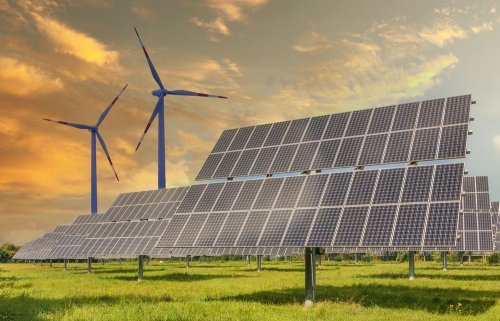
Global green energy capacity is expected to grow by 2,400 GW between 2022 and 2027, equivalent to all of China's installed capacity today, The Economist reports.
It is noted that this growth in renewable energy is 30% higher than the IEA's forecast in 2021 before Russia's full-scale invasion of Ukraine. During 2022-2027, renewable energy sources will account for 90% of the increase in global generating capacity.
The article emphasized that during this period, the use of fossil fuels, in particular coal, is also expected to decrease. Because of the energy crisis, many countries around the world have resumed or expanded coal mining, the operation of coal-fired power plants, and postponed their closure.
The authors emphasized that in 2022 coal consumption increased by 1.2%, exceeding 8 billion tons for the first time in history. Demand for coal is expected to remain strong through 2025. But this rise will be moderated by increased use of renewable energy sources, and will decline after 2025.
“Last year, global capital spending on wind and solar assets increased from $357 billion to $490 billion, outstripping investment in new and existing oil and gas wells for the first time. The Rystad Energy consulting company believes that investments will continue to grow over the next two years," they emphasized.
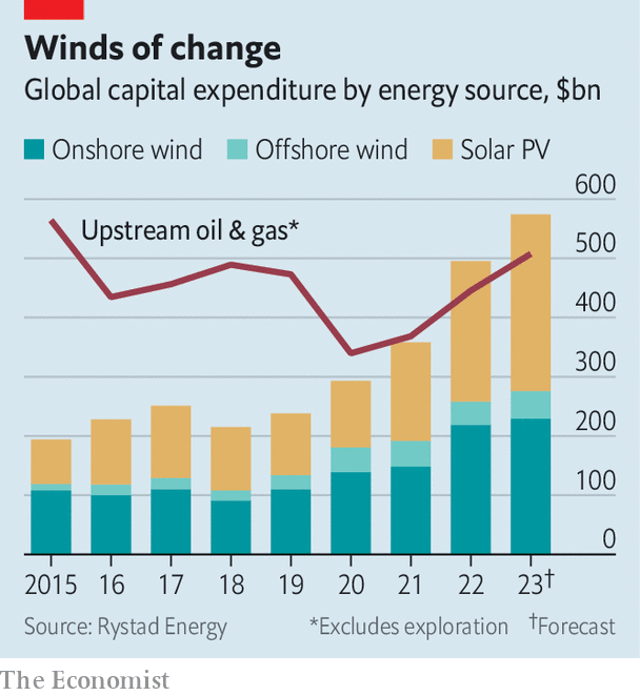
It is noted that energy efficiency will play an important role in the energy transition. Thus, in 2022, the world economy became 2% less energy-intensive, if we measure the amount of energy it uses to produce one unit of GDP. This is the fastest rate of increase in 10 years.
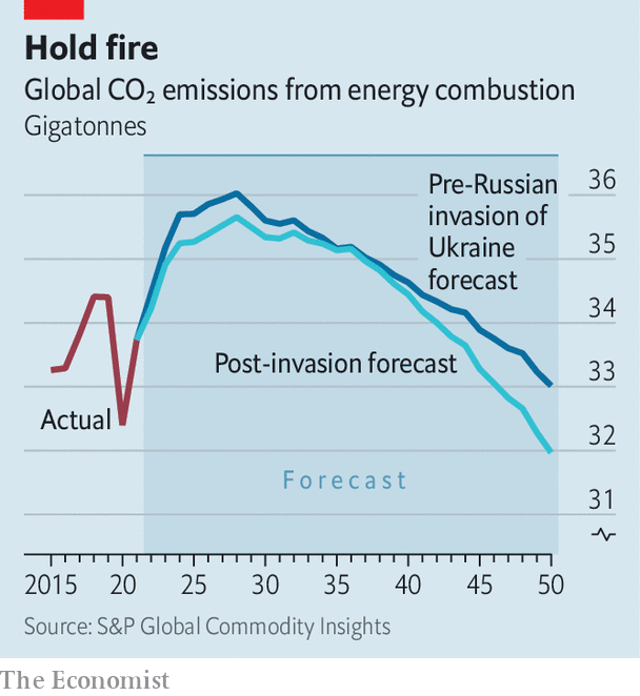
"As green energy turbocharges and fossil fuel use declines, carbon dioxide emissions look set to fall much faster than expected just 12 months ago," the authors stressed.
Emissions from energy burning will peak in 2027, not 2028 as expected before the war, according to data firm s&pGlobal.
"The recent mad rush to use fossil fuels is unlikely to last long, or be big enough to counter the green boom," the article says.
Earlier, EcoPolitic wrote, that a study by the think tank Ember showed that in 2022, renewable energy produced 22% of all electricity in EU states, ahead of energy generated from gas (20%) and coal (16%).
As EcoPolitic previously reported, the new forecast of the oil and gas giant BP (formerly British Petroleum) showed that the Russian-Ukrainian war will affect the long-term demand for energy and will accelerate the global green transition.