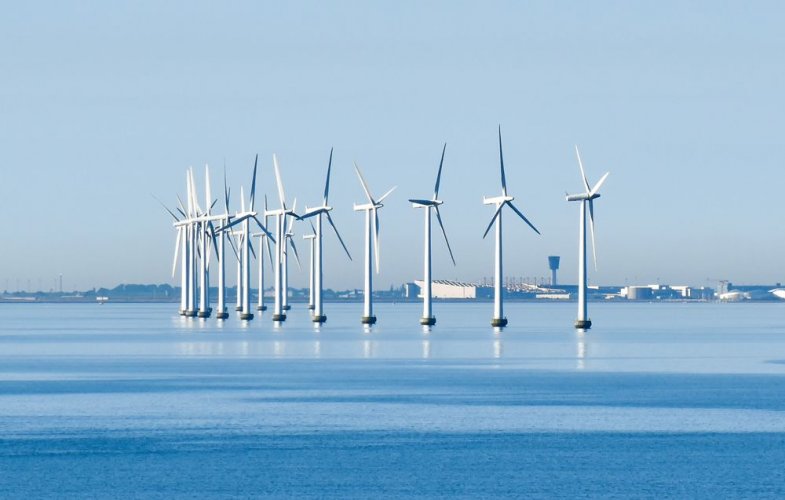
Germany and Denmark plan to build the Bornholm Energy Island wind power hub in the Baltic Sea, which will have a capacity of more than 3 gigawatts.
The project will require €3 billion of infrastructure investment and €6 billion for the offshore wind park, reports Bloomberg.
The project will connect several wind farms and distribute the energy produced by them between the two countries. The German network operator 50Hertz and the Danish Energinet will build the Energy Island and the connection with the mainland. They will share both costs and profits from the project.
The wind energy hub will start operating in 2030 and will be able to meet the needs of 4.5 million households.
"This is the first time in Europe that two countries have cooperated in such a project," said German Energy Minister Robert Habeck.
"We will make sure that this deal is also beneficial for taxpayers," said Danish Energy Minister Dan Jorgensen. "It takes a lot of trust and desire between the two countries to be able to take on a project of this magnitude."
After the launch of the project, other Baltic countries and Poland will have the opportunity to join it.
The countries agreed that any new partner would need the approval of both sides. Germany is particularly concerned about the impact of any diversion of energy flow on electricity supplies.
Habeck, who is also Germany's vice chancellor, said the energy island would pass near major pipelines that carry russian gas to Europe.
"But now it will be our own renewable energy, not russian gas," he said.
The European Commission aims to increase the capacity of the block's offshore wind power plants from the current level of 12 GW to 300 GW by 2050.
Earlier, EcoPolitic wrote, that Finland, Sweden, Estonia, Latvia, Lithuania, Poland and Denmark have committed increase wind energy production sevenfold until 2030.
As EcoPolitic previously reported, Heinrich Quick, Head of Offshore at 50Hertz Transmission, said that in Europe offshore interconnectors, energy islands and offshore generation networks will play an increasingly important role.