

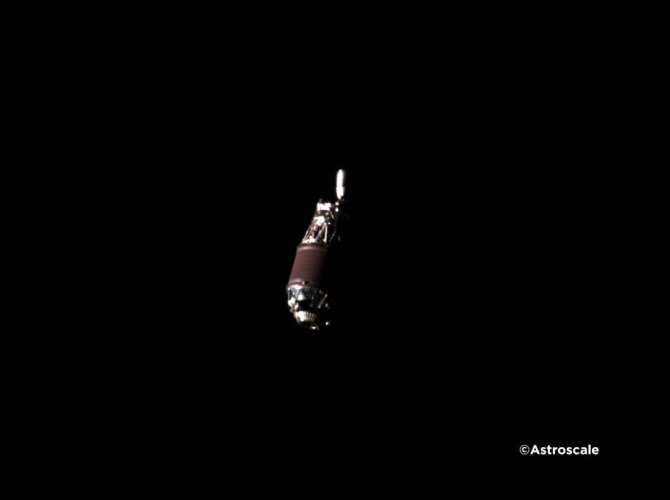
The Japanese space agency Astroscale has released a photo taken during a space debris removal mission. The picture shows a jettisoned rocket.
This was reported by Ukrainska Pravda.
"Look at the image of space debris obtained during approach and approach operations during our ADRAS-J mission," the company wrote on the X social network page.
The main task of the ADRAS-J satellite is a safe approach to the object and its study. The image shows an object wrapped in brown insulating material moving through the dark space of space. This object is an 11-meter Japanese H-2A rocket, weighing approximately 3 tons.
The company notes that the successful approach of the rocket to a distance of several hundred meters to the object is an important step aimed at technical progress, which will contribute to solving the problem of space debris.
"At the next stage of the ADRAS-J mission, it will try to acquire additional images. It is expected that the collected images and data will make a significant contribution to improving the understanding of space debris and providing important information for future missions to remove it," the company wrote on the X social network page.
It is reported that they plan to retrieve objects and burn them in the Earth's atmosphere using a satellite equipped with a robotic arm.
Space flight historian Gunter Krebs noted that the published photo is not the first image of space debris. In 2003, the US Air Force Research Laboratory's XSS-10 satellite reportedly encountered a spent Delta II rocket upper stage and captured an image of the object. However, this operation was a much simpler task than that performed by the ADRAS-J probe.
As EcoPolitic previously reported, in 2021, the magnet of the ELSA-d spacecraft from the Japanese manufacturer Astroscale was launched into Earth orbit, with the task of collecting space debris.