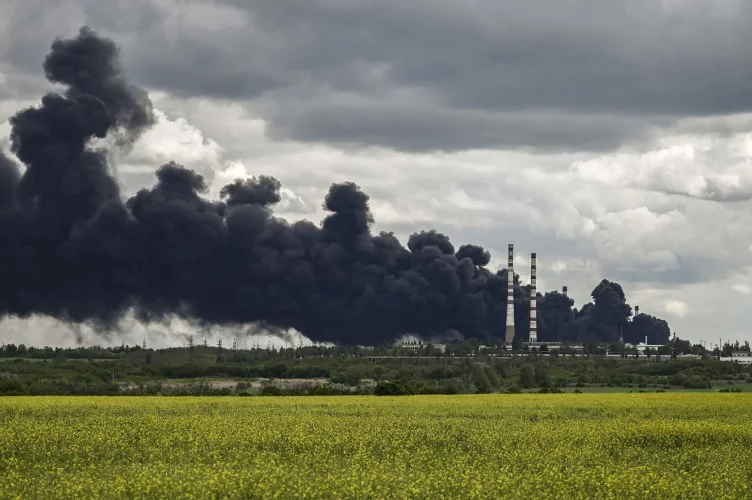
A study by experts in carbon accounting showed that the war in Ukraine deepens the climate crisis, and the amount of CO2 emissions during the first 12 wars reached about 120 million tons.
The indicator covers emissions from fuel, forest fires, changes in energy use in Europe and future reconstruction, Reuters reports.
It is noted that the report was developed for the UN climate summit in Bonn using methods for reporting military emissions from the Conflict and Environment Observatory.
The researchers emphasized that the calculated amount is equivalent to the annual emissions of Belgium. And global emissions of greenhouse gases have already reached a record level.
"We did not expect that the emissions of the war would be so significant, and it is not only the war itself that contributes to the emissions, but also the future reconstruction of the destroyed infrastructure," said the leader of the research team, Lennard de Klerk.
It is noted that accounting for carbon emissions, including military emissions, will be in the spotlight at the COP28 climate summit in Dubai in 2023. After all, countries evaluate progress in achieving the goals of the Paris Climate Agreement.
The researchers found that about half of the net increase in emissions since the start of the war is due to the expected reconstruction of buildings, roads and factories damaged during the fighting. About 19% of emissions come from military activities, such as burning fuel in vehicles, manufacturing ammunition, building concrete fortifications, etc.
It is noted that the authors also took into account emissions from the detonation of the Nord Stream gas pipeline, changes in the route of international flights, as well as the movement of refugees.
"If you look at the environmental cost of what's happening in Ukraine, this war is a disaster when it comes to carbon emissions," said James Appathurai, NATO's deputy assistant secretary general for emerging security challenges.
The report acknowledges the decline in Ukraine's domestic economic activity due to the war. However, these emissions mostly moved to other countries. In addition, the decrease in CO2 emissions in Europe due to the decrease in the use of natural gas and the energy crisis was almost completely offset by the increase in the use of oil, coal and liquefied natural gas.
The Ministry of Environmental Protection and Natural Resources stated the importance of initiating discussions about the impact of war on the climate. After all, its consequences will not be reflected in the annual reports of the Secretariat of the UN Framework Convention on Climate Change.
Earlier, EcoPolitic wrote, that Deputy Minister of Environmental Protection and Natural Resources of Ukraine for European Integration Svitlana Grynchuk said that Russia's war against Ukraine accelerates climate change and causes an increase in greenhouse gas emissions.
As EcoPolitic previously reported, in Ukraine in 2022 carbon emissions increased by 23%, compared to 2021, and about 33 million tons of CO2 entered the atmosphere due to the military aggression of the Russian Federation.