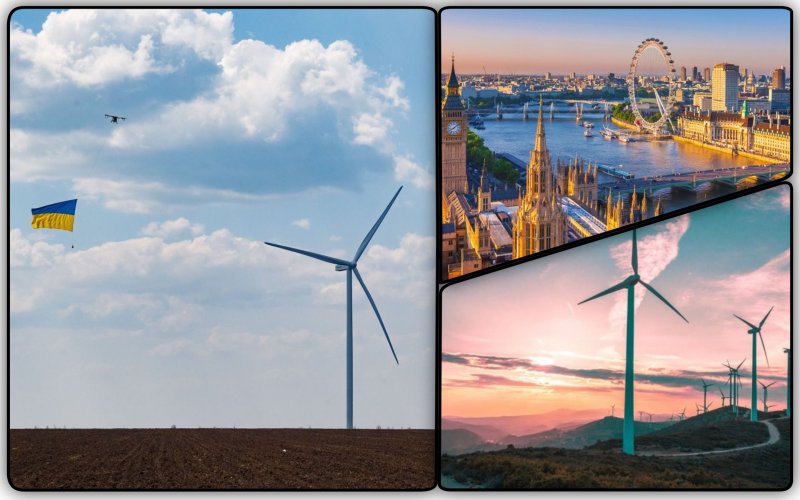
Since the start of the full-scale invasion, Ukraine has built more wind power capacity (114 MW at Tiligul wind farm) than Great Britain (1 MW in Staffordshire).
British officials are unhappy with delays in the construction of new wind farms, despite the government's promise to ease restrictions on land-based wind farms, and are pointing to Ukraine as an example, The Guardian reports.
"This extraordinary revelation is a terrible indictment of [UK Prime Minister] Rishi Sunak and his stunning failure to end the onshore wind ban," said shadow climate change secretary Ed Miliband. "Even governments fighting for their survival , can begin to build the clean energy infrastructure necessary to overcome the cost of living crisis, the energy security crisis, and the climate crisis."
It is noted that the country has had a ban on onshore wind farms since 2015 due to increased planning restrictions under the national planning policy. Although the government has promised to ease restrictions on land-based wind turbines, wind industry representatives fear their deployment will continue to be held back.
The article emphasized that 19 wind turbines were launched in Ukraine at a distance of about 100 km from the front line in the Mykolaiv region, while in Great Britain – only 2.
According to analysts, such a ban on the cheapest source of electricity cost the British about $987 million in the winter of 2022-2023. Households are facing electricity bills that are expected to remain higher than pre-pandemic levels for the rest of the decade amid the energy crisis and the Russian-Ukrainian war.
"It is simply amazing that Ukraine, fighting for its survival, has built more wind power on land than England. The government should start by lifting the ban on new onshore wind power plants – with one stroke of the pen, the cheapest available source of energy is opened," said the founder and CEO of the Britain Remade campaign, which advocates for green economic growth Sam Richards.
DTEK Executive Director Maksym Timchenko stated that the Tyligul Wind Power Plant is a symbol of Ukraine's resistance and will help rebuild the green country and become a key partner in Europe's energy future.
The article emphasized that since 2010, UK renewable energy capacity has increased by 500%, which was the second largest increase in Europe. In 2022 alone, 3,790 MW of new RES facilities were launched in the country. Coastal wind turbines are also developed if there is support from local communities.
Earlier, EcoPolitic wrote, that in May, the first phase of the Tyligul wind power plant with a capacity of 114 MW and 19 wind turbines was launched in the Mykolayiv region. The power of the station should reach 500 MW, which will make it the largest in Ukraine and Eastern Europe.
As EcoPolitic previously reported, in November 2022 the British government announced the possible lifting of the ban on the construction of onshore wind power plants.